Showing posts with label war preparations. Show all posts

Friday, July 20, 2012

WMD used to justify yet another illegal intervention?

Did you hear how Susan Rice adamantly told the UNSC yesterday that the US/NATO resolution which Russia and China vetoed did not in the least authorize a military intervention and that the US had no such plans?

Here a headline from today's Jerusalem Post:
'US, Israel discuss destroying Syrian weapons'
The United States and Israel were in discussions over whether Israel should take out Syrian weapons facilities as the regime of Syrian President Bashar Assad falters.
It appears that, yet again, the WMD canard will be used to justify a US-executed but Israeli-ordered illegal military intervention.

That would be almost comical if it was not so utterly disgusting.

The Saker

Tuesday, November 22, 2011

From Tahrir Square to Wall Street and the rest of the USA, the Empire bares its fangs (again)

The level of violence meted out by the Empire against its opponents is clearly on the rise: from Tahrir Square in Egypt, to the many Occupy Wall Street demonstrations, to the constant saber-rattling against Iran, the Empire is clearly cracking down on its opposition.

This new trend is particularly striking in the USA.  People who have never lived in the USA or who, even more so, have never studied here, do probably not realize the amazing degree of freedom US colleges have enjoyed in the past.  Let me illustrate this by a simple example.

I got one of my college degrees from The American University in Washington, DC.  Of of the teachers at this university was a former Ambassador of Grenada to the USA, until Reagan invaded the small island to show the world that the USA was still a superpower after its Marines had just been blown up to smithereens in Beirut two days earlier.  While the USA could impose a puppet-regime in Grenada, it could do nothing to remove this (now ex-) Ambassador from American U. because, in essence, all US colleges had a semi-official status of extra-territoriality due to their academic nature.  Sure, the Reaganites hated having this Marxist ex-Ambassador speaking her mind not only on campus, but also off-campus, but there was nothing they could do about it.  That was the type of freedom US colleges enjoyed as recently as 1986.

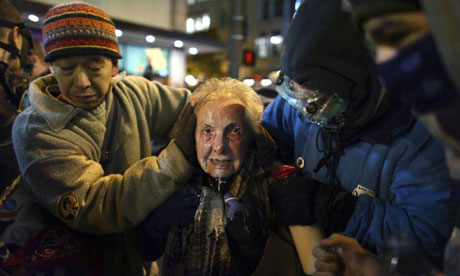
So while the pepper-spraying of protesting students in UC Davis might not appear like a big deal to non-Americans, to those Americans old enough to remember the 1980s (or even the civil rights and anti-war movements of the 1960) this is an outrage which goes against everything the USA was supposed to stand for.

Seattle activist Dorli Rainey, 84, after being
hit with pepper spray during an Occupy Seattle protest.
What matters here is not that some pepper sprayed in the eyes of the students, its the clear message this sends: the time for freedom is over and now we will do what was so unthinkable even very recently.  This is why protesters are being beaten up with batons, tasered, pepper-strayed and even killed in greater and greater numbers: the regime is sending a simple and clear message to its subjects: give it up, or we will crush you.

The gloves are also off in Egypt where the torture and murder of pro-democracy demonstrators has resumed.  Amazingly, stunningly, the Egyptians have found in themselves the courage and internal resources to continue the fight.  The expression "heroic people" is, as a rule, hyperbole, but in the case of the Egyptian people it seems quite appropriate to me.

The Empire probably feels emboldened by its comprehensive success in Libya and by its hope to repeat something similar in Syria  (the counter-examples of Iraq, Lebanon, Pakistan, Afghanistan and Somalia seem quickly forgotten amidst all the high-fiving and back-slapping about the "great NATO victory" in Libya).  Amazingly, the always inept and useless Arab League has learned nothing from its shameful role in the Libyan war and seems to be willing to repeat exactly the same actions against Syria.  The only good news here is that at least China and Russia seemed to be saying "no way, not again!".  But does that really matter?  In a world were UNSC Resolutions carry no weight at all, and in which the current UNSC does not even seem be able to produce a majority in favor of a Palestinian state - does it make any difference at all what Russia or China have to say?

The bottom line is clear: both the Obama Administration and the US regime which it currently represents are clearly headed towards a dramatic increase in violent actions.  On one hand, the economies of the USA and the EU are tanking, the political elites are as hated and as openly challenged as ever while, on the other hand, brazen acts of illegal violence yield what the rules of the Empire think of as "successes".  Add to this the upcoming elections in the USA, and a Zionist lobby gone insane with a typical mix of arrogance and paranoia, and you get an explosive cocktail.

Sadly, it appears that we must brace ourselves for a major increase in violence, both inside the USA, and internationally.   Yes, the days of this Empire are numbered, but only in the long term.  For the foreseeable future it still has a lot of "reserve capabilities of violence" to inflict on all its opponents.

The Saker

Friday, March 18, 2011

Sickening display of imperial sabre-rattling

I just heard these two clowns - Obama and Cameron - looking all macho, with fire in their eyes, making all sorts of threats against Gaddafi and the sight of these two corporate suits trying to sound marital just made me sick to my guts.

It was like watching a bad remake of the movie "Dubya and his poodle Blair".


At the fall of the Berlin wall, NATO was left without a mission and without any kind of justification or rationale for its existence.  The wars in Croatia, Bosnia and Kosovo gave it a new purpose: to enforce the US colonial rule in Europe.  At that time Russian politicians were moaning and whining about how they had been lied to (which they had) and how NATO had no other purpose.  Then came the disgraceful wars in Iraq and Afghanistan in which NATO was essentially defeated.  Well, guess what?  Russia just gave NATO its own little "Grenada" - a feel good mission which cannot fail (the Libyan military is really a joke) and which will grant corporate suits like Obama and Cameron their "macho credentials" (very important for Imperial leaders).

In the meantime, Ziuganov and Zhirinovski are bitching in Moscow, but who cares about what these two clowns have to say?

As for the folks celebrating in Benghazi, they remind me of the hort-sighted Bosnian-Muslims celebrating their imminent 'independence' (ha!) in Sarajevo just before all hell broke loose: all they will get is a bloodbath and a re-colonization by the USA.

Camp Bondsteel v2.0, Libya.

What is wrong with these people?!  Can they really not learn from history?  Must they really repeat the same tragic mistakes over and over again?

Sickening.  And totally depressing.

I have to admit that on days like today I am thoroughly disgusted by mankind.

The Saker

Thursday, March 3, 2011

Is the Libyan regime the target of a massive disinformation campaign? (UPDATED WITH VIDEO FROM TRNN)

I looked around.  The best I could find is some footage of some explosion off a road in the middle of the desert "near" the city of Breda.  While the smoke is rising you can hear the sound of a jet engine.

Ok.  Let's assume that this is indeed a bomb/missile strike by the Libyan Air Force. I would say that since a) there are no civilian areas to be seen anywhere in the footage b)  the road is filled with armed anti-Gaddafi forces here is what this footage is really showing:

Some jet pilot loyal to Gaddafi apparently detected the movement of anti Gaddafi forces on the highway and attempted to strike them.  The pilot missed by a big margin (due to incompetence, faulty equipment or deliberately) and then left.

What does al-Jazeera do with this footage?  It titles it "Jets dropping bombs in and around Libya's eastern town of Brega" (notice the plural and the location).  The reporter then says that the university was particularly targeted and that he spoke to a doctor who told him that 20 people where killed.

First, if what I saw in the footage is what they are referring to, then its really trivial to the point of being boring.  There is nothing at all in international humanitarian law, in the law of war, the universal human rights, the Geneva Conventions or any other international legal instrument which bans the proportional use of military means against combatants.  Nothing at all.

The alleged bombing of the Brega university is less clear, but until we have evidence that the strike was either grossly disproportional or deliberately targeted a civilians there is no basis to accuse the Libyan regime of anything.  Yes, most people do not know that, but "collateral damage" as such has never been outlawed by any legal instrument.

Now, please, before somebody start thinking that I am pro-Gadaffi or anti opposition, I would like to make clear once more that I am in no way defending Gadaffi or denying that atrocities are committed by his forces.  ALL I am saying is that I see no evidence of that, so far.

I monitored the entire war in Bosnia and Croatia as a professional military analyst with access to intel briefings every morning and I know all too well how the international media is only too willing to parrot any US strategic psyop nonsense as long as it sells.  Think about it, the al-Jazeera reporter near Brega just made a handsome income by showing exactly what?  A plume of smoke over the desert.  For all I know, he could have added the sound of the jet engine himself.

I need to caution you all here: not only is the corporate Ziomedia totally and absolutely unreliable, most reporters are lazy at best and pathological liars at worst; they might show you 3 year old military training footage and call it "Gadaffi forces murdering peaceful civilians".  Then, in a situation of de-facto civil war, false flag operations are inevitable.  Again, in Bosnia, there were so many totally fabricated stories (like the Serbian concentration camps in Bosnia) and false flags attacks (for example in infamous "Markale massacre") which the corporate Ziomedia swallowed without any critical investigation that we should expect more (other examples of such propaganda are the "Timisoara massacre" in Romania, the "baby-incubator atrocity" in Kuwait or the "Racak massacre" in Kosovo).

The other scary thing is that al-Jazeera is constantly airing interviews of Libyans who are demanding that a no-fly zone be imposed upon Libya.  Why is al-Jazeera airing only such interviews even though, at least as far as I know, all Libyan opposition movements or leaders are very much opposed to this kind of 'help'.

Maybe it's my own past psychological traumas and bitter disappointments, but all this brings me a lot of very unpleasant flashbacks about the war in Croatia, Kosovo and, in particular, Bosnia.  The fact that I dislike Gadaffi just about as much as I disliked Milosevic makes the resemblance even more eerie.

One more thing.  Who is this former Justice Minister for Gadaddi who has now re-branded himself as a Libyan patriot?  You know, the guy in the little red hat you see making grand statements about Libya's future? (Sorry, I really did not catch his name)

The way I see it, in a repressive regime, the Minister of Justice is just about the worst rubber-stamping and torturing SOB possible.  So how did this guy suddenly end up being paraded around on the idiot box as some kind of 'opposition leader'?!

All this leaves me with a knot in my stomach, a sickening feeling of "deja vu", and a bad aftertaste in my mouth.

Please tell me that I am over-reacting, that my fears are unfounded, that Libya will not turn into a "2nd Bosnia" and that there is no cause to suspect the worst!

Can you?

The Saker

PS: one more thought: why are the self-righteous buffoons at the World Court seriously declaring that they are going to investigate Gadaffi and his regime when the Zionist state has bombed Palestinian civilians for many years without any such investigations?    What about the Turkish Air Force bombing the Kurds?  That kind of hypocritical crap - again - reminds me very painfully of all the "humanitarian theater" which was orchestrated by the US and Europe during the war in Bosnia.

PPS: yet another addendum: before some politically correct 'humanitarian' accuses me of white-washing genocidal dictators (or something else of a similar ilk) let me pre-empt this accusation by saying the following: false flag operations and disinformation campaigns only work when they are credible.  Look at the folks targeted in the ones I listed above: Milosevic, Ceausescu, Saddam - not exactly the kind of folks one would put beyond committing atrocities.  The false flags worked because their target was a known killer.  Ditto for 9-11, by the way.  If the USA had accused Luxembourg of it nobody would have believed it.  But when the US accused al Qaeda it worked perfectly.  Even the 100% baseless accusation that Saddam was supporting al Qaeda was largely accepted.  And if the Brits had decided to accuse Gandhi of eating babies or worshiping Satan and everybody would have laughed.  My point?  If Gaddafi is so easily targeted by strategic psyops (assuming that this is what is going on) it is because he is an unsavory character in pretty much the same league as Milosevic, Ceausescu or Saddam.

Oh, and before I forget: to those who today idealize Gaddafi like other idealized Saddam, Milosevic or Ceausescu in the past, I would say this: being anti-imperialist or the target of a psyop campaign does not automatically make you a good person, much less so a hero.  IMHO, Saddam, Milosevic and Ceausescu were all bloodthirsty maniacs, and I strongly believe that Gaddafi is every bit as evil as they were.

PPPS:  Excellent report from TRNN:

Wednesday, February 10, 2010

New Balkan Wars Loom on the Horizon

by Pyotr Iskenderov for Strategic Culture Magazine

The contours of the Kosovo separatists' plan to suppress the Serbian resistance in the northern part of the province with the help of the US and the EU are getting increasingly visible. The statements emanating from Pristina and the intensifying international debates over the Kosovo theme do not only show that the Albanian separatists are preparing an attack against their opponents but also give an idea of its potential scenario, the distribution of roles in it, and the extent to which Hashim Thaci and other former leaders of the terrorist Kosovo liberation army are relying on the international support in the process.

The debates at the January 22 open session of the UN Security Council on Kosovo were unprecedentedly heated. It was the first time since the summer of 2007 (when Russia managed to derail the Resolution recognizing the Kosovo independence, proposed by the West on the basis of UN Special Envoy Martti Ahtisaari's plan) that the parties to the dispute over Kosovo defined their positions with such utmost clarity. There was an impression that the world's major powers were speaking different languages. UN Secretary General Ban Ki-moon, the US, and West European countries “urged flexibility” in admitting Kosovo to regional and international mechanisms and forums, whereas Russia and Serbia regarded the approach as an attempt to dilute the role of the UN in the province and to legitimize its independent status. The discussions were centered around Pristina's so-called final solution plan for North Kosovo, which Thaci inadvertently unveiled several days prior to the session. He said the plan was being drafted jointly with the international representatives and was aimed at strengthening what he called Kosovo sovereignty and territorial integrity. Thaci said 2010 would be the year of consolidation for Kosovo. The priorities in the framework of the plan include the elimination of the Serbian self-government established in Kosovska Mitrovica and nearby Serbian communities based on the May, 2008 elections held in accord with the laws of Serbia. Another blow will be dealt to Serbian police forces and custom service, which at the moment are maintaining at least partial control over the traffic across the administrative border between Kosovo and the rest of Serbia.

NATO's KFOR deployed in Kosovo will render military assistance to Albanians. There is information that on the whole the corresponding decision was made during Commander of Joint Force Command Naples, Admiral Mark Fitzgerald's January visit to Kosovo, after which he described the Serbian self-government as... a threat to the security of Kosovo. “All violations of UN Security Council Resolution 1244 pose a threat to security. Since the resolution does not approve of parallel institutions, they are cause for concern”, said Fitzgerald.

Pristina's priority is the international support for the operation, which the US and the EU are supposed to ensure. The US will be blocking the attempts by Russia and China to have a response resolution passed by the UN Security Council. At the same time Brussels will be exerting ever greater pressure on Serbia to make it deny support to the Serbs of Kosovo and seal off the border with the province so as not let Serbian volunteers reach Albania.

Chances are that the operation will be launched already next April after the International Court of Justice issues an indefinite verdict on the Kosovo independence and the establishment of the Mitrovica municipality headed by Albanians and the few Serbs ready to cooperate with them.

Serbia's pro-Western President B. Tadic spoke with great caution of the anti-Serbian plan harbored by Pristina, NATO, and the EU, essentially saying little more than that the “final solution” promised nothing good to the Kosovo population. Russia's Deputy Permanent Representative to UN I. Shcherbak was much more outspoken. He said that from Russia's standpoint it is necessary to arrest decisively any attempts to float concepts harmful to Kosovo regardless of their source, as they do not only breach UN Security Council Resolution 1244 but also destabilize the province and provoke tensions.

There is information that the plan was co-authored by EU Special Representative and UN Civil Administration head Pieter Feith. The Administration was established in the spring of 2008, shortly after the declaration of the Kosovo independence and its recognition by the US and major EU counties. The Administration that no UN documents regulate comprises representatives of 14 EU and NATO countries and Switzerland, which are implementing the Ahtisaari plan, a EU brainchild the UN Security Council never approved. It is noteworthy that Kosovo separatist government foreign minister Skender Hyseni who represented Kosovo at the UN Security Council session made no comments concerning the plan for the northern part of Kosovo. Speaking to the media after the session, he claimed without elaborating that the EU mission and the Civic Administration were not promoting any final solutions for North Kosovo.

A survey of recent developments leads to the conclusion that the blueprint for suppressing the Serbian resistance in Kosovo is being drafted at a level much higher than that of the province. Given its basic parameters (a snap offensive supported by the NATO and EU pseudo-peacekeepers with international political backing plus the installation of a puppet administration), the plan for a final solution for North Kosovo is similar to the one Georgian President M. Saakashvili had in mind launching an attack against South Ossetia in August, 2008. Even the stated objectives – the restoration of the constitutional jurisdiction in Saakashvili's wording – is the same in both cases.

Even earlier, in August, 1995, a similar scenario was imposed on the Serbs of Krajina when Croatia sent regular army forces to attack them while the US and the EU backed the operation diplomatically. Actually, at that time the diplomatic support played no practical role as neither Yugoslavia nor the Russian leadership demonstrated any will to help Serbian Krajina in its tragedy. Yugoslavian leader S. Milosevic took more interest in getting rid of his competitors R. Karadzic and R. Mladic with the hands of the international community, and Moscow paid little if any attention to the whole Balkan theme.

It is hard to predict the outcome of the current developments as the Bosnian front, no less important to Serbs, Russia, and the Orthodoxy, is likely to gain a place on the map of the new Balkan war alongside the Kosovo one. Outgoing Croatian President Stipe Mesic said the Republic's army should launch an offensive against the Bosnian Serb Republic in case it holds a Kosovo-style self-determination referendum.

The situation in Bosnia and Herzegovina will get strained soon as Bosnian Serbs are going to hold a referendum on their constitutional status. Its aim is not to let the leaders of Sarajevo, US and EU put an end to Republika Srpska. The outgoing Croatian President, Stjepan Mesic, promised that in case the referendum takes place, the regular army of Croatia will enter the territory of Bosnia and Herzegovina to cut off the 15-km Posavina corridor, which connects the western and the eastern parts of Republika Srpska in the area of Brcko, close to the Croatian border.

“If Milorad Dodik (Prime Minister of Republika Srpska) decides to hold a referendum on separation, I will send the troops to divide the region inhabited by the Bosnian Serbs”,- the Croatian President said, adding that in case of success, a sovereign state of Bosnian Serbs will 'seize to exist'. He made the announcement during an informal press-conference in Zagreb on January 18.

A military campaign against Banjaluka may be held simultaneously with an armed action by Kosovo`s Albanian authorities against the city of Kosovska Mitrovica and Serbian communities in Northern Kosovo. In this case the US, NATO and the EU will manage to complete separation of the Serbian territories. The Serbian Republic will be surrounded by hostile states and thus will be no longer able to carry out independent foreign policy. The defeat of the Kosovan and Bosnian Serbs will become Russia`s biggest loss in the Balkans over the past two decades and will harm Moscow's attempts to play an active role in other strategically important regions in Eurasia.

The first reaction of Serbia and Russia to such rude interference of the Croatian leader into affairs of the neighboring state was surprisingly reserved. Serbia's President Boris Tadic made an attempt to respond to the remarks made by his Croatian counterpart at the UN Security Council meeting on Kosovo on January 22. But he commented on the issue not during his main speech (though parallels between what was going on then in Bosnia and Herzegovina and in Kosovo were more than obvious). He spoke during the debates because he found such kind of issues could not be discussed during official reports. Mr. Tadic also met the UN Chief Ban Ki-moon to tell him that Mesic`s 'dangerous words were unwelcome in political discourse' but immediately noted that Serbia did not want to worsen relations with Croatia.

Such peace-loving rhetoric was accepted in Zagreb. Croatia's Prime Minister Jadranka Kosor told journalists that Serbia and Croatia should abandon debates and work together to develop neighborly relations. However, the Prime Minister did not disavow the President's announcement.

Russia's reaction is still too vague. Summing up the results of 2009 at the press-conference on January 22 in Moscow, Russia's Foreign Minister Sergei Lavrov commented on Mr. Mesic`s announcement: “We insist that all the sides involved respect the Dayton Agreement and avoid the use of force”. (1)

Meanwhile, the way the situation is developing in the region in recent months proves quite the contrary: the West and the leaders of Sarajevo are definitely going to undermine the Dayton agreement. Two rounds of talks held by the heads of the Bosnian political parties in October 2009 at a NATO base in Butmir outside Sarajevo, revealed the the western strategy toward Bosnia and Herzegovina. The Bosnian Serbs are demanded to abdicate their authorities settled in the Dayton Peace Agreement. Though formally Russia is a member of the Dayton Agreement Peace Implementation Council, it did not take part in the discussions in Butmir. So, it would be a fatal mistake to expect the US, EU and NATO to abandon their new political course. It would also mean to be inexcusably weak in regard to Russia's interests in Bosnia and Herzegovina and in the Balkans in general.

It was not accidentally that the International Crisis Group, which traditionally deals with promoting the western political propaganda in conflict regions, in every detail commented on the future of the Balkans a few months before the recent events. Experts in the Group believe that Moscow and Belgrade remain the West`s major rivals in the region because “an international approach to the Balkans is dominated by concern over Serbia`s reaction to the independence of Kosovo”. In their opinion, Russia “has become stronger to oppose to the Western policy it sees hostile to its interests”. (2)

Under these circumstances, Moscow should better revise its policy in the Balkans. Russian diplomats should no longer view the Dayton agreements as too weak to withstand political attacks. This all will make it logical to put in question political status of Bosnia and Herzegovina. This approach will help Moscow no longer be an outsider in Bosnia and launch a series of international talks on territorial, political and ethnocultural problems in the Balkans, where peoples and their interests are in jeopardy. Taking into consideration intentions of the West to put an end to the Serbian Orthodox community in the Balkans, revision of the existing borders in the conflict regions may become the only way for Russia to defend its interests. As of today, there are at least three self-proclaimed states which statuses are being doubted: Bosnia and Herzegovina, Kosovo and Macedonia. Their territorial and administrative revision could become the least painful way to avoid new wars in the Balkans.

It is remarkable that recently the authorities of Sarajevo have been urging Russia to contribute to the 'implementation of the Dayton Peace Agreement', the Bosniak Muslim member of the Presidency of Bosnia and Herzegovina, Haris Silajdzic, said at the meeting with the Russian special envoy for Kosovo, Alexander Botsan-Kharchenko. And this is a very disturbing sign because Silajdzic has long been known for his extremist views about Republika Srpska. The majority of people in Western Europe cannot but be aware that the Bosnian Serbs remain the only counterbalance to radical pan-Islamic tendencies in Bosnia and Herzegovina. And this it what gives Russia the right to boost its activities in the Balkans.

Dr. Petr A. Iskenderov is a historian, senior researcher at the Institute for Slavic Studies of the Russian Academy of Science, and the Vremya Novostey and the Voice of Russia radio station international politics commentator.
-------
(1)Http://www.mid.ru/brp_4.nsf
(2)Bosnia`s Incomplete Transition: Between Dayton and Europe. Sarajevo-Brussels, 2009. P.14

Wednesday, July 29, 2009

Iran in the crosshairs (again). Ditto for Latin America.

The Islamic Republic is in trouble, no doubt. Following the failure of the coup attempt against Supreme Leader Ali Khamenei by Rafsanjani and his "Guccis" (via Mousavi) one could have somewhat naively hoped that things would settle down, but this is clearly not the case.

It now appears that Intelligence Minister Gholam Hossein Mohseni Ejeie has been sacked and replaced by Majid Alavi. There are also reports of other ministers resigning. The Iranian Parliament is also appears to be involved in the crisis. There are also reports of direct disagreements between Ahmadinejad and Khamenei not only on the issue of the Vice Presidency but also on the issue of how the crackdown on the Guccis should be handled.

While it is impossible for me to ascertain what is really going on, one thing is sure: this is definitely a bad sign.

In the meantime, the Empire issued what is, in essence, an ultimatum to Iran: "either deal with us or be bombed". For course, this is not how this was presented to the world. The official version is that the "US proposal to negotiate with Iran is not open-ended". Ditto from Obama's bosses in Israel.

As for Obama, his trip to Russia was just like his trip to Egypt: replete with great speeches and absolutely lacking in any kind of concrete changes from Dubya's imperial policies. Even the absolutely useless "missile shield" in Europe (whose only imaginable purpose is to alienate Russia) is still officially on the US agenda.

Generally, is is quite clear that Obama is nothing more than a very charming and smart salesman for the exact same policies as the ones implemented by the USA since Clinton's election (and the Neocon takeover of power which followed it). "More of the same, only worse, but better packaged" appears to be the motto of the Rahm Obama Administration. Either that, or simply "No we can't [change]!".

Or take a look at the coup in Honduras. It literally *reeks* of Eliot Abrams and the rest of the Reagan's "crazies" and their murderous policies in Central America. Oh sure, the Obama Administration is (cautiously) condemned the coup, but the fact is that since the USA controls Honduras and the Honduran military at about 99.999999999999% it could have stopped the coup and restored Zelaya in 24-36 hours tops! So all that talk of the coup being "illegal" is just another new climax of US hypocrisy (at least the Reaganites would have been open about whom they support).

To top it all, the USA is now opening three bases in Colombia. Needless to say, Chavez got the message loud and clear.

Bottom line: the USraelian Empire is threatening military action against Iran and Latin America. In a way, the new US Administration is even more bellicose than the previous one. Dubya, having started three wars (Afghanistan, Iraq and Somalia) and lost all three of them could hardly be expected to start another three (Pakistan, Iran and Latin America) without triggering a massive outrage in the US (and worldwide) public opinion. However, Obama, with his "young and smart" image and with the full support of the Democratic Party in the USA is going to do just that.

Add to this another "cold" war with Russia and that's a grand total of SEVEN(!!) wars that the Empire is seriously pondering. Of course, Somalia is pretty much over, at least for now. For the time being, Iraq is more or less "frozen", and in Pakistan there is the illusion of "success" in the SWAT area. The cold war with Russia is not going to go "hot" and the same is true for Venezuela and Latin America. The Empire even has the option of choosing not to strike at Iran. Still, it is exceedingly unlikely that all these "minimal" options will be exercised by the US administration simultaneously. A far more likely approach is a one-by-one series of conflicts.

What is certain is that more wars are coming. Soon.

The Saker

PS: while I was writing this piece I got a phone call from Ron Paul's Campaign for Liberty asking me to support an audit of the Fed. In itself, this is a very sound idea, in particular since, here too, Obama is making things much worse. What worries me is the somewhat naive hope of the US libertarians that stuff like auditing the Fed could make a difference. It won't. The only chance for the USA to avoid a complete collapse (not unlike the one of the Soviet Union in 1991) is to bring down the entire Zionist-run imperial superstructure which drains it from all its resources (human and material) and the prerequisite first step to achieve that would be to openly denounce it. And that ain't gonna happen any time soon.

Sunday, January 11, 2009

Will Hizballah intervene in the Gaza conflict?

by Amal Saad-Ghorayeb for The Electronic Intifada

While Israel fervently attempts to terrorize the Palestinians into submission in Gaza, many observers have started to wonder why Hizballah has refrained from stepping in militarily to assist its brothers-in-arms, Hamas. Such musings fail to take account of the constraints on Hizballah's room for action, as well as the circumstances under which Hizballah would ignore such constraints. The question that should be posed is not so much if Hizballah will act, but when.

As things currently stand, Hizballah is not in a position to directly help Hamas militarily by opening a new front with Israel. In the first place, Hizballah and its supporters have only recently recovered from the devastating impact of Israel's war against them in July 2006. A Hizballah offensive against northern Israel would surely be met with "disproportionate" force on Israel's part, which Israel has been threatening as much for several months now. Mass destruction and devastation aside, Hizballah would once again be faced with intense domestic pressures to disarm, and possibly, more externally manufactured, locally-executed conspiracies hatched against it that could drag it into the kind of civil warfare that the movement found itself in during May 2008.

Armed action by Hizballah would not only hurt the movement but would also harm Hamas whose status as a nationalist resistance movement, capable of defending its own people, would be greatly undermined and its raison d'etre called into question. Furthermore, since Hamas has thus far managed to withstand the Israeli onslaught on its own without suffering any significant damage to its organizational hierarchy or military infrastructure, Hizballah does not regard an intervention on its part as an exigent need.

The preconditions for Hizballah's active engagement in the conflict are two. First, if Hamas is left bleeding to death on the battlefield, either due to the decapitation of its leadership ranks or if its military infrastructure suffers a significant blow, drastically impairing its military performance and leading to its eventual collapse, Hizballah would likely step in. Second, if the organization is forced to accept a conditional ceasefire along the lines of the current French-Egyptian proposal that meets all of Israel's key demands while weakening Hamas militarily and politically, Hizballah would feel compelled to come to its rescue.

For Hizballah, the need to act under such circumstances would override all the attendant costs that come with such action -- a calculation which takes as its basis Hizballah's moral responsibility towards the Palestinians and the shared strategic fate between the two resistance movements. As expressed by Hizballah Secretary General Hassan Nasrallah on 16 July 2008: "[the resistance] is one project and the resistance movement is one movement and has one course, one destiny, one goal, despite its different parties, factions, beliefs, sects and intellectual and political trends ... Resistance movements in this region, especially in Lebanon and Palestine, complement one another and are contiguous groups ..."

Hizballah's view of the conflict in Gaza

This moral and strategic imperative to act is also based on Hizballah's understanding of the current war as but one episode of an open-ended and comprehensive war waged by the US-Israeli-"moderate" Arab axis against the jabhit al-mumana'a (political and military resistance front) which includes Iran, Syria, Hizballah and Hamas. According to this narrative, the events unfolding are simply an extension of the July War of 2006, as evinced by Israel's admission that one motive behind its current onslaught is to restore the deterrence capability and image it lost in July 2006. Further bolstering this view is the virtually identical stand moderate Arab regimes have taken on Gaza as the one taken in July 2006. In fact, the perception of the Arab role has shifted from one of "silence" and concealed "collaboration" with Israel in the July War, to open "cooperation" and "partnership" with the Zionist state in its war against Gaza. So blatant has Arab, and especially Egyptian, government support for Israel's military campaigns become, that even UN Secretary-General Ban Ki-moon (known for his sympathies to the US and Israel) chided Arab regimes on 29 December for "not doing enough" to help the Palestinians in Gaza, while Israeli officials and media continue to knowingly embarrass their moderate Arab allies by flaunting their newly out-of-the closet relationship.

Considering the extent of Arab cooperation with Israel in its latest military (mis)adventure and in view of the ferocity of the latter, the current Gaza episode is deemed a particularly dangerous moment in the regional conflict insofar as it represents not merely a war against Hamas, but against the Palestinian cause, or as Nasrallah described it on 29 December, "the fate of Palestine." Given that the Palestinian cause is embodied by Hamas and defines the political identity of its regional allies, this conflict is one in which the ideological and strategic stakes for all members of the resistance front are extremely high. Nasrallah admitted as much in his 28 December speech: "what is happening in Gaza will have repercussions not only for Gaza alone or Palestine, but for the entire umma [a term used to refer to the Arab nation in a secular nationalist context and for the world community of Muslims]. We must continue work and not be satisfied with an activity here, a demonstration there ... we must exert every effort to defend our people."

Hizballah's regional strategy in the Gaza conflict

For Hizballah, the Israeli offensive against Gaza must have been foreseeable given Israel's repeated violations of its ceasefire agreement with Hamas over the past several months and the latter's refusal to renew it at least a month before it expired. It is more than likely that Hizballah has been preparing for this eventuality alongside Hamas for some time now. In a sign of such coordination, on 15 December Nasrallah used a televised speech to mobilize popular support for an "open ended" campaign to lift the siege on Gaza that was to be launched on 19 December, several days before the Israeli assault began. It is no coincidence that the Hizballah leader chose to make this announcement one day after Hamas' political head, Khaled Meshal, formally declared the movement's ceasefire with Israel over on 14 December.

Over and above this political coordination, Hizballah must have helped Hamas ready itself for such an Israeli operation by providing weapons and training, as well as through joint military planning. Hizballah officials' strong confidence in Hamas' military performance appears to stem from an intimate knowledge of the organization's capabilities. This conclusion reveals itself in the assertion made by the head of Hizballah's parliamentary bloc, Mohammad Raad, who claimed on 2 January that "the enemy will be surprised by the range of rockets found in the resistance's arsenal in Gaza." This argument is further bolstered by Nasrallah's admission in March 2002 that the three Hizballah officials whom Jordan had captured as they were trying to smuggle weapons into the West Bank, did in fact belong to the movement, as well as his declaration at the time that "to supply arms to the Palestinians is a duty ... it is shameful to consider such an act as a crime."

Hamas' fighting style also seems to bear the hallmarks of the military tactics Hizballah used during the July War such as its use of underground bunkers and tunnel networks, as well as adopting similar rocket tactics, all of which suggest Hizballah's extensive training of Hamas' military forces. Nasrallah came close to admitting as much when he claimed on 31 December that "the resistance in Gaza benefitted more from these lessons [from the July War] than the Israelis." More than simply receiving military training, Hamas's military strategy appears to conform to the "new school of fighting" founded by Hizballah's assassinated military leader, Imad Mughniyeh (himself rumored to have personally trained and equipped several Palestinian groups over the years), which combines conventional and non-conventional, guerilla warfare that functions not only to liberate occupied territory, but to defend it from aggression.

Hizballah's strategy vis-a-vis Egypt

Not only did Hizballah coordinate its activity on the Gaza crisis with Hamas, but also with Iran. One such indication of this coordination was the fact that the Iranian campaign against Egypt's closure of the Rafah crossing was launched several days in advance of the one kicked off by Nasrallah, prompting Cairo to recall its diplomatic envoy from Tehran. On 12 December, Ayatollah Ahmad Khatami, a member of the Assembly of Experts with strong ties to Iran's Supreme Leader, Imam Khamenei, disparaged Arab regimes in language reminiscent of Khomeini's revolutionary discourse of the 1980s: "Forget about silence. They are cooperating with Israel." Referring to Egypt by name, in light of its cooperation with Israel on the Gaza siege, Khatami asked: "where has your Islam gone, where has your humanity gone?" In a similar vein, in his 28 December speech Nasrallah denied the existence of an Arab "silence," insisting that it was an Arab "partnership" with Israel. Like Khatami, Nasrallah also singled out Egypt by name, warning it that if did not open the crossing then it too would be "partners to the crime, partners to the murders and partners to the Palestinian tragedy." To that end, the Hizballah leader called on "millions" of Egyptians to brave government repression and take to the streets to express their outrage, similarly urging the Egyptian armed forces to apply pressure on the regime to open the crossing.

While many have dismissed Nasrallah's verbal barrage on the Mubarak regime as little more than a diversionary or compensatory tactic designed to divert attention from or compensate for Hizballah's inaction, such a view fails to appreciate the unprecedented nature of this attack, as well as the wider strategy underpinning it. Not since the 1980s has Hizballah adopted such an inflammatory discourse against an Arab regime, or even singled out any one for attack. Not even during the July War, when Arab complicity with Israel was at its peak, did Nasrallah call on the Arab masses to exert pressure on their governments, nor did Hizballah's relations with those regimes take a turn for the worse thereafter. At the time, Hizballah clearly did not want to burn its bridges with Arab regimes or provide them with ammunition to invoke the Shiite scarecrow and stoke Sunni-Shiite tensions. In Gaza though, Hizballah has not found any such room for diplomacy and self-restraint. In his 7 January speech, Nasrallah warned that although Hizballah did not make enemies of those who had betrayed it during the July War, "we will make those who collaborate against Gaza and its people our enemies."

Hizballah's policy shift and its coordination with Iran on this matter signal a joint Iranian-Hizballah strategy of exposing the Mubarak regime's collusion with Israel and pressuring it to lift its siege of Gaza. These goals also fulfill the grander objective of shaking the foundations of the Egyptian-Israeli alliance which, in turn, would serve to weaken Israel's regional position. A strategy of this kind is deemed necessary given Egypt's "public embrace" of Israel, as one Israeli journalist put it (Haaretz, 9 January). In contrast to the July War when Egypt and other moderate regimes confined their collaborative role to blaming Hizballah for Israel's aggression, this time round Egypt has not even bothered to feign neutrality while secretly trying to benefit from Israel's campaign against Hamas. In this war, Egypt cannot even play the role of conspiring mediator because it is in fact, a party to the conflict. Egypt's foreknowledge of Israel's operation -- some would even argue, its demand that Israel launch such an operation -- is now common knowledge, as is the false sense of security it lulled Hamas into prior to the Israeli assault.

But the most palpable indication of Egypt's shared war aims with Israel is in its siege of Gaza and its ardent refusal to lift it. Hizballah and its allies view the opening of the Rafah crossing as being key to the outcome of the conflict. As Nasrallah explained on 28 December: "today the Egyptian stand is the cornerstone of what is going on in Gaza. If the crossing is opened, and water, food, medicine, and money, and even arms reach our people in Gaza, the epic victory in Lebanon will be repeated." Hizballah's wartime experiences demonstrate this fact only too well. Syria's opening of its border crossing with Lebanon, permitting the movement of weapons, goods and refugees, was pivotal to Hizballah's military success in 2006. In the case of Rafah, the opening of the border crossing is deemed even more indispensable for the Palestinians considering that it is not merely a supply line for Hamas, but a lifeline for Gaza's population who are besieged from all sides.

While Nasrallah's strategy has failed to persuade Mubarak to open the crossing, it did serve to greatly embarrass his domestic and regional standing and reduce his regime's role to a purely defensive one, preoccupied with formulating lamentable counter-arguments to the Hizballah chief's accusations, and rallying its moderate allies to its defense. Furthermore, to cover up for its moral bankruptcy the Egyptian regime has now formulated a ceasefire initiative in the vain hope that it can somehow restore its lost regional role. For the Palestinians though (not to mention the vast majority of Egyptians and Arabs), no action on Egypt's part can compensate for the opening of the Rafah border crossing. Moreover, the initiative itself serves Israel's interests and military objectives, as well as as those of Mahmoud Abbas, in so far as it merely seeks to reinstate the Fatah-Israel agreement of 2005 which called for the supervision of the border by Fatah security men and European monitors. Although Hizballah has yet to comment on the initiative, Hamas has expressed "major reservations" about it, while Iran has rejected it outright. It can be therefore surmised that Hizballah's and Iran's forthcoming strategy will be to ensure that Hamas is not pressured to accept the Egyptian proposal, which would weaken it politically and militarily. Hizballah and its allies will strongly back Hamas' refusal to become the Islamist equivalent of Fatah.

Hizballah's readiness to intervene militarily

While some commentators have suggested that a rift has emerged within Hizballah over the circumstances under which it should assist Hamas militarily, such assumptions seem implausible. As mentioned earlier, Israel's offensive against Gaza could not have taken Hizballah by surprise and it is therefore highly unlikely that the party's leadership was caught off guard and has suddenly found itself subject to internal pressures to take immediate action. As one of the pillars of Hizballah's ideology and strategic vision, defending Hamas and the Palestinians from Israel, is by necessity an issue which enjoys a party consensus.

Moreover, the party leadership has not publicly committed itself to a policy of restraint, nor is it likely that it has done so behind the scenes as some Lebanese officials in the rival March 14 camp have been claiming. When Lebanese parliament majority leader Saad Hariri announced earlier this month that he had received assurances from Saeed Jalili, the head of Iran's National Security Council, while the latter visited Beirut that Hizballah would not respond to the Israeli assault on Gaza, Nasrallah lambasted him for granting "free assurances" to Israel. In fact, upon contacting a reliable source at the Iranian embassy in Lebanon, this author was informed that no such assurances were given to Hariri on Jalili's part.

The reason then for Hizballah's constructive ambiguity, whereby it neither confirms nor denies its intent to join the conflict, is clear: although its resistance has so far remained on the sidelines of the conflict, it is highly improbable that it would continue to do so if Hamas were on the verge of collapse. Based on the centrality of the Palestinian cause to Hizballah and its strategic role in confronting the US-Israeli project, it cannot allow Hamas to be crushed militarily on the battlefield or politically, by means of a humiliating ceasefire arrangement that would weaken the movement. It is in this context that we should read Hizballah's recent pledges to "never abandon" the Palestinian cause. In another indication of the resistance movement's readiness to militarily support Hamas, Nasrallah made an underreported request to his followers in one of his addresses on 29 December marking the Muslim holy day of Ashura: "I hope that you who gather in this place ... will always be ready to respond to any call, position and decision." While this can be construed to mean that Hizballah's followers were merely being asked to support its right to defend itself in case of an Israeli attack on Lebanon, it could be argued that Hizballah hardly needs to ask the party faithful who have more than proven their loyalty to the resistance movement to support its right to self-defense. Besides, Hizballah does not formulate positions or decisions on self-defense, which is considered not merely a non-negotiable right but a duty that is incumbent upon it.

Scenarios of intervention

Although an armed intervention on Hizbullah's part would incur the wrath of Israel, rallying popular Shiite support for such a strategy would not prove too difficult if Hizballah depicted it not so much as opening a new front but as legitimate self-defense. Israel has provided the resistance movement with more than enough provocations of which it can avail itself and thereby use to ignite a war with the Zionist state. Aside from Israel's continued occupation of the Shebaa Farms and Ghajar, which the Lebanese government has thus far been unable to liberate through diplomatic means, Israel routinely abducts Lebanese civilians from the Lebanese side of the Blue Line, most recently in December 2008.

More frequently still, Israeli planes violate Lebanese airspace on a daily basis in violation of UN Resolution 1701. In fact, Hizballah issued a statement in July 2008 decrying the incursions as "provocative, unacceptable and condemned," urging the Lebanese government and relevant UN bodies to take necessary measures to end the violations. On 31 July 2008, Lebanon's Al-Akhbar newspaper, considered close to the movement, also reported that Hizballah was planning to take "practical measures" in response to the violations. Around the same time, several reports emerged in Arab media of the planned deployment of anti-aircraft missile launchers in the Lebanese mountains for the purpose of shooting down Israeli planes. But irrespective of the veracity of such reports, Hizballah would not even have to down any jets to protest the overflights, but could settle for firing anti-aircraft guns that "accidently" fall on northern Israeli settlements as it has done in the past.

Retaliating for Israel's assassination of Mughniyeh would also enable Hizballah to spark a war with Israel. That Hizballah will respond to the assassination is almost a certainty considering his political and military significance to the movement and recalling Nasrallah's 14 February declaration to engage in an "open war" with Israel, as well as the oath he made on 22 February to avenge his death: "Oh Hajj Imad, I swear by God that your blood will not go in vain." Perhaps Hizballah has reserved its right to respond for such a time when it would serve a much wider strategic purpose than mere tit-for-tat. What better purpose than to save the Palestinian cause from possible collapse?

Whichever scenario unfolds, Hizballah would still have to explain the timing of any defensive measure it takes. The movement would be fully justified in presenting its attack as a preemptive one and could legitimately argue that it lies next in the line of fire by an emboldened Israel that had succeeded in finishing off Hamas politically or militarily. As warned by Nasrallah on 28 December and again on 7 January, the possibility of an impending Israeli attack on Lebanon remained a very real one which Hizballah was more than ready to confront. As a matter of fact, Israel's threats against Lebanon did not commence with the war on Gaza but have been a persistent feature of its official discourse for well over a year now.

Hizballah's readiness for war

Hizballah began to respond to those threats not only with counter-threats but with a new discourse emphasizing the eradication of Israel as a Zionist state by means of "destroying its army." The linkage between Israel's survival as a state and its deterrence capability was not a new one for Hizballah, but as Nasrallah explained on 22 February 2008, the notion of destroying its "remaining deterrence" once and for all was. On Hizballah's first July War anniversary on 14 August 2007, Nasrallah stunned his supporters and Israel alike when he "promised" a "big surprise" in any upcoming war with Israel "that could change the course of the war and the fate of the region," and which would enable Hizballah to score "a historic and decisive victory." Not only would Hizballah decisively eliminate Israel's remaining deterrence, but it would do so quickly: "Any new war will be swift and the victory shall be fast" Nasrallah stated on 24 August 2008.

While many have conjectured that Nasrallah's threats suggest Hizballah's acquisition of advanced weapons such as anti-aircraft missiles, an equally valid conclusion (and one that doesn't rule out the former) would be that it has developed a new method or strategy of warfare involving a much larger number of fighters than has been used in the past. As declared by Nasrallah on 14 February 2008: "In any coming war, not just one Imad Mughniyeh will be waiting for you, and not just a few thousand fighters. Imad Mughniyeh has left behind him tens of thousands of trained, equipped and ready-for-martyrdom fighters." These fighters would display "an unprecedented method of fighting" which Israel had supposedly "never seen since its establishment," Nasrallah stated on 24 August 2008.

Regardless of Hizballah's readiness for war, and its potential to destroy Israel's military deterrence, what is certain is that for the movement and many of its supporters and allies, destroying the Zionist regime in Israel is no longer confined to the ideological realm but has entered the realm of strategic interests as well. Regional security requires that the perpetual threat that Israel poses to its neighbors be neutralized once and for all. While such logic may seem like a throw back to the 1950s and 1960s, the new thinking shares more in common with the American notion of "regime change" and one-state solution proposals rather than with "throwing the Jews into the sea." If the war against Gaza has achieved anything, it is that it has succeeded in drumming this logic in the Arab and Muslim political consciousness.

Amal Saad-Ghorayeb is a Lebanese political scientist, scholar and analyst who teaches at Lebanese American University, and author of book Hizbullah: Politics and Religion. She is currently working on a book on Iran's regional alliances with Hizballah, Hamas and Syria for IB Taurus which is due to be published in 2010.

Saturday, December 27, 2008

Israel begins its much announced assault on Gaza - what is next? (UPDATED!)


Israel's lack of options - sympathy with the devil?


After weeks of rumors, speculations and not so veiled threats, Israel has finally begun its assault on the Gaza strip. Predictably, it began with F-16 airstrikes at "Hamas targets" and, equally predictably, the hospitals in Gaza are filling up with many casualties (190+ killed and many more wounded). Actually, this is the "least-bad" strategy for Israel as it makes it possible to achieve a number of simple objectives:

  • Destroying as much as possible of the Hamas infrastructure in Gaza thereby "softening up" Hamas in preparation of a ground assault
  • Killing a number of Hamas officials with the same aim as in above
  • Scaring the Palestinians in Gaza, think of it as an Israeli version of "shock and awe"
  • Exposing as little Israeli lives as possible (Hamas has proved that it can destroy Merkavas)
  • Scoring political brownie points with the Israeli public opinion by appearing "firm" and "doing something"

So far so good, but what comes next?! There the outlook for Israel looks much much bleaker and the choice of easy options rapidly shrinks to very little. Let's look at four basic possible options the Israelis can pick from:

Gradually phasing out the attacks and come back to some kind of deal with Hamas:

While otherwise not unreasonable, this option is unlikely to be very attractive for the Israelis for a simple reason: it solves nothing, it only freezes the conflict and pushes the hard and inevitable decisionmaking time further in the future. In this logical, the current airstrikes are just a way to bring Hamas to the negotiating table assuming, of course, that that kind of strikes would somehow inspire the Palestinians to accept living in the biggest concentration camp on the planet.

Sustaining an air campaign against Gaza for a long(er) period of time:

Think of it has "crowd control with F-16s", only unlike what the Americans are doing in Iraq and Afghanistan. For the Israeli politicians this is always an attractive choice - killing Palestinians in great numbers while not risking spilling "Jewish blood". First problem with this option: F-16 tend to run out of targets very fast, at least when they are used for crowed control. Second problem, this gives no incentive whatsoever to Hamas to do anything but increasing the tempo of its missile strikes at Isarel. Third, this is a PR disaster for the already universally despised "only democracy in the Middle-East". Lastly, this "solution" really solves nothing, it's just a more brutal version of the first option (freezing the conflict).

Initiated a limited invasion of Gaza

The danger of that option is immediately apparent to any Israeli politician: the loss of "Jewish life". Even a limited invasion of Gaza is absolutely guaranteed to result in the death of Israeli soldiers. Still most Jews could be convinced to accept these deaths if they believe that less Jewish lives would be at risk from doing something than from doing nothing. Problem - even once postulated that some limited Jewish casualties are acceptable this option seems devoid of any real military rationale. Think of it, what could be achieved in such a limited attack? As the example of Falludjah has shown, Hamas forces will have no difficulty redeploying deep into Gaza if pressed hard and while in normal warfare retreats are very dangerous to execute, in the mostly urban condition of the Gaza strip Hamas forces will, no doubt, be able to pull back very safely when needed (remember how much time Hamas had to prepare for this invasion). Just "squeezing" Gaza around the edges makes no sense at all, and its not like Hamas needs to get right to the edge of Gaza to fire its rockets (and even short range rockets could then be re-directed at Israeli forces participating in the operation). As with all the options above, the "limited invasion" option achieves nothing real. It could be a feel-good "psychotherapy" for the insecure Israeli public, but the feel-good effect would not last very long.

A full-scale invasion of Gaza

That's the big one, the option which definitely change the situation on the ground, doubt here, but would it change it for better?

First, that means taking on about 15'000 Hamas fighters plus another 1'000-1'5000 Iz al-Din al-Qassam operators and taking them on in a highly prepared urban environment in the midst of 1'500'000 Palestinians fully supportive of Hamas. Even if Hamas fighter are nowhere near the level of capability of Hezbollah operators, taking them on inside Gaza is a highly nontrivial task. This could also take a lot of time with no easy, fast, victory to show for. Even if the Israelis managed to fully occupy Gaza and take control of all its main objectives, there would be enough Hamas fighters left in the Strip to immediately initiate a resistance campaign. Then there is the issue of the inevitable civilian toll that such an invasion would result in. Of course, Israeli Jews don't give a damn about killing Palestinians, but just imagine the PR disaster such a butchery would result in for the "only democracy in the Middle East which shares our Western values"! No amount of alarmist warnings about the "new Antisemitism" or the "next Holocaust" will help cover up the horrors of a full-scale invasion of Gaza (although a major war elsewhere, say between India and Pakistan, or another well-timed "9/11" might do the trick).

A full-scale invasion of Gaza also begs the question of the end result sought. To put the Israelis back in charge of a Mega-prison with 1'500'000 Palestinian inmates? That would mean taking on the responsibility of the conditions inside the strip - a logistical nightmare even if taken on only for propaganda purposes.

No, short of simply killing them all, or at least most of them, there is no workable "solution" for the Gaza problem the Israelis are faced with. Nor do they have a solution for the "Hezbollah problem" in Lebanon, or the "Arab problem" inside Israel problem. Heck, I would even argue that Abbas and his Fatah thugs have outlived their utility and that soon there will be an equally frustrating "West Bank problem" for the Israeli leaders to tackle.

The reality is simple - Israel is running straight into the wall of reality: there is no way a state based on racism and violence can survive in the long term. To cling on to their racist dream of a "Jewish state" the Israeli Jews need to come to terms with the fact that the only way to achieve this is to kill or deport the vast majority of Palestinians and that is simply not an achievable goal to begin with. Even more importantly - there is only one viable alternative to the murder or deportation of most Palestinians: giving up the sick dream nightmare of a "Jewish state" and accepting the inevitability of the "One State Solution" of a single, unitary state based on the simple "one man one vote" (the "Two State" nonstarter has already petered out before even coming into existence).

I don't think that the Israeli Jews are anywhere near coming to accept the inevitability of a non-racist "one state", not by a long margin, thus the utterly senseless violence with continue *without* any kind of real strategy or vision behind it.

Remember who is ruling Israeli today (at least formally): Ehud Olmert, the guy who totally FUBARed Israel's idiotic war against Lebanon in 2006. This guys is a born looser, somebody in the same league as Dubya or Saakashvili - expect nothing even remotely reasonable from him. Would Livni & Co. do any better? I don't think so. I think of Livni as the "Israeli Obama", "racist imperialism with a human face": same ugly policies - different person in charge of promiting them.

Olmert and Livni will kill Palestinians simply because that is what they are capable of. There is no need at all for any long-term strategy: the Israelis are not "result oriented" - they have, for a long while already, become purely "activity oriented" with a basic and simple rationale: if there is a problem - let's just kill more Palestinians.

What is going on in Gaza is senseless. It is also an disgrace for all of civilized mankind who mostly just sits there and watches how the Zionists are going berserk killing and maiming thousands of people in the futile pursuit of a sick racist fantasyland which will never happen.

And the end of this is nowhere in sight.

The Saker

UPDATE 1: According to al-Manar, the number of victims is now as high as 225+ dead and another 700+ wounded. There can be no doubt now that Israel has committed major war crimes (again, what else is new?).


Al-Jazeera report about the first day of bombings in the Gaza strip:


Hamas press conference video:


Iranian TV reports about the carnage in Gaza:

Thursday, December 25, 2008

Is Israel about to re-invade Gaza?

al-Manar reports:

Israeli Army Gets Green Light for Gaza Operation

The Israeli defense establishment is currently preparing for a military move against Hamas targets in Gaza after it received the green light Wednesday from the Israeli Cabinet.

During a cabinet meeting about the situation in and outside the Gaza Strip, a senior Israeli occupation army officer gave ministers in attendance an overview of the potential retaliatory moves that the defense establishment is planning against Hamas' regime. A media blackout was declared on the deliberations.

By late morning Wednesday, the Magen David Adom rescue service declared its highest level of alert.

An Israeli official told Israeli daily Haaretz that Israel's response will go beyond the air raid, "Our response will be substantial and painful to Hamas," the official said.

Most strikes will come from the air and be aimed at facilities believed to be of strategic importance to Hamas' political and military leadership. However, the officer said that weather conditions are currently preventing the air force from launching the raids.

According to officials in Tel Aviv, the overview also included a special reference to the possible implications of attacking Hamas.

"We are not eager to strike, but we will not hesitate to act," one official said. "If Hamas is looking for noise, we will make Gaza very noisy."

Prime Minister Ehud Olmert's government claimed it had shown restraint until now but vowed to act if the salvoes continued.

The same official said that Israel would be willing to extend the June cease-fire, which expired last week, if Hamas would agree to resume it.

Israeli Foreign Minister Tzipi Livni is expected to arrive on Thursday in Cairo for a meeting with Egyptian President Hosni Mubarak, whose administration helped facilitate the cease-fire. Sources close to Livni said she intended to tell Mubarak that Israel will not accept Hamas' current terms for a ceasefire. Hamas' statements also contained a similar mix of threats and assurances.

Meir Yifrach, head of Sdot Negev Regional Council, said that the current situation was intolerable and that "the people of the southern region of Israel are demanding that the government order the army to act in Gaza so that civilian life may be allowed to return to normal."

Israeli Defense Minister Ehud Barak said Wednesday night that he had ordered the Israeli army to prepare itself to deliver a "response" to the rocket attacks fired by the Islamic resistance groups in Gaza. He said Hamas was responsible and would pay a price.

"Anyone who hurts Israeli civilians or soldiers will pay the price in a big way," Barak said in an interview on a Channel 2 talk show. "We will bring the solution, and we will not let this situation continue."

Israeli defense officials said the army now had approval for a number of operations that would likely include heavy air strikes against Hamas and Islamic Jihad targets, as well as pinpoint ground operations against resistance infrastructure.

The ambiguity about the timing of an army operation was in line with what Olmert told the security cabinet on Sunday - that Israel would not give Hamas a "promo" of when and how it would respond.

However, hints that Israel's response was well on the way could be found in a statement a government official released after the four-hour security cabinet meeting.

"Hamas bears sole responsibility for the deterioration in the South. They deliberately undermined the understandings reached through Egypt, and they acted to destroy the calm," the official said, in what sounded like an explanation to the world of why Israel needed to act.

Meanhile, the Palestinian resistance factions said that more than 70 mortar shells and Katyusha and Kassam rockets pounded the Negev. The barrage hit communities throughout the South, reaching as far north as Ashkelon and as far south as Kerem Shalom. At least two Grad-model Katyusha rockets were fired into Ashkelon on Wednesday, and a Kassam with extended range hit Netivot. Nearly 60 settlers were treated for emotional trauma and anxiety.

"Hamas will hit not only Sderot, but also what lies beyond Sderot," Hamas legislator Mushir al-Masri said, in a possible reference to extended ballistic capabilities.

Other spokespeople said the organization will agree to "resume" the ceasefire, if the organization's conditions are met. Hamas is demanding an improved ceasefire agreement that also includes the West Bank.

In a statement by Hamas' military wing, Iz al-Din al-Qassam, a spokesperson warned that "thousands of additional Israelis will soon be within the range of our rockets if Israel continues with its aggression."

"The residents of the south will stay in the bomb shelters for a long time," the Hamas statement continued, adding that "threats of an [Israeli] military offensive don't scare us because we are more prepared than ever."

All Israeli towns within a 30-kilometer radius of the Gaza Strip were hooked up on Wednesday to an early warning system designed to deliver rocket launch alerts. Among the newly-connected towns and cities are Ofakim and Netivot.

Ashdod, with its center just outside the 30-kilometer mark, is expected to be connected to the system within the next 24 hours. Some towns are already connected to the "Color Red" system, which alerts residents living within a seven-kilometer radius of the Strip.

Saturday, December 20, 2008

Report: India may attack Pakistan

Press TV reports:

Indian military has prepared operations against targets in Pakistan and awaits the signal to go forward, a US intelligence report says.

"These most likely would take the form of unilateral precision strikes inside Pakistan-administered Kashmir, along with special forces action on the ground in Pakistan proper," Global Intelligence Service, Stratfor said in its latest report.

"Sources have indicated to Stratfor that New Delhi is going through the diplomatic motions in order to give Pakistan the opportunity to take care of the militant problem itself - but the Indians know that Islamabad has neither the will nor the capability to address their concerns," the agency said.

It explained that India knew strikes in Pakistan would not eliminate the terrorist threat, "but that would not be the aim of any such operation". It added, "Instead, India has to communicate firmly that it will no longer tolerate attacks from Pakistan-based militants - whether they are rogue or approved by the state. Failure to do so risks emboldening the militants and their enablers, as well as a domestic political backlash. The Indian government could not live with either of those outcomes."

Earlier on Friday, Indian Foreign Minister Pranab Mukherjee said that the government was keeping all options open in dealing with the situation. "If a country cannot keep the assurances that it has given, then it obliges us to consider the entire range of options that exist to protect our interests and people from this menace."

"We have made repeated appeals to our neighbors over the years to ensure that they do not provide support to terrorist activities and to dismantle the terrorist infrastructure. But our pleas have been ignored in spite of assurances given by them," he added.

Foreign Minister Pranab Mukherjee warns that India will consider all options against Pakistan.

The remarks come three weeks after New Delhi blamed the Pakistan-based banned militant group, Lashkar-e-Taiba for orchestrating the November 26 attacks on Mumbai, which left 172 people dead.

US, Indian and British officials claim to have clear evidence suggesting that the attacks originated in terrorist training camps inside Pakistan.

India has demanded the handover of 40 suspected militants allegedly involved in the attacks. Islamabad, however, says it will not extradite any suspect, insisting that they should be tried in Pakistani courts.

Pakistan President Asia Ali Zargar said on Wednesday that intelligence agencies had failed to offer concrete proof justifying claims that militants who attacked Mumbai were Pakistani nationals.
-------
Comment: when analyzing any information two things must be considered: a) the source and b) the information itself and its consistency with other sources. In this case, I would rate "Stratfor" as something like a "C" - decent, but not really trustworthy. As for the info that India *might* strike Pakistan, well, as with almost any *might* kind of information it is not really big news. *Will* strike, or a time frame, that would be really interesting. But *might*? Yeah, they *might*, that is true almost by definition, but will they? So far, I simply seem no reason to lean either towards a 'yes' or a 'no'. I just post this report "for your information"

The Saker

Monday, December 1, 2008

India on "war level" security alert

By Bappa Majumdar for Reuters India:

India will increase security in the country and on its borders to a "war level" in the wake of the deadly attacks in Mumbai that killed nearly 200 people, a government minister said on Sunday.

"Our intelligence will be increased to a war level, we are asking the state governments to increase security to a war level," Sriprakash Jaiswal, India's minister for state for home affairs, told Reuters in an interview.

India said on Sunday it had proof of a Pakistani link to the Mumbai attacks, while officials in Islamabad said it would move troops to the Indian border if tensions between the nuclear-armed rivals spilled over.

"They can say what they want, but we have no doubt that the terrorists had come from Pakistan," Jaiswal said.

India has already boosted coastal security with the Indian Navy and the coast guard carrying out coordination patrols.

The Mumbai attackers are said to have come to the city by sea from the Pakistani port of Karachi, according to security officials.

They have said they were from the Lashkar-e-Taiba a Pakistan-based group that has been blamed for previous attacks in India.

"We have evidence of their nationalities. We will reveal everything soon," Jaiswal added.

Tuesday, October 14, 2008

Russia sends a very clear message to the West (and to itself)

Russia has recently embarked on the most massive military maneuvers since the fall of the Soviet Union in 1991. Interestingly, the role of the Ground Forces was this time rather limited and it is the Navy and the Air Force which took center stage. The maneuvers, code name "Stability 2008" included the use of Tu-95MS and Tu-160 strategic rocket bombers, IL-86 inflight refueling aircraft, Tu-22M3 intermediate range heavy bombers, A-50M AWACs, Mig-31 and Su-27 interceptors as well as the participation of the Navy's flagship the aircraft carrier Admiral Kuznetsov (and its Su-33 airwing) and one SSBN which set a record with its submerged launch of an SLBM with ten MIRVs to a distance of over 11'000km. Russia's newest Topol-M mobile (land based) ICBM was also launched by the Russian Strategic Rocket Forces. There were also less noticed aspects to all this, including the use of at least 2'000 troops from the "Cosmic Defense Forces" tasked with anti-ballistic missile interception and destruction exercises. All this points to one very clear conclusion: the Russians were practicing for a major war, not a local conflict (indeed, according to some media reports, the maneuver's scenario featured a joint Russian-Belarussian defense against a US-NATO attack).

In the West, the message was received loud and clear, this is why CNS news stated that this "show of force was extraordinary even by Cold War standards" (this is not literally true, but it's close enough. For example, for the first time in Russian history a strategic Tu-95MS bomber fired *all* of its strategic (nuclear) cruise missiles).

So what are the Russians up to?

I think that these maneuvers have two intended audiences. First, of course, the "crazies" in the West who might seriously be contemplating a conflict with Russia but second, the Russian armed forces themselves whom President Medvedev is trying really hard to convince that the Brezhnev/Eltsin era is over once and for all and that the Russian government is really fully determined to not only restore, but even further develop Russia's military power. For example, Medvedev was recorded talking about this with the crew of the aircraft carrier Admiral Kuznetsov (which is reportedly in need of repairs and upgrades) and this conversation was carried by the Russian military TV channel "Zvezda" for the rest of the country to see:


(sorry for the lack of translation, but the footage really says it all)

Medvedev's words are not the usual empty promise which has been made to the Russian armed forces for over a decade now: it is an official and long-term commitment to take all the necessary measure to secure Russia's ability to defeat threats against it at all levels: from local insurgents (like in Chechnia), to a local war (as in Georgia), to a major war against the NATO alliance (as shown by these exercises).

On the heels of a truly amazing total defeat inflicted on the US and Israeli financed, equipped and trained Georgian military in only 4 days, these recent maneuvers point to a very different conflict scenario: the resolve
and capability to take on, if needed, Saakashvili's Imperial patrons and an increasingly aggressive and arrogant NATO alliance.

While none of this is a "full spectrum dominance" a la Neocon, this definitely shows a "full spectrum defensive capability". Hopefully, this message will also be understood by the crazies in charge in the White House, the Imperial Congress and the Pentagon.