Showing posts with label Serbia. Show all posts

Sunday, November 16, 2014

A Serbian Fighter’s Story

Dejan “Deki” Beric is a Serbian volunteer fighter serving with the Novorussia Armed Forces in defense of the Donbass. In this interview with journalist Ivan Maksimovic, Beric, a sniper, explains his motivations and the political atmosphere in his homeland. For centuries now Serbs and Russians have fought alongside one another, and the journey of Beric and other Serbs can be viewed as a continuation of this fraternal bond. Translated by Mark Hackard.

*** (originally posted on the website Soul of the East)***

Why are you here in Novorussia? What was your motive in coming to the edge of the world, about which we knew almost nothing until recently, in order to risk your life? How and because of what?


I’ve told why I’m in Novorussia many times already. So I’ll be brief right now. I came to help our Orthodox brothers and fight against the NATO criminals who bombed our land, just as more than anyone they have saber-rattled and threatened to attack Crimea. I had forgotten then the fact that NATO and the countries supporting this organization are the usual cowards. They can enter a conflict only where there’s the possibility of bombing from afar, if possible against 90% civilian targets to sow fear and panic. So they haven’t directly participated, but their influence is clearly visible here. And so several American officers were wounded here. They weren’t in battle – they’re located a bit further from the frontline and explain how important it is to destroy civilian targets. I’ve heard this from more than one Ukrainian POW, with a multitude repeating the same words.
Dejan “Deki” Beric
How do you see events today in the former Ukraine? If you had waited up to the present moment, would your decision today be the same as it was when you came to Novorussia?

The situation in Ukraine is more than horrible. If it weren’t for the awful censorship in the Serbian press, then you would be able to see all the horrors of civil war. What we are shown is more than 50% lies.

I can find a simple explanation for this: in Serbia the objective press hasn’t been bought by foreigners. But there is none, so whatever’s not bought is controlled through the government, which is not Serbian and is pushing Serbia to the precipice. I’d like to be wrong…If I hadn’t come over from the very beginning, I would have after the first photos of children murdered in the streets and in schools…

Everyone has a different awareness. I will never forget what the criminals from NATO did in Serbia. I’ll always repeat this – not so that people know I haven’t forgotten, but to remind those who have forgotten. I simply can’t imagine myself sitting in a warm room and playing on the computer when vampiric fascism is awakening in its worst form.

Dejan was “hiding” from the press for a long while until he went on a highly important mission with Motorola’s group of Novorussian fighters. From that moment his life from a standpoint of popularity entered a new phase.

The Serbian public found out about you when it was announced you had blown up a Ukrainian junta armored transport with your rifle. Was this one of the most important events during the war in former Ukraine for you as well?


I was hiding skillfully until we came to help Motorola’s group, which is when we punched through a corridor for the towns Snezhnoe-Stepanovka-Marinovka. They had a reporter with them, and he recored what happened on a small video camera. He asked me for an interview and said it was only for them, and already the next day it turned up on Youtube.

I’ve gone through all the sectors where battles were engaged. Among Serbs in battle I’ve met only one man, Slavisha from Belgrade. Unfortunately he’s not with us now; he’s resting, since when an airplane bombed the house they were in, he got shrapnel in the stomach. He’s alright now, but he’s still not adequate for hard work.

Dejan tells us that in Novorussia he’s not with the Chetniks or any other group, but with the people for whom he came, and it’s very important to him that the local populace accept him as their own.

I proudly wear a five-pointed star on my beret next to my bat reconnaissance pin. Some in Serbia don’t like this, but it’s my choice. Here people are proud of this.

I can’t set apart a most important event. Maybe in Marinovka, when I was able to blow up an armored transport carrier with shots from my sniper rifle. I was using armor-piercing incendiary rounds. It wasn’t some feat like they ascribe to me – the carrier was attacking our positions and I was firing from a heavy-caliber weapon. It passed us by, so we moved forward a bit further than planned. I shot it up more from the disadvantage of having no anti-tank weapons on me. The armor proved weak. I don’t know where I hit, but after a pair of bullets, it caught on fire.

It’s a widespread opinion that in war, snipers find themselves concealment and from there “calmly” shoot at moving targets by choice. What really is a sniper in war?

This opinion is mistaken. I’m a normal soldier, like others with automatic rifles. I became a sniper by force of circumstances. A sniper at the famous airport in Donetsk was killing two to three civilians a day. For four days they couldn’t get him. In four days that balance had reached twelve killed, and of them only one man – the rest were women and children. I grabbed a sniper rifle and went to wait for him. I studied where he was operating from and designated the point where I’d lie in wait for him. I was lucky that I had calculated correctly and saw him after his first shot. He wasn’t firing anymore after that. Then I was given an assignment to destroy snipers. And that, I suppose, is my main task. Or the hardest one, in any case. Sometimes I read comments in the press that some people see a sniper as murdering civilians. It’s painful to read such things, but as a smart man said, “it’s not important what is said, but who says it.” And so as before, I’m a sniper in a reconnaissance-sabotage brigade named Ryazan in honor of our commander. We were a recon-sabotage group with one armored carrier, and now it’s a brigade with three hundred combatants and solid hardware.

How do the people of Novorussia and how do you look upon the reaction in Serbia? Including both the people and the government.

I don’t want to speak of how people here view the reaction from Serbia, because I can’t explain the actions of the Serbian government.

I’ll say only that it’s unimportant what the government thinks – what the people thinks is important. There is a lot of moral support, which is very important. The government gave away Serbia, so how can it be an indicator of attitudes after that? We are normal people who have always shed blood for one another; we are the measure of relations between the two peoples. Just as during the criminal bombardment of Serbia, when the government in Russia didn’t represent the Russian people. Russians came to help as volunteers. Many of them married in Serbia and Republika Srpska.

Recently a law was passed that envisages criminal punishment for participants in wars outside Serbia. This law doesn’t concern Serbian soldiers, who together with NATO forces “guard the peace,” who go on these missions voluntarily and exclusively for money. Those who go in such a way to foreign wars are said to represent their country with pride.

You are in Novorussia to defend the local population from fascism. You’re participating in the defense of Orthodox holy places and nations, and you’re not demanding money for it. How do you view this law?

Your question is relevant. I’ll express my opinion and relay what former soldiers of the criminal NATO army say.

Fighters who had served five years on contract in the French army arrived into our brigade three months ago. The man who was most respected in this group was a Frenchman of Serbian descent, Nicola. Now he’s the commander of an international group. We’re no longer together, but we maintain contact when possible. What is there worth saying anything about NATO after his words: “I was in this criminal army in Afghanistan and I’m ashamed of it. I came here to fight against fascism.”

What must happen with a man in order to leave a well-paid, well-organized army and come to fight in an army where they don’t pay? Concerning organization, there’s still much that needs to be done. When he arrived I told him they fight here, and he didn’t believe it. Some twenty days later, when he went to Donetsk, we met. With a smile he told me what he thought, that we scare him, but everything is precisely so. Perhaps many won’t understand why he did this, but I know. I saw him when he arrived and again recently. No one will drive him from here; his conscience has awakened.

And this conscience should awaken in Serbia. There are arriving ever more men who were in the armies of the NATO nations, and they finally want to struggle for a just cause.
French and Serbian volunteers in Novorussia.
Dejan says that this law forbidding participation in foreign wars was passed on the initiative and wishes of someone outside of Serbia, someone who desires to defend their own interests.

Serbia is no longer the country of its inhabitants. Our beautiful land is managed by foreigners, and their blind followers are in power. I read this law and for me, as a man who knows what loyalty to one’s country is, it’s more than ridiculous. Why? I can’t precisely cite it right now, but it’s written that only the Serbian regular army can participate in wars beyond Serbia’s borders. So the Serbian army becomes one of the cogs in the NATO machine. The Serbian army will be participating in the murder of civilians, just as seventeen armies abused Serbia.

I hope that God will forgive our government for passing such a shameful law. I was horrified when I read it. I didn’t want to engage in politics, but by their actions they force me to… Aleksandr Vucic called upon us to return to Serbia and no longer disgrace her. I don’t know whether he was ashamed of his ancestors when he announced such a thing. Both of his grandfathers fought against the fascists. Struggle against injustice is in our blood, and by their actions they are pushing men to come here. If I understood correctly, and correct me if I’m wrong, but we, arriving here by the call of our hearts, are disgracing Serbia, and those who are mercenaries in armed forces that bombed maternity homes, hospitals, schools, houses, and trains – they are defending Serbia’s honor. In my opinion that’s mad.

Remember the great words said on holy Serbian soil: “It’s not important how many of the enemy there are, what’s important is the sacred place you defend.” And so I remain here in the hope that in Serbia normal men will come to power and change the law so that I can go to my country. I’m interested solely in whether someone will pass a law condemning the government, which by its actions has led people in Serbia to commit suicide because they cannot pay their bills after their already minor pensions or salaries, earned by their labor, were reduced. The government carries direct responsibility for a multitude of lost lives in Serbia. To whom will they answer for this? And to finish with politics: Gentlemen politicians, I wish you long life and robust health, so that you can await the marriage of your great grandsons, and then see how future generations will be ashamed of what you have done.

Saturday, November 15, 2014

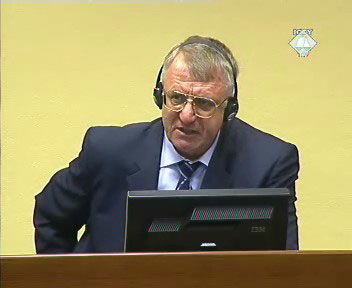
The Šešelj Case: Justice At Last?

by Stephen Karganovic

After almost twelve years of extra-judicial agony at the Detention Unit of the International Criminal Tribunal for the Former Yugoslavia at the Hague, on November 12 Serbian political leader Vojislav Šešelj returned home to Belgrade. True, the circumstances of his release (regarded as “provisional” in the terminology of the Tribunal which incarcerated him) leave quite a few more questions than they provide answers. To state just a simple one that immediately comes to mind, why isn’t there a verdict after the seemingly interminable trial? (Chief Prosecutor Serge Brammertz forecasts there might be one at the end of 2015.)

Sordid background of the Šešelj case. All who have followed attentively these lengthy proceedings will attest to their uniqueness, even by unconventional the standards of the ad hoc political court in the Hague. Politics has undisguisedly directed these proceedings from the start. A nationalist political gadfly, Vojislav Šešelj and his Serbian Radical Party were a most inconvenient presence for the slavishly pro-Western regime installed in Belgrade after the October 2000 “color revolution,” which saw the rise of the infamous “Otpor” outfit of professional subversives backed by Western money and logistics who were the operational precursors of a succession of similarly orchestrated coups elsewhere. In a memorable exchange with the then Hague Prosecutor Carla del Ponte, Serbian Prime Minister Zoran Djindjić pleaded with her to “take Šešelj to the Hague and never bring him back.” Del Ponte obliged in 2003 and issued an arrest warrant for Šešelj soon thereafter, never mind the fact that neither the indictment was ready nor was there evidence to support it. That was leisurely compiled over the following several years, while the defendant Šešelj was rotting away in his prison cell in the Netherlands and waiting for the procedural niceties which usually precede detention to be completed.

But all the while he was under guard a safe political distance away from Western-installed minions in Belgrade who were busily tearing Serbia apart and following subserviently the cues of Western ambassadors who assumed proconsular authority in the devastated country.

Procedural travesty. One would think that the five-year pre-trial delay in the commencement of the Šešelj trial was enough of an egregious violation of the accused’s human and procedural rights to cause the matter to be dismissed. But not at ICTY. It would seem self-evident that the outrageous delay and concomitant denial of provisional release throughout that period, coupled with the inexpeditious pace of the trial after it finally started, constituted a sufficiently grave violation of the right to speedy trial and thus a valid reason for quashing further proceedings. Be it noted that the right to a “fair and expeditious trial” is guaranteed in Rule 65ter (B) of the Tribunal’s own Rules of Evidence and Procedure, which the ultimately twelve year incarceration of Vojislav Šešelj appears by any reasonable standard to have violated. Add to that the complete collapse of prosecution’s case by the time it ended in March of 2011 and its consequent failure to demonstrate a single charge in the indictment. According to the Tribunal’s own rules, Rule 98bis to be exact, at that stage the Chamber should have assessed the evidence in the light most favorable to the accused and abrogated further proceedings if it appeared that the prosecution failed to present proof that might reasonably lead to a conviction.

Despite Prosecution’s manifest failure to present such proof, and the clearly expressed view of Chamber president Antoneti that the concept of joint criminal enterprise, upon which much of the indictment hinged, was misapplied in the Šešelj case, the majority of the Chamber voted for the trial to proceed. The political beneficiaries of this prolongation were the then and present rulers of Serbia. As a result of it, they were shielded until a few days ago from the unsavory prospect of a triumphant Šešelj returning to lead his resurgent Radical Party in the next Serbian elections. To make matters even more absurd, instead of moving forward to some sort of conclusion after the 98bis hearing in the Spring of 2011, the case-in-chief since then has been meandering around collateral issues, specifically contempt of court charges against the defendant for allegedly publicizing the identities of prosecution’s protected witnesses. It did not matter that all those witnesses had signed affidavits that they do not object to the lifting of protective measures. The trial was thus effectively prevented from advancing into the defence phase or the issuance of a verdict while these contrived issues were being considered, although the conclusion of the tedious proceedings as a whole was long overdue.

A word is in order about the presiding judge Jean-Claude Antonetti. After several judges in succession were replaced, he was appointed to head Šešelj’s Chamber on the eve of the trial’s commencement. Judged by purely formal standards, his performance has been commendable. But note should be taken of the fact that, though unlike his predecessors he has been a generally fair umpire in the courtroom, Antonetti alone had no decisive influence, flanked as he was by judges Harhoff (replaced recently by judge Mandiaye Niang) and Latanzzi who made no attempt to conceal their animosity toward the defendant. There is no particular reason to question Antoneti’s personal honour and professional rectitude, but his practical role in the Šešelj proceedings was limited and may be likened to that of Dubček: his role is to act as the Tribunal’s “human face”. Whatever the ultimate reason for Antoneti’s assignment, it must be recognized that his generally reasonable conduct has had the paradoxical effect of improving the quality of Šešelj’s performance. No longer obliged to assume the posture of an enfant terrible in order to dramatise the unfairness and absurdity of the proceedings against him, Vojislav Šešelj, who may not be a man of great social refinement but happens to be a person of enormous erudition and legal competence, could at last focus on the effective conduct of his defence and demonstrate publicly his complete mastery of the lawyer’s craft.

The list of procedural violations in the Šešelj case is long and varied, but we may reduce it to the following principal issues.

Undoubtedly, a fundamental issue in this category is the apparent fact that the indictment itself was not motivated by legal but crassly political motives. Though scandalous, Prime Minister Djindjić’s invitation to prosecutor Del Ponte to make Šešelj disappear from Belgrade was somewhat understandable coming from politician Djindjić seeking to get rid of his foremost political rival. But that a supposedly reputable international judicial institution should act upon such a crudely political invitation, as The Hague Tribunal has done, is an outrage of the first order.

The “Trial”. Such an infelicitous inception of the Šešelj case could not but lead to a lengthy train of subsequent abuses. In spite of the fact that Šešelj turned himself in voluntarily within days of being informed of the warrant for his arrest and that at various junctures during his incarceration he satisfied all of the Tribunal’s own criteria for pre-trial release, he was consistently denied that privilege afforded to others. That remained the position until the Chamber finally faced the insoluble dilemma of having to legally rationalize a guilty verdict and at the same time justify a politically correct lengthy prison sentence exceeding the accused’s already unreasonably lengthy pre-verdict incarceration. The priority became getting rid of the pesky defendant. When a few months ago Vojislav Šešelj was diagnosed with a metastasis of liver cancer, a Solomonic solution for a virtually unconditional “conditional release” emerged. The Tribunal practically threw him out of his UN Detention Unit cell and packed him off to Belgrade. They undoubtedly did it in the fond expectation that the unpleasant prisoner will be called to meet his Maker and spare his jailers another in-house death before it became simply untenable to further delay the preordained and politically mandated (but given the overall judicial fiasco, enormously embarrassing) guilty verdict.

Tainted from the outset, the case against Vojislav Šešelj began to really unravel once the trial started. It turned out that “expert” witnesses brought by the prosecution were a parade of half-wits and ignoramuses or, in Šešelj’s own memorable courtroom phrase referring to prosecution experts, “If they know less than I do about the subject matter of their expertise, they have no business being here.” The alleged percipient witnesses to Šešelj’s crimes were an unmitigated disaster for the prosecution, and their performance was marked by wholesale perjury. The vast majority admitted in court, under Šešelj’s merciless cross-examination, that they were blackmailed, pressured, or suborned to give false evidence against him under the direction of the prosecutor. One even revealed in open court that prosecution investigators had promised him access to “girls” if he agreed to give incriminating evidence against the defendant. Many prosecution witnesses, apparently relieved that they could finally do so in the relative safety of open court, withdrew large portions or all of their previously given statements and one, to the apparent amazement of the judges, requested permission to walk over to the defendant and to embrace him.

The prosecution of Vojislav Šešelj, more than any other scandalous proceeding at ICTY, illustrates the true nature of the Hague Tribunal and symbolises most clearly its institutional corruption which was best encapsulated by the distinguished authority John Laughland in the title of one of his books: travesty.

Oh, yes, and haven’t we forgotten to mention the official charges against Vojislav Šešelj? Not at all, they just happen to be completely ludicrous and of negligible import in relation to the gross subversion of basic legal principles that the conduct of his trial in all its phases represents. The defendant stands accused of “inciting” to violence and ethnic persecution in his political statements, an offence that is not even listed as a crime in the Tribunal’s Statute, any more than is the elusive doctrine of Joint Criminal Enterprise, which in any event would be regarded as legally protected free speech from any but a politically vindictive point of view.

The known “political unknowns” of the Šešelj case. Heading this list is uncertainty about the impact that Šešelj’s abrupt return from the Hague might have on the foremost political issue of the day in Serbia: how to get rid (hopefully by peaceful means) of the unsavoury tandem of President Tomislav Nikolić and Prime Minister Alexander Vučić, until 2008 Šešelj’s close associates and his designated Radical Party caretakers while the leader was incarcerated, who are currently running the country into the ground. In a stunning about face, five years ago these former lieutenants completely renounced their long held views to become leading exponents of joining the EU, signing off on the takeover of Kosovo, and embracing just about every other notion that previously they vigorously opposed and claimed to abhor. It is rumoured that their sudden conversion may have been encouraged by some irresistible monetary inducements combined with promises of Western backing to gain power in Serbia after several previous unsuccessful attempts. The renegade tandem’s palpable nervousness mounted as the day of Šešelj’s triumphant return to Belgrade on Wednesday, November 12, approached.

Though perhaps dying of cancer, Vojislav Šešelj is entitled to regard this, perhaps final, stage of his political career and physical life with considerable satisfaction. Singlehandedly (because he chose to use his knowledge as a former law professor to represent himself at the Hague) he not only slew but also utterly humiliated the ICTY dragon. Under Šešelj’s relentless pounding the prosecution case simply fell apart. It is thus that in the end what began as a standard Hague litany of “crimes against humanity” (including murder, torture, cruel treatment, persecution, wanton destruction of villages, and even pillage of public and private property, to name just a few) essentially shrank to politically incorrect rhetoric, hardly unusual for exuberant politicians in many parts of the world and scarcely an offence warranting long-term incarceration.

A few years ago, in his annual press conference Russian Foreign Minister Lavrov singled out the persecution of Vojislav Šešelj for particular criticism and cited it as one of the significant reasons for closing down the Hague Tribunal. The record of illegality and systematic professional misconduct that has characterised the Šešelj case makes Mr. Lavrov’s recommendation urgent and entirely appropriate. One should only like to add that after almost two decades of serious damage to international law it would not be enough to merely shut it down. Particularly in light of the paradigmatic nature of the abuses inflicted on Vojislav Šešelj, but no less for a long train of similar misconduct in a host of other cases, all the decisions and verdicts of the Hague Tribunal must be reviewed, the pernicious precedents it set dismissed, and its willing servants professionally disciplined.

Monday, April 7, 2014

Saker interview with Nebojsa Malic aka "Grey Falcon"

Today I want to do something which I have not done in a long while: interview somebody by email and give that person the space to fully answer.  For those interested, in the past I did that with Mizgin (Kurdistan), Roger Tucker (One Democratic State), Taimur (Indian Kashmir), Gilad Atzmon (Palestine), Joel Bainerman (Israel), Uri Avnery (Israel), Jonathan Cook (Palestine), Joel S. Hirschhorn (USA), Anticapitalista (Greece) and Scott Horton (USA).  I think that I like this format and I will come back to it again.

[BTW - my dream would be to make such an "email interview" with a Hezbollah official or party member but, alas, all my attempts to obtain such an interview have, so far, failed.  If anybody could help me get such an interview I would be eternally thankful to him/her!!]

Just a few days after seeing him interviewed by Peter Lavelle on RT about Crimea, I got an  email from Nebojsa Malic who blogs at Gray Falcon and who is currently President of the R. Archibald Reiss Institute for Serbian Studies in Washington, DC.  I immediately seized the opportunity to ask him a question which had been nagging at me for many years already.

I understand that the topic of war in Bosnia might reopen old wounds for some readers and I also understand that some might categorically disagree with Nebojsa Malic's point of view.  To those readers I would say two things: the war in Bosnia left everybody wounded, not just one group.  As for what lessons can be learned from this war, they might be painful, but they are also important because of the undeniable fact that what happened in Bosnia was the blueprint which was subsequently applied to Kosovo, Chechnia, Libya, Syria and the Ukraine.

I would very much welcome another point of view on this topic, especially one from a supporter of Alija Izetbegovic.  If somebody is willing to share such a point of view here, I would be delighted to publish it.

Finally, and especially because this is a painful topic, I will be far stricter than usual in my comments moderation policy.  While everybody will be free to express disagreements or criticisms, any comment which will be rude or include any ad hominems will be deleted.  Likewise, I will tolerate no insults towards any of the Bosnian ethnic and religious groups involved in this war.  We all probably think that this or that party was in the right, and that's fine, but at the end all parties are first and foremost victims of this war.  Thus they ideally all deserve respect and, if that is impossible, then at least basic courtesy.  This restriction does not apply to any of the external parties to this conflict whom you may insult to your heart's content (if you feel that this adds something useful to the conversation).

A big "thank you!" to Nebojsa Malic for his time and very interesting answer.

The Saker
-------

Question from The Saker:

Ever since the war in Bosnia began, I have been convinced that the Bosnian-Muslims have been conned by the USA into the wrong alliance and that they would have been infinitely better off if they had sided with the Serbs against the Croats. Do you agree with that? If not - why not? As far as I know, Radovan Karadzic made several offers to make a deal, but they were all rejected. Is that true? Can you be specific and outline what the Bosnian-Serbs offered as a basis for negotiations? I also know that some Bosnian-Muslims were favorable to a dialog with the Bosnian-Serbs - why did that never happen? There is the mostly overlooked example of Fikret Abdic in Bihac. Why was his "model" not emulated by other Bosnian-Muslim leaders? Why has a "Bosnian Akhmad Kadyrov" not appeared during this war? Lastly, what are your hopes for a future national reconciliation between all Bosnians?

Answer from Nebojsa Malic:


My experience in Bosnia is enough to sell me on the idea of powerful personalities as forces of history. Because a lot of what happened in Bosnia cannot be explained other than through the man who emerged as the leader of the Bosnian Muslims, Alija Izetbegovic.
The rift between Bosnia’s communities is religious, but also historical. The Serbs are natives who remained loyal to the Orthodox Church. Bosnia’s Muslims are mainly local converts to Islam over the four centuries of Ottoman rule (1461-1878). And then you have the locals who converted to Catholicism, as well as settlers who arrived from all over the Austro-Hungarian Empire during the 1878-1918 occupation; these two groups were later shoehorned into the catch-all category of “Croats.”
A century ago, there were both Serb, Croat and Muslim members of “Young Bosnia,” the organization behind the 1914 assassination of the Hapsburg heir in Sarajevo that was later used as a pretext for WW1. When Austria-Hungary fell apart at the end of the war, the unified state of South Slavs (in 1929 renamed “Yugoslavia”) got mired in a bitter conflict between the Orthodox Serb majority and the Catholic Croats. When Hitler invaded in 1941, Croats sided with the Axis and established their own state, which immediately began the mass murder of Serbs. Many Muslims, sadly, joined the Croats in this endeavor, perhaps seeing the German Reich as the return of Austria-Hungary (within which most of their Ottoman privileges were preserved). Others backed the Germans directly, unhappy that the Ustasha regime saw them as nothing more than “Islamic Croats.”
One of those people was the young Alija Izetbegovic – too young to join the two Muslim Waffen-SS divisions, but old enough to be an activist. Briefly imprisoned by the Communist regime after the war, he was released and later went to law school.
Originally intent on dismembering Yugoslavia, Tito’s Communists rethought the idea when they came into power in 1945. So they partitioned the country into “socialist republics.” One of these republics reunited the two Ottoman provinces of Bosnia and Herzegovina into a single polity, which was supposed to hold Yugoslavia together as a place belonging to Serbs, Muslims and Croats alike. A system of ethnic quotas was put into place to encourage parity, and in the 1960s the Muslims were recognized not just as a religious group, but as a proper nation (narod, as opposed to narodnost).
In 1971, young Izetbegovic wrote a treatise called “The Islamic Declaration,” calling for a return of secularized Muslim societies to political Islam – eight years before the revolution in Iran did precisely that. But his samizdat wasn’t noticed until the early 1980s, when Albanian separatism began manifesting as terrorist attacks, and the Communists jailed Izetbegovic – with a dozen associates – on charges of “inciting ethnic hatred”. Agitating the loudest for his release was a group of Serbian writers and political activists.
The Yugoslav Communist Party started to come apart in 1989, and by 1990, individual republics were holding their own elections. Izetbegovic met with a prominent Muslim who had been living in exile in Switzerland – Adil Zulfikarpasic – and together with him and historian Muhamed Filipovic established the “Party of Democratic Action” (SDA). This was prior to the abolition of a law banning ethnic political parties, hence the neutral name. Zulfikarpasic invested his money, Filipovic his idea of a Muslim-dominated “Bosniak” nation, and Izetbegovic his zeal. They scored another success by talking Fikret Abdic into headlining the SDA’s election ticket. Abdic was a successful Muslim businessman from western Bosnia, who late in the 1980s crossed a powerful political clan and was railroaded on charges of embezzlement; this garnered him much sympathy among all Bosnians, in addition to his regional popularity.
Meanwhile, the Bosnian Serbs split their support between the “nationalist” Serb Democratic Party (SDS) and the more “Yugoslav”-oriented Social-Democrats and the Reformist Alliance. SDS leader Radovan Karadzic, a poet and psychiatrist, kept trying to negotiate a “historic agreement” with the Muslims. But a deal he made with Zulfikarpasic and Filipovic was rejected by Izetbegovic, and the two were driven out of the SDA. After Abdic had won most of the votes in the presidential poll, he was pressured to cede the chair of the seven-member body to Izetbegovic, who thus became “President of Bosnia”.
Meanwhile, at Izetbegovic’s instructions, the SDA made a pact with the Croats (the local branch of the ruling Croatian party, HDZ, aiming to resurrect the 1940s independent Croatia). Even then, the Serbs offered Izetbegovic a deal: he could be the president of Yugoslavia, composed of Bosnia, Serbia, Montenegro and possibly Macedonia. He said no. In February 1991 he famously declared: “I would sacrifice peace for a sovereign Bosnia-Herzegovina… but for that peace in Bosnia-Herzegovina I would not sacrifice sovereignty.” In October 1991, SDA and HDZ legislators illegally called an independence referendum.
The last-ditch effort by the Europeans to salvage peace in Bosnia resulted in the “Cutilheiro plan” proposed by the top Portuguese diplomat. Under it, Bosnia would be partitioned into three ethnic provinces, but in return the Serbs and Croats would recognize its independence and integrity. Izetbegovic signed it at first – then, in mid-March 1992, following the visit by U.S. Ambassador Warren Zimmerman, reneged on the deal. The Croats were already raiding the border areas, seeking to continue Croatia’s war (officially ended by the January 1992 armistice) by proxy in Bosnia. Faced with the complete collapse of political dialogue, the Serbs took to arms as well.
Izetbegovic’s entire strategy was to get the U.S. military involved on his behalf. Meanwhile, he entrusted the head of the ulema, Mustafa Ceric, to “Islamize” the Muslims in line with Izetbegovic’s 1971 declaration, even to the point of importing Wahhabis and “Afghans” to serve as missionaries.
Fikret Abdic tried to make peace even then. He had left Sarajevo in March 1992, going back to western Bosnia. In 1993, he proclaimed the “Autonomous Region of Western Bosnia” (Autonomna Oblast Zapadna Bosna). At the time, Izetbegovic’s alliance with the Croats had fallen apart, and Muslims and Croats were fighting viciously in central Bosnia and Herzegovina. Both the Serbs and the Croats had made separate peace with Abdic.
While Izetbegovic thought he was using the Americans, they were using him. Washington continued to sink several European peace initiatives in 1992 and 1993, while gradually dragging NATO into the Bosnian War at the expense of the UN. In 1994, Washington arranged a truce between Izetbegovic’s Muslims and the Croats and forced them into a military alliance, as well as the political one (“Federation of Bosnia and Herzegovina”). The Croatian Army was armed and trained by American “contractors” and in August 1995 – backed by NATO - launched an all-out assault on the Serb-inhabited territories claimed by Croatia. This was the cue for Izetbegovic’s Fifth Corps to attack Abdic. Outnumbered, outgunned and unable to get support from the hard-pressed Serbs, Abdic’s followers surrendered. They have been persecuted ever since.
But Washington had its own agenda: by ending the war in Bosnia, America could posture as a white knight coming to the aid of oppressed Muslims (thus scoring propaganda points in the Muslim world) while reasserting dominance over Europe. In the minds of American leaders, by the time the Dayton peace talks began, Izetbegovic and the Bosnian War had served their purpose.
According to Richard Holbrooke, chief US negotiator at the Dayton talks in November 1995, Izetbegovic tried to sabotage the talks several times. Holbrooke’s memoirs relate the Americans’ frustration with Izetbegovic at that point, describing how he drove even the normally sanguine Warren Christopher into a paroxysm of rage. In the end, Izetbegovic gave in – the Americans had secured the backing of the Serbs, the Croats, and the rest of his delegation, and he could not refuse the peace plan without being obviously responsible. The Bosnian War ended with a partition. It was essentially the same plan the Americans urged Izetbegovic to reject in 1992, only now a 100,000 people were dead and the country destroyed by war.
Izetbegovic claimed, echoed by his hagiographers, that he “saved” the Bosnian Muslims from “Serb aggression and genocide.” In reality, he almost destroyed them – by pushing them into a suicidal war against their friends, neighbors and relatives, by letting the West use them as propaganda pawns, and in the end by stealing from the billions of dollars in foreign aid that came to Bosnia after the war. Bosnia’s economy never recovered, but the bank accounts of SDA officials benefited handsomely.
With his wartime propaganda poisoning the well of Muslim relations with Serbs and Croats, it has been impossible to glue Bosnia together even 18 years after Dayton. Not only did he destroy the inter-ethnic trust by reneging on agreements with Serbs and Croats, Izetbegovic also deceived and discarded every Muslim associate of his. He double-crossed Zulfikarpasic, Filipovic before the war, Abdic during, and his wartime lieutenants Ganic and Silajdzic afterwards. The warlords he personally commanded during the war (such as Jusuf “Juka” Prazina or Musan “Caco” Topalovic) ended up dead on Belgian roads, or “shot while attempting to escape” police custody, or victims of mysterious suicides and “car accidents.”
None of this absolves the West from responsibility for the Bosnian tragedy, by the way. Their attempts to use Izetbegovic may have been the deciding factor in plunging Bosnia into war. And their behavior after Dayton – making Bosnia into a de facto protectorate and trying to impose their vision of what the country should be (which was often conflicted, and always confused) – created a powerful disincentive for any sort of internal dialogue. This is why the legacy of hatred and distrust has persisted to the present day, even though Izetbegovic himself died in 2003.
What motivated his hatred of the Serbs is difficult to divine – some say it was his family history, as they left Serbia in 1867 and settled in Bosnia, ever resentful of the Serb “infidels” – but ultimately doesn’t matter. The damage has been done. A generation of Muslims has grown up learning to hate the Serbs and Croats, and believe themselves the victims to whom the West owes a living. The real question is who among the Bosnian Muslims will have the courage to challenge Izetbegovic’s political dogma, and the vision to transcend it. Right now, there is no one that comes to mind.
Though Sulejman Tihic, who succeeded Izetbegovic as the head of the SDA in 2001, has made many attempts to mend fences with the Serbs over the years, the “old guard” within the party – led by Izetbegovic’s son Bakir – successfully undermined all his efforts. To make matters worse, Tihic has cancer, and his prognosis is terminal.
I hope the same is not true of the future of Bosnia. But nothing gives me reason to be optimistic.

Nebojsa Malic was born in Sarajevo (today the capital of Bosnia-Herzegovina) and lived through the Bosnian War. He was a translator for the Sarajevo City Hall in 1995, as well as a freelance interpreter to the Anglosphere media. After leaving Bosnia in 1996, he got a BA in History and International Studies from Graceland University in Iowa. He started writing on Balkans issues in 1999, blogs at Gray Falcon since 2004, and is currently President of the R. Archibald Reiss Institute for Serbian Studies in Washington, DC.

Sunday, September 19, 2010

Serbia Surrenders Kosovo to the EU


On September 10, at the UN General Assembly, Serbia abruptly surrendered its claim to the breakaway province of Kosovo to the European Union. Serbian leaders described this surrender as a “compromise”. But for Serbia, it was all give and no take.

In its dealings with the Western powers, recent Serbian diplomacy has displayed all the perspicacity of a rabbit cornered by a rattlesnake. After some helpless spasms of movement, the poor creature lets itself be eaten.

The surrender has been implicit all along in President Boris Tadic’s two proclaimed foreign policy goals: deny Kosovo’s independence and join the European Union. These two were always mutually incompatible. Recognition of Kosovo’s independence is clearly one of the many conditions – and the most crucial – set by the Euroclub for Serbia to be considered for membership. Sacrificing Kosovo for “Europe” has always been the obvious outcome of this contradictory policy.

However, his government, and notably his foreign minister Vuk Jeremic, have tried to conceal this reality from the Serbian public by gestures meant to make it seem that they were doing everything possible to retain Kosovo.

Thus in October 2008, six months after U.S.-backed Kosovo leaders unilaterally declared that the province was an independent State, Serbia persuaded the UN General Assembly to submit the following question to the International Court of Justice for an (unbinding) advisory opinion: “Is the unilateral declaration of independence by the Provisional Institutions of Self-Government of Kosovo in accordance with international law?’”

This was risky at best, because Serbia had more to lose by an unfavorable opinion than it had to gain by a favorable one. After all, most of the UN member states were already refusing to recognize Kosovo’s independence, for perfectly solid reasons of legality and self-interest. At best, a favorable ICJ opinion would merely confirm this, but would not in itself lead to any positive action. Serbia could only hope to use such a favorable opinion to ask to open genuine negotiations on the status of the province, but the Kosovo Albanian separatists and their United States backers could not be forced to do so.

One must stop here to point out that there are two major issues involved in all this: one is the status and future of Kosovo, and the other is the larger issue of national sovereignty and self-determination within the context of international law. If so many UN member states supported Serbia, it was certainly not because of Kosovo itself but because of the larger implications. Nobody objected to the splitting of Czechoslovakia, because the Czechs and the Slovaks negotiated the terms of separation. The issue is the method. There are literally hundreds, perhaps thousands, of potential ethnic secessionist movements within existing countries around the world. Kosovo sets an ominous precedent. An armed separatist movement, with heavy support from the United States, where an ethnic Albanian lobby had secured important political backing, notably from former Senator and Republican Presidential candidate Bob Dole, carried out a campaign of assassinations in 1998 in order to trigger a repression which it could then describe as “ethnic cleansing” and “genocide” as a pretext for NATO intervention.

This worked, because US leaders saw “saving the Kosovars” as the easy way to save NATO from obsolescence by transforming it into a “humanitarian” global intervention force. Bombing Serbia for two and a half months to “stop genocide” was a spectacle for public opinion. The only people killed were Yugoslav citizens out of sight on the ground. It was the lovely little war designed to rehabilitate military aggression as the proper way to settle conflicts.

The reality of this cynical manipulation has been assiduously hidden from Americans and most Europeans, but elsewhere, and in certain European countries such as Spain, Greece, Cyprus and Slovakia, the point has not been missed. Separatist movements are dangerous, and whenever the United States wants to subvert an unfriendly government, it has only to incite mass media to portray the internal problems of the targeted government as potential “genocide” and all hell may break loose.

So Serbia did not really have to work very hard to convince other countries to support its position on Kosovo. They had their own motivations – which were perhaps stronger than those of the Serbian government itself.

What did Serb leaders want?

The question put to the ICJ did not spell out what Serb leaders wanted. But it had implications. If the Kosovo declaration of independence was illegal, what was challenged was not so much independence itself as the procedure, the unilateral declaration. And indeed, there is no reason to suppose that Serb leaders thought they could reintegrate the whole of Kosovo into Serbia. It is even unlikely that they wanted to do so.

There are very mixed feelings about Kosovo within the Serb population. It is hard to know how widespread is the sense of concern, or guilt, regarding the beleaguered Serb population still living there, vulnerable to attacks from racist Albanians eager to drive them out. The sentimental attachment to “the cradle of the Serb nation” is very strong, but few Serbs would choose to go live there, even if the province were returned to them. In former Yugoslavia, the province was a black hole that absorbed huge sums of development aid, and would certainly be a heavy economic burden to impoverished Serbia today. Economically, Serbia is probably better off without Kosovo. Nearly twenty years ago, the leading Serb author and patriot Dobrica Cosic was arguing in favor of dividing Kosovo along ethnic and historic lines with Albania. Otherwise, he foresaw that the attempt to live with a hostile Albanian population would destroy Serbia itself.

Few would admit this, but the proposals of Cosic, echoed by some others, at least suggest that in a world with benevolent mediators, a compromise might have been worked out acceptable to most of the people directly involved. But what made such a compromise impossible was precisely the US and NATO intervention on behalf of armed Albanian rebels. Once the Albanian nationalists knew they had such support, they had no reason to agree to any compromise. And for the Serbs, the brutal method by which Kosovo was stolen by NATO was adding insult to injury – a humiliation that could not be accepted.

By taking the question to the UN General Assembly and the ICJ, Serbia sought endorsement of a reopening of negotiations that could lead to the sort of compromise that might have settled the issue had it been taken up in a world with benevolent mediators.
International Court of No Justice

On July 22, the ICJ issued its advisory opinion, concluding that Kosovo’s “declaration of independence was not illegal”. In some 21,600 words it evaded the main issues, refusing to state that the declaration meant that Kosovo was in fact properly independent. The gist was simply that, well, anybody can declare anything, can’t they?

Of course, this was widely interpreted by Western governments and media, and most of all by the Kosovo Albanians, as endorsement of Kosovo’s independence, which it was not.

Nevertheless, it was a shameful cop-out on the part of the ICJ, which marked further deterioration of the post-World War II efforts to establish some sort of international legal order. Perhaps the most flagrant bit of sophistry in the lengthy opinion was the argument (in paragraphs 80 and 81) that the declaration was not a violation of the “territorial integrity” of Serbia, because “the illegality attached to [certain past] declarations of independence … stemmed not from the unilateral character of these declarations as such, but from the fact that they were, or would have been, connected with the unlawful use of force or other egregious violations of norms of general international law…”

In short, the ICJ pretended to believe that there has been no illegal international military force used to detach Kosovo from Serbia, although this is precisely what happened as a result of the totally illegal NATO bombing campaign against Serbia. Since then, the province has been occupied by foreign military forces, under NATO command, which both violated the international agreement under which they entered Kosovo and looked the other way as Albanian fanatics terrorized and drove out Serbs and Roma, occasionally murdering rival Albanians.

The ICJ judges who endorsed this scandalous opinion came from Japan, Jordan, the United States, Germany, France, New Zealand, Mexico, Brazil, Somalia and the United Kingdom. The dissenters came from Slovakia, Sierra Leone, Morocco and Russia. The lineup shows that the cards were stacked against Serbia from the start, unless one actually believes that the judges leave behind their national mind-set when they join the international court.

Digging Itself Deeper Into a Hole

Probably, the Tadic government had expected something better, and had planned to follow up a favorable ICJ opinion with an appeal to the General Assembly to endorse renewed negotiations over the status of Kosovo, perhaps enabling Serbia to recover at least the northern part of Kosovo whose population is solidly Serb.

Oddly, despite the bad omen of the ICJ opinion, the Tadic government went right ahead with plans to introduce a resolution before the UN General Assembly. The draft resolution asked the General Assembly to state the following:

Aware that an agreement has not been reached between the sides on the consequences of the unilaterally proclaimed independence of Kosovo from Serbia,

Taking into account the fact that one-sided secession cannot be an accepted way for resolving territorial issues,

1. Acknowledges the Advisory opinion of the ICJ passed on 22 July 2010 on whether the unilaterally proclaimed independence of Kosovo is in line with international law,

2. Calls on the sides to find a mutually acceptable solution for all disputed issues through peaceful dialogue, with the aim of achieving peace, security and cooperation in the region.

3. Decides to include in the interim agenda of the 66th session an item namely: "Further activities following the passing of the advisory opinion of the ICJ on whether the unilaterally proclaimed independence of Kosovo is in line with international law.”

The key statement here was “the fact that one-sided secession cannot be an accepted way for resolving territorial issues”. This was the point on which the greatest agreement could be attained. The United States made it known that it was totally unacceptable for the General Assembly to hold a debate on such a resolution. The main Belgrade daily Politika published an interview with Ted Carpenter of the Cato Institute in Washington saying that the Serbian draft resolution on Kosovo was "irritating America and the EU's leading countries". American diplomats were “working overtime” to thwart the resolution, he said. Carpenter said that the Serbian resolution was seen in Washington as an unfriendly act that would lead to a further deterioration in relations, and that as a result of its Kosovo policy, Serbia’s EU ambition could suffer setbacks that would have negative consequences for the Serbian government "and the Serb people".

Carpenter conceded that this time around, the country would not be threatened militarily, but noted that the United States was influential enough to "make life very difficult" for any country that stood up against its policies. He concluded that Serbia would "have to accept the reality of an independent Kosovo", and that Washington would thereupon leave it to Brussels to deal with the remaining problems.

The American stick was accompanied by a dangling EU carrot. Carpenter expressed his hope that the EU would consider various measures, "including adjustment of borders, regarding Kosovo, and the rest of Serbia", but also, he noted, Bosnia-Herzegovina, suggesting that Serbs could be satisfied if a loss of Kosovo were compensated by a unification with Bosnia's Serb entity, the Republika Srpska. Giving his own opinion, Carpenter said such a solution would at least be much better than the current U.S. and EU policy, “which seems to be that everyone in the region of the former Yugoslavia, except Serbs, has a right to secede”.

Carpenter, who was a sharp critic of the 1999 NATO bombing of Serbia, and who warned that secessionist movements around the world could use the Kosovo precedent for their own purposes, said that such a solution was possible “in the coming decades”… a fairly distant prospect.

The decisive arm twisting was perhaps administered by German foreign minister Guido Westerwelle on a visit to Belgrade. Whatever threats or promises he made were not disclosed, but on the eve of the scheduled UN General Assembly debate, the Tadic government caved in entirely and allowed the EU to rewrite the resolution.

The resolution dictated by the EU made no mention of Kosovo other than to “take note” of the ICJ advisory opinion, and concluded by welcoming “the readiness of the EU to facilitate the process of dialogue between the parties.”

According to this text of the resolution, which UN General Assembly adopted by consensus; “The process of dialogue by itself would be a factor of peace, security and stability in the region. This dialogue would be aimed to promote cooperation, make progress on the path towards the EU and improve people's lives.”

By accepting this text, the Serbian government abandoned all effort to gain international support from the many nations hostile to unilateral secession, and threw itself on the mercy of the European Union.

Still More to Lose

In a TV interview, I was asked by Russia Today, “What does Serbia stand to gain?” My immediate answer was, “nothing”. Serbia implicitly abandoned its claim to Kosovo in return for nothing but vague suggestions of “dialogue”.

A usual aim of all policy is to keep options open, but Serbia has now put all its eggs in the EU basket, in effect rebuffing all the member states of the UN General Assembly which were ready to support Belgrade as a matter of principle on the issue of unnegotiated unilateral secession.

Rather than gain anything, the Tadic government has apparently chosen to try to avoid losing still more than it has lost already. After the violent breakup of Yugoslavia along ethnic lines, Serbia remains the most multiethnic state in the region, which means that it includes minorities which can be incited to demand further secessions. There is a secession movement in the ethnically very mixed northern province of Voivodina, which could be more or less covertly encouraged by neighboring Hungary, an increasingly nationalist EU member attentive to the Hungarian minority in Voivodina. There is another, more rabid separatist movement in the southwestern region of Raska/Sanjak led by Muslims with links to Bosnian Islamists. Surrounded by NATO members and wide open to NATO agents, Serbia risks being destabilized by the rise of such secession movements, which Western media, firmly attached to the stereotypes established in the 1990s, could easily present as persecuted victims of potential Serb genocide.

Moreover, no matter how the Serbs vote, the US and UK embassies dictate the policies. This has been demonstrated several times. Little Serbia is actually in a position very like the Pétain government in 1940 to 1942, when it governed a part of France not yet occupied but totally surrounded by the conquering Nazis.

It would take political genius to steer little Serbia through this geopolitical swamp, infested with snakes and crocodiles, and political genius is rare these days, in Serbia as elsewhere.

EU to the rescue?

Under these grim circumstances, the Tadic government has in effect abandoned all attempt at independence and entrusted the future of Serbia to the European Union. Serb patriots quite naturally decry this as a sell-out. Indeed it is, but Russia and China are far away, and could not be counted on to do anything for Serbia that would seriously annoy Washington. The fact is that much of the younger generation of Serbs is alienated from the past and dreams only of being in the EU, which means being treated as “normal”.

How will the EU reward these expectations?

Up to now, the EU has responded to each new Serb concession by asking for more and giving very little in return. At a time when many in the core EU countries feel that accepting Rumania and Bulgaria has brought more trouble than it was worth, enlargement to include Serbia, with its unfairly bad reputation, looks remote indeed.

In reality, the most Belgrade can hope for from the EU is that it will muster the courage to take its own policy line on the Balkans, separate from that of the United States.

Given the subservience of current EU leaders to Washington, this is a long shot. But it has a certain basis in reality.

United States policy toward the region has been heavily influenced by ethnic lobbies that have pledged allegiance to Washington in return for unconditional support of their nationalist aims. This is particularly the case of the rag-tag Albanian lobby in the United States, an odd mixture of dull-witted politicians and gun-running pizza parlor owners who flattered the Clinton administration into promising them their own statelet carved out of historic Serbia. The result has been “independent” Kosovo, in reality occupied by a major US military base, Camp Bondsteel, NATO-commanded pacifiers and an EU mission theoretically trying to introduce a modicum of legal order into what amounts to a failing state run by clans and living off various criminal activities. Since Camp Bondsteel is untouchable, and the grateful hoodlums have erected a giant statue to their hero, Bill Clinton, in their capital, Pristina, Washington is content with this situation.

But many in Europe are not. It is Europe, not the United States, that has to deal with violent Kosovo gangsters peddling dope and women in its cities. It is Europe, not the United States, that has this mess on its doorstep.

The media continue to peddle the 1999 fairy tale in which heroic NATO rescued the defenseless “Kosovars” from a hypothetical “genocide” (which never took place and never would have taken place), but European governments are in a position to know better.

As evidence of this is a letter written to German Chancellor Angela Merkel on October 26, 2007 by Dietmar Hartwig, who had been head of the EU (then EC) mission in Kosovo just prior to the NATO bombing in March 1999, when the mission was withdrawn. In describing the situation in Kosovo at a time when the NATO aggression was being prepared on the pretext of “saving the Kosovars”, Hartwig wrote:

“Not a single report submitted in the period from late November 1998 up to the evacuation on the eve of the war mentioned that Serbs had committed any major or systematic crimes against Albanians, nor there was a single case referring to genocide or genocide-like incidents or crimes. Quite the opposite, in my reports I have repeatedly informed that, considering the increasingly more frequent KLA attacks against the Serbian executive, their law enforcement demonstrated remarkable restraint and discipline. The clear and often cited goal of the Serbian administration was to observe the Milosevic-Holbrooke Agreement to the letter so not to provide any excuse to the international community to intervene. … There were huge ‘discrepancies in perception’ between what the missions in Kosovo have been reporting to their respective governments and capitals, and what the latter thereafter released to the media and the public. This discrepancy can only be viewed as input to long-term preparation for war against Yugoslavia. Until the time I left Kosovo, there never happened what the media and, with no less intensity the politicians, were relentlessly claiming. Accordingly, until 20 March 1999 there was no reason for military intervention, which renders illegitimate measures undertaken thereafter by the international community. The collective behavior of EU Member States prior to, and after the war broke out, gives rise to serious concerns, because the truth was killed, and the EU lost reliability.”

Other official European observers said the same at the time, and in 2000, retired German general Heinz Loquai wrote a whole book, based especially on OSCE documents, showing that accusations against Serbia were false propaganda. While the public was fooled, government leaders have access to the truth.

In short, EU governments lied then, for the sake of NATO solidarity, and have been lying ever since.

Now as then, there are insiders who complain that the situation in reality is very different from the official version. Voices are raised pointing out that Republika Srpska is the only part of Bosnia that is succeeding, while the Muslim leadership in Sarajevo continues to count on largesse due to its proclaimed victim status. There seems to be a growing feeling in some leadership circles that in demonizing the Serbs, the EU has bet on the wrong horse. But that does not mean they will have the courage to confront the United States. In Kosovo itself, the most radical Albanian nationalists are ready to oppose the EU presence, by arms if necessary, while feeling confident of eternal support from their U.S. sponsors.
The Betrayal of Serbia

If the latest self-defeat at the UN General Assembly can be denounced as a betrayal, the betrayal began nearly ten years ago. On October 5, 2000, the regular presidential election process in Yugoslavia was boisterously interrupted by what the West described as a “democratic revolution” against the “dictator”, president Slobodan Milosevic. In reality, the “dictator” was about to enter the run-off round of the Yugoslav presidential election in which he seemed likely to lose to the main opposition candidate, Vojislav Kostunica. But the United States trained and incited the athletically inclined youth organization, Otpor (“resistance”), to take to the streets and set fire to the parliament in front of international television, to give the impression of a popular uprising. Probably, the scenarists modeled this show on the equally stage-managed overthrow of the Ceaucescu couple in Rumania at Christmas 1989, which ended in their murder following one of the shortest kangaroo court trials in history. For the generally ignorant world at large, being overthrown would be proof that Milosevic was really a “dictator” like Ceaucescu, whereas being defeated in an election would have tended to prove the opposite.

Proclaimed president, Kostunica intervened to save Milosevic, but not having been allowed to actually win the election, his position was undermined from the start, and all power was given to the Serbian prime minister, Zoran Djindjic, a favorite of the West who was too unpopular to have won an election in Serbia. Shortly thereafter, Djindjic violated the Serbian constitution by turning Milosevic over to the International Criminal Tribunal for Former Yugoslavia (ICTY) in The Hague – for one of the longest kangaroo court trials in history.

Pro-Western politicians in Belgrade labored under the illusion that throwing Milosevic to the ICTY wolves would be enough to ensure the good graces of the “International Community”. But in reality, the prosecution of Milosevic was used to publicize the trumped up “joint criminal enterprise” theory which blamed every aspect of the breakup of Yugoslavia on an imaginary Serbian conspiracy. The scapegoat turned out to be not just Milosevic, but Serbia itself. Serbia’s guilt for everything that went wrong in the Balkans was the essential propaganda line used to justify the 1999 NATO aggression, and by going along with it, the “democratic” Serbian leaders undermined their own moral claim to Kosovo.

In June 1999, Milosevic gave in and allowed NATO to occupy Kosovo under threat of carpet bombing that would destroy Serbia entirely. His successors fled from a less perilous battle – the battle to inform world public opinion of the complex truth of the Balkans. Having abandoned all attempt to assert its moral advantage, Serbia is counting solely on the kindness of strangers.

Diana Johnstone is author of Fools’ Crusade: Yugoslavia, NATO and Western Delusions (Monthly Review Press). She can be reached at diana.josto@yahoo.fr

Wednesday, February 10, 2010

New Balkan Wars Loom on the Horizon

by Pyotr Iskenderov for Strategic Culture Magazine

The contours of the Kosovo separatists' plan to suppress the Serbian resistance in the northern part of the province with the help of the US and the EU are getting increasingly visible. The statements emanating from Pristina and the intensifying international debates over the Kosovo theme do not only show that the Albanian separatists are preparing an attack against their opponents but also give an idea of its potential scenario, the distribution of roles in it, and the extent to which Hashim Thaci and other former leaders of the terrorist Kosovo liberation army are relying on the international support in the process.

The debates at the January 22 open session of the UN Security Council on Kosovo were unprecedentedly heated. It was the first time since the summer of 2007 (when Russia managed to derail the Resolution recognizing the Kosovo independence, proposed by the West on the basis of UN Special Envoy Martti Ahtisaari's plan) that the parties to the dispute over Kosovo defined their positions with such utmost clarity. There was an impression that the world's major powers were speaking different languages. UN Secretary General Ban Ki-moon, the US, and West European countries “urged flexibility” in admitting Kosovo to regional and international mechanisms and forums, whereas Russia and Serbia regarded the approach as an attempt to dilute the role of the UN in the province and to legitimize its independent status. The discussions were centered around Pristina's so-called final solution plan for North Kosovo, which Thaci inadvertently unveiled several days prior to the session. He said the plan was being drafted jointly with the international representatives and was aimed at strengthening what he called Kosovo sovereignty and territorial integrity. Thaci said 2010 would be the year of consolidation for Kosovo. The priorities in the framework of the plan include the elimination of the Serbian self-government established in Kosovska Mitrovica and nearby Serbian communities based on the May, 2008 elections held in accord with the laws of Serbia. Another blow will be dealt to Serbian police forces and custom service, which at the moment are maintaining at least partial control over the traffic across the administrative border between Kosovo and the rest of Serbia.

NATO's KFOR deployed in Kosovo will render military assistance to Albanians. There is information that on the whole the corresponding decision was made during Commander of Joint Force Command Naples, Admiral Mark Fitzgerald's January visit to Kosovo, after which he described the Serbian self-government as... a threat to the security of Kosovo. “All violations of UN Security Council Resolution 1244 pose a threat to security. Since the resolution does not approve of parallel institutions, they are cause for concern”, said Fitzgerald.

Pristina's priority is the international support for the operation, which the US and the EU are supposed to ensure. The US will be blocking the attempts by Russia and China to have a response resolution passed by the UN Security Council. At the same time Brussels will be exerting ever greater pressure on Serbia to make it deny support to the Serbs of Kosovo and seal off the border with the province so as not let Serbian volunteers reach Albania.

Chances are that the operation will be launched already next April after the International Court of Justice issues an indefinite verdict on the Kosovo independence and the establishment of the Mitrovica municipality headed by Albanians and the few Serbs ready to cooperate with them.

Serbia's pro-Western President B. Tadic spoke with great caution of the anti-Serbian plan harbored by Pristina, NATO, and the EU, essentially saying little more than that the “final solution” promised nothing good to the Kosovo population. Russia's Deputy Permanent Representative to UN I. Shcherbak was much more outspoken. He said that from Russia's standpoint it is necessary to arrest decisively any attempts to float concepts harmful to Kosovo regardless of their source, as they do not only breach UN Security Council Resolution 1244 but also destabilize the province and provoke tensions.

There is information that the plan was co-authored by EU Special Representative and UN Civil Administration head Pieter Feith. The Administration was established in the spring of 2008, shortly after the declaration of the Kosovo independence and its recognition by the US and major EU counties. The Administration that no UN documents regulate comprises representatives of 14 EU and NATO countries and Switzerland, which are implementing the Ahtisaari plan, a EU brainchild the UN Security Council never approved. It is noteworthy that Kosovo separatist government foreign minister Skender Hyseni who represented Kosovo at the UN Security Council session made no comments concerning the plan for the northern part of Kosovo. Speaking to the media after the session, he claimed without elaborating that the EU mission and the Civic Administration were not promoting any final solutions for North Kosovo.

A survey of recent developments leads to the conclusion that the blueprint for suppressing the Serbian resistance in Kosovo is being drafted at a level much higher than that of the province. Given its basic parameters (a snap offensive supported by the NATO and EU pseudo-peacekeepers with international political backing plus the installation of a puppet administration), the plan for a final solution for North Kosovo is similar to the one Georgian President M. Saakashvili had in mind launching an attack against South Ossetia in August, 2008. Even the stated objectives – the restoration of the constitutional jurisdiction in Saakashvili's wording – is the same in both cases.

Even earlier, in August, 1995, a similar scenario was imposed on the Serbs of Krajina when Croatia sent regular army forces to attack them while the US and the EU backed the operation diplomatically. Actually, at that time the diplomatic support played no practical role as neither Yugoslavia nor the Russian leadership demonstrated any will to help Serbian Krajina in its tragedy. Yugoslavian leader S. Milosevic took more interest in getting rid of his competitors R. Karadzic and R. Mladic with the hands of the international community, and Moscow paid little if any attention to the whole Balkan theme.

It is hard to predict the outcome of the current developments as the Bosnian front, no less important to Serbs, Russia, and the Orthodoxy, is likely to gain a place on the map of the new Balkan war alongside the Kosovo one. Outgoing Croatian President Stipe Mesic said the Republic's army should launch an offensive against the Bosnian Serb Republic in case it holds a Kosovo-style self-determination referendum.

The situation in Bosnia and Herzegovina will get strained soon as Bosnian Serbs are going to hold a referendum on their constitutional status. Its aim is not to let the leaders of Sarajevo, US and EU put an end to Republika Srpska. The outgoing Croatian President, Stjepan Mesic, promised that in case the referendum takes place, the regular army of Croatia will enter the territory of Bosnia and Herzegovina to cut off the 15-km Posavina corridor, which connects the western and the eastern parts of Republika Srpska in the area of Brcko, close to the Croatian border.

“If Milorad Dodik (Prime Minister of Republika Srpska) decides to hold a referendum on separation, I will send the troops to divide the region inhabited by the Bosnian Serbs”,- the Croatian President said, adding that in case of success, a sovereign state of Bosnian Serbs will 'seize to exist'. He made the announcement during an informal press-conference in Zagreb on January 18.

A military campaign against Banjaluka may be held simultaneously with an armed action by Kosovo`s Albanian authorities against the city of Kosovska Mitrovica and Serbian communities in Northern Kosovo. In this case the US, NATO and the EU will manage to complete separation of the Serbian territories. The Serbian Republic will be surrounded by hostile states and thus will be no longer able to carry out independent foreign policy. The defeat of the Kosovan and Bosnian Serbs will become Russia`s biggest loss in the Balkans over the past two decades and will harm Moscow's attempts to play an active role in other strategically important regions in Eurasia.

The first reaction of Serbia and Russia to such rude interference of the Croatian leader into affairs of the neighboring state was surprisingly reserved. Serbia's President Boris Tadic made an attempt to respond to the remarks made by his Croatian counterpart at the UN Security Council meeting on Kosovo on January 22. But he commented on the issue not during his main speech (though parallels between what was going on then in Bosnia and Herzegovina and in Kosovo were more than obvious). He spoke during the debates because he found such kind of issues could not be discussed during official reports. Mr. Tadic also met the UN Chief Ban Ki-moon to tell him that Mesic`s 'dangerous words were unwelcome in political discourse' but immediately noted that Serbia did not want to worsen relations with Croatia.

Such peace-loving rhetoric was accepted in Zagreb. Croatia's Prime Minister Jadranka Kosor told journalists that Serbia and Croatia should abandon debates and work together to develop neighborly relations. However, the Prime Minister did not disavow the President's announcement.

Russia's reaction is still too vague. Summing up the results of 2009 at the press-conference on January 22 in Moscow, Russia's Foreign Minister Sergei Lavrov commented on Mr. Mesic`s announcement: “We insist that all the sides involved respect the Dayton Agreement and avoid the use of force”. (1)

Meanwhile, the way the situation is developing in the region in recent months proves quite the contrary: the West and the leaders of Sarajevo are definitely going to undermine the Dayton agreement. Two rounds of talks held by the heads of the Bosnian political parties in October 2009 at a NATO base in Butmir outside Sarajevo, revealed the the western strategy toward Bosnia and Herzegovina. The Bosnian Serbs are demanded to abdicate their authorities settled in the Dayton Peace Agreement. Though formally Russia is a member of the Dayton Agreement Peace Implementation Council, it did not take part in the discussions in Butmir. So, it would be a fatal mistake to expect the US, EU and NATO to abandon their new political course. It would also mean to be inexcusably weak in regard to Russia's interests in Bosnia and Herzegovina and in the Balkans in general.

It was not accidentally that the International Crisis Group, which traditionally deals with promoting the western political propaganda in conflict regions, in every detail commented on the future of the Balkans a few months before the recent events. Experts in the Group believe that Moscow and Belgrade remain the West`s major rivals in the region because “an international approach to the Balkans is dominated by concern over Serbia`s reaction to the independence of Kosovo”. In their opinion, Russia “has become stronger to oppose to the Western policy it sees hostile to its interests”. (2)

Under these circumstances, Moscow should better revise its policy in the Balkans. Russian diplomats should no longer view the Dayton agreements as too weak to withstand political attacks. This all will make it logical to put in question political status of Bosnia and Herzegovina. This approach will help Moscow no longer be an outsider in Bosnia and launch a series of international talks on territorial, political and ethnocultural problems in the Balkans, where peoples and their interests are in jeopardy. Taking into consideration intentions of the West to put an end to the Serbian Orthodox community in the Balkans, revision of the existing borders in the conflict regions may become the only way for Russia to defend its interests. As of today, there are at least three self-proclaimed states which statuses are being doubted: Bosnia and Herzegovina, Kosovo and Macedonia. Their territorial and administrative revision could become the least painful way to avoid new wars in the Balkans.

It is remarkable that recently the authorities of Sarajevo have been urging Russia to contribute to the 'implementation of the Dayton Peace Agreement', the Bosniak Muslim member of the Presidency of Bosnia and Herzegovina, Haris Silajdzic, said at the meeting with the Russian special envoy for Kosovo, Alexander Botsan-Kharchenko. And this is a very disturbing sign because Silajdzic has long been known for his extremist views about Republika Srpska. The majority of people in Western Europe cannot but be aware that the Bosnian Serbs remain the only counterbalance to radical pan-Islamic tendencies in Bosnia and Herzegovina. And this it what gives Russia the right to boost its activities in the Balkans.

Dr. Petr A. Iskenderov is a historian, senior researcher at the Institute for Slavic Studies of the Russian Academy of Science, and the Vremya Novostey and the Voice of Russia radio station international politics commentator.
-------
(1)Http://www.mid.ru/brp_4.nsf
(2)Bosnia`s Incomplete Transition: Between Dayton and Europe. Sarajevo-Brussels, 2009. P.14