Showing posts with label intelligence. Show all posts

Tuesday, September 3, 2013

Russian military detects two missiles launches in the Mediterranean - Shoigu briefs Putin

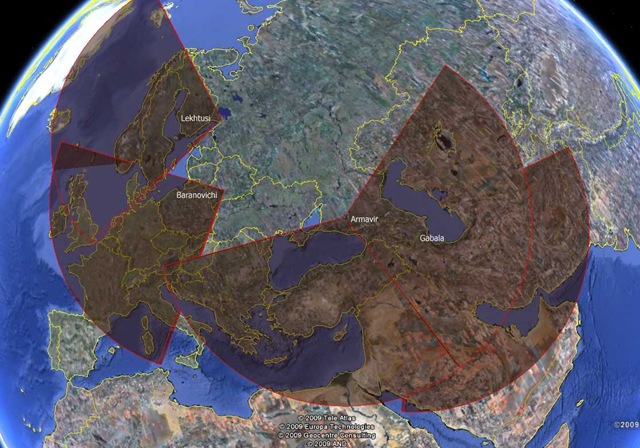
According to Russian media sources, early this morning the Russian early warning radar system Armavir run by the Russian Aerospace Defense Forces detected the launch of two missiles in the Mediterranean.  Both missiles were fired in an eastern trajectory and both eventually fell into the sea.  

Russian early warning radars systems
 
First, nobody admitted firing these missiles, in fact everybody denied it, but eventually the Israelis admitted that they did that in a joint operation with the US Navy.  The Israelis claimed that the launch was designed to test the Israeli anti-missile system, but it is at least as likely that it was designed to test the Russian and/or Syrian capabilities and that as soon as it became clear that the missiles were tracked, they were dumped into the sea.  This was probably not an attempt to attack Syria since any objective would require more missiles (typically 5 per target).


Voronezh-DM radar
According to Russian sources the Syrian air defenses were not put on high alert and the Russian personnel in Syria was not warned of an incoming attack.

My own take is that this was probably a test designed to see how the Russians and Syrians would be capable of detecting the launch of missiles as far as from the central Mediterranean and if they did, how they would react to the flight of inbound missiles.

I would also add that considering the current situation making such unannounced "tests" is completely irresponsible.  Thank God that the Russians did immediately detect and track these missiles and that the Syrians did not have to assume that they are being attacked.  That kind of reckless behavior is typically of the usual Israeli arrogance.

The other good news is that the Russian defensive network seems to work very well indeed and that this will further deter the US military from attempting any kind of surprise attack.  In a paradoxical way, the Israeli arrogance gave the Russians and the Syrians a very good opportunity to test their interoperability and communication procedures.  With the arrival of dedicated Russian Navy intelligence ships near the Syrian coast the Russian military will have the ability to not only immediately detect any launch as they did today, but also to track the inbound flight of US cruise missiles throughout their flight which will greatly facilitate the work of the Syrian air defenses while offering an additional 'depth' of protection for the Russian Navy task force.

If anybody in Israel or the USA had any illusions about Russian capabilities in the Middle-East the quasi instantaneous response from the Kremlin and the Russian media this morning has completely crushed them.

Good.

The Saker

Friday, November 12, 2010

Secret Revealed: Spying Costs $80 Billion a Year


The annual cost of U.S. intelligence is public for the first time: just over $80 billion for 2010.

Figures released by the government Thursday show $27 billion goes to military intelligence and $53.1 billion covers the CIA and some of the other 16 intelligence agencies.

Steven Aftergood, a secrecy specialist at the Federation of American Scientists, says it is "the most complete disclosure we have ever had."

The $80 billion exceeds the $51 billion spent on the State Department and foreign aid programs in 2010. But it's only a tenth of the $814 billion economic stimulus program passed by Congress last year.

The new director of national intelligence, James Clapper, said during his Senate confirmation hearing that it was time to tell the American public the total cost of intelligence.

The last director of national intelligence, retired Admiral Dennis Blair, had revealed in congressional testimony that the 2009 figure was around $75 billion. Clapper said he has convinced Defense Secretary Robert Gates to make it standard practice to release the actual figure.

The military budget goes to places like Army and Navy intelligence and the Defense Intelligence Agency, while some organizations, such as the National Security Agency and the National Geospatial Intelligence Agency, get funding from both budgets, Aftergood says.

The figures drew an immediate pledge to slash intelligence spending from Senate Intelligence Chairwoman Dianne Feinstein, a Democrat. She said intelligence spending had "blossomed to an unacceptable level in the past decade," doubling since the Sept. 11, 2001, terrorist attacks.

Given the U.S. financial situation, "cuts will be necessary," Feinstein said. She did not indicate what programs she would target, but she noted that this year's $27 billion military budget includes supplemental funding for counterterrorism and the wars in Afghanistan and Iraq.

Feinstein has spoken out in hearings this year about the high cost of satellite intelligence. While most figures for such programs are classified, the National Geospatial-Intelligence Agency awarded roughly $7 billion in contracts to two commercial satellite providers this year.

The increased satellite surveillance has been credited with providing the information needed for more accurate CIA Predator drone strikes against militants in the lawless tribal areas of Pakistan, and in aiding special operations strikes against militants in Afghanistan, as well as sites in Africa.

Friday, July 9, 2010

US and Russia swapping 'spies'

(Carlo - I reply to your emails via this post for all, I hope you don't mind - VS)

Now its official: the USA and Russia have swapped 'spies'. Or are they?!

Well, the Russians have for sure released some very real spies, including a nuclear scientist and even a former GRU Colonel (now that there is no death penalty in Russia, this guy should, IMHO, have received life without parole. An agency like the GRU simply cannot afford to have traitors in its midst).

But does that make the Russian 'spies' in the US any more real? I absolutely do not think so. I have no idea why the Russian government agreed to this deal and I very much regret that it did. I would have loved to see these absolutely ridiculous accusations cross-examined. Of course, the US regime could have done what it does so often - ordered a secret trial. So from the humanitarian point of view, I am happy for the 11 "spies" that they are now back in Russia. Except for the case of Sergei Skripal, I see nothing wrong with the Russians expelling a number of spies to get their nationals back.

But does that make them real SVR 'illegals'? Of course not.

So maybe some other agency was involved. Under Eltsin there was a quasi constant "reforming" of the Russian intelligence community with constant name changes, boss changes, missions changes, fusion of agencies, etc. etc. Eltsin's notorious bodyguard Korzhakov even created his own, as did all the big "new Russian" oligarchs and many banks. And since the "private sector' and the Russian mob are really so intertwined as to be indistinguishable, God only knows how many private spy agencies or "for hire" spy agencies are out there. These 11 could have been linked to any of them.

Another thing which supports this version is that, at least according to the FBI, these guys have been monitored for a full decade. Well, if the FBI monitored them for a full decade, that means that whatever training or preparations they got was in the mid to late 1990s - exactly during the infamous Eltsin years. And one can easily imagine that what these 11 did was to get the hell out of a crisis ravaged Russia and then flashed a middle-finger to Eltsin's wannabe spy masters. After all, it is quite clear from the FBI documents that even though these 11 were monitored during a decade, they did absolutely nothing illegal. In other words, they were happy to enjoy their new lives and did not give a damn about spying.

In theory, it is conceivable that this could have happened with the SVR but I honestly don't think so. I have had the opportunity to meet a number of former PGU SSSR (First Main Directorate of the KGB, the external intelligence branch, which then became the SVR) officers in the mid 1990s and while they were not happy about the situation of their agency, they did not report an apocalyptic collapse down to a "kindergarten level" of spy playing.

My guess is therefore that these 11 were the product of some semi-private operation which the Russian government today is embarrassed by and this is why they agreed to the exchange.

The Saker

Wednesday, March 4, 2009

The Electronic Frontier Foundation (EFF) has created the Surveillance Self-Defense website

From the EFF's SSD home page:
The Electronic Frontier Foundation (EFF) has created this Surveillance Self-Defense site to educate the American public about the law and technology of government surveillance in the United States, providing the information and tools necessary to evaluate the threat of surveillance and take appropriate steps to defend against it.

Surveillance Self-Defense (SSD) exists to answer two main questions: What can the government legally do to spy on your computer data and communications? And what can you legally do to protect yourself against such spying?

Go to the SSD website (https://ssd.eff.org/home) and read it all for yourself!

I would add a few comments on my own.

First, if you have any reasons to fear a government then you should never use any computers at all, at least none which belong to you. Basically, you need to pretend that ANYTHING that goes on the Internet will become public knowledge. Only use computers which are not traceable to you in any way (usage, contents of transmission, physical location and monitoring, etc.).

Second, you need to assume that ANY computer you have at home, or in your car, or in your office, will be not only electronically penetrated, but physically seized.

Third, do not use encryption for anything not 100% legal and politically correct. You HAVE to assume that Uncle Shmuel can - and will - decrypt all your encrypted communications or stored data. The truth is that Uncle Shmuel can probably not do this, but you have to assume he can. Encrypted data is like a 'red flag', like I beacon of sorts yelling "I am hiding something! I am hiding something!" - at least that is what the bad guys think. So *never* use it for anything illegal or politically incorrect (that can get you blacklisted also), but DO use as much encryption as you can if you do only 100% Uncle Shmuel approved stuff as this overloads their snooping infrastructure.

So, you might ask, is it possible to use the Internet and defeat the government spooks? Yes, of course, but chances are you do not know how - so don't try. You need to understand how networks work, what triggers suspicion, what kind of encryption is really solid, etc. Most of you probably don't, and knowing just a little is even more dangerous than simply operating by the three basic assumptions above.

The main thing: do not attract attention, do not be noticed. Bury yourself deep in the 'background noise' of the Internet.

You cannot built a fortress against the big guys, not a legal one, not a technological one. Once they see you - you are dead. So remain unseen.

But do check out the SSD website. It's a good basic reading.

Good luck!

Thursday, November 13, 2008

So who is really getting US intelligence support in the greater Middle-East?

I have been observing for a while how almost every party in the greater Middle-East is accusing its opponents of benefiting from US support in general and of US intelligence support in particular. The Iranians accuse the US of helping the Kurds, the Kurds accuse the US of being in league with Iran, the Israelis are accused of supporting both Turkey and the Kurds, the Maliki regime is accused of being a puppet to both the USA and Iran, the Afghans and the Pakistanis are US allies, even though they both oppose US policies in the region, etc. etc. etc.

Everybody is accusing everybody of being a "US puppet" (and many of them are), and everybody is accusing everybody of getting US intelligence support. Is that something likely?

Let me make clear from the start that I have no first hand knowledge whatsoever of what the USA, or anyone else, does or does not do. I have never worked for, or with, any US intelligence agency either, but I still have some experience in this kind of issues and I would like to share some of it with you.

Intelligence sharing is a tricky and rather formal process which is very strictly regulated. Since any intelligence sharing does reveal something about methods and means, the decision to pass on intelligence to any foreign national cannot be taken lightly and potentially can land you in jail unless you carefully cover your bureaucratic rear end. So how is it done?

Well, first and foremost, it is done through formal intelligence sharing agreements between two countries or within a formal alliance. There can be no doubt whatsoever that Turkey, for example, benefits from US intelligence sharing and vice-versa. Typically, intelligence which is jointly collected is also shared, although in some cases some are "more equal than others" and my guess is that Turkey gets *less* intelligences from US operations inside Turkey or operating from Turkey (say from the AWACS flights from Incirlik) than, say, the UK . Turkey being a NATO member also entitles it to the intelligence which is typically shared inside the Alliance. Of course, there might be some far more sensitive stuff happening in parallel to these more formal arrangements such as, for example, the intelligence shared between Israel and Turkey. Israel is, of course, a special case to begin with since it has absolutely no formal alliance or treaty of any kind with the USA while at the same time having access to information which other NATO member countries will never get. But let's set the Israeli case aside for a moment as it is highly atypical for what is the norm in the intelligence world.

Intelligence exchanges happen by various ways including computer access given to various databases, special emailed newsletter style reports, special briefings, etc.. Also, joint seminars are often organized between the intelligence agencies of two or more countries. Sometimes this type of information identifies the country of origin, and sometimes not (in which case the euphemism "partners" is used). What is almost never shared are the sources, means and methods, but any intelligence analyst can make some educated guesses about that based on the type of intelligence received.

To suppose that the kind of intelligence sharing described above can happen between, say, the USA and Iran is utter nonsense, if only because of the highly formal and regulated arrangements needed to make that happen. However, there is another kind of very different intelligence sharing which still might occur between two countries which are officially rather hostile to each other: issue-specific intelligence. For example, if, say, a US diplomat is abducted in Afghanistan, the Americans might decide to approach the Iranians to see if they will agree to share some valuable info. The reality is that all intelligence agencies talk to each other, all of them - even fierce enemies - but that kind of contact will have to be cleared at the very top level and will not be in any way regular or systematic. As an aside here, I would only add that all Western governments stay in informal contact with putatively "terrorist" organizations like Hezbollah or Hamas who, in turn, maintain informal representatives in most Western countries. If it transpired that the German government has been maintaining a regular contact with a PKK liaison officer in Germany I would not be surprised one bit. However, "contacts" does *not* mean "intelligence sharing" and it is important not to conflate the two.

Another, very different, case is the case of the rogue intelligence agency. That is the kind of stuff which can happen in a country in which the intelligence agency is really not controlled by anyone in the Executive Branch, a situation when an intelligence agency is more of a "secret service" kind of outfit. I suppose that the perfect example of this would be the Pakistani ISI which, I suspect, is literally capable of doing anything, including sharing intel with al-Qaeda. Keep in mind that in this case, this does not even need to be an ISI specific issue. It could well be that some branch of the ISI could be sharing intel with al-Qaeda without the top bosses, or the other branches of ISI, even being aware of that. That kind of stuff is dangerous to those doing it, it can land them in front of a firing squad, but in highly dysfunctional countries like Pakistan it can, and does, happen.

But the case of the USA is very different: although the US is not the single actor which it is often assumed to be and the Pentagon, the State Department and the CIA might have very different interests there are limits on what this competition entails: they will compete with each other and try to promote their respective proxies, but this kind of stuff will not involve illegal intelligence sharing if only because that can land the people engaged in it behind bars. It is one thing to advance your bureaucratic interests, but quite another to break the law. One should "never say never", I suppose, but I really cannot imagine this kind of stuff happening in the US intel community (even Pollard got hard jail time for giving info to Israel!).


Then there is the case of tactical or battlefield intelligence sharing. This is far less complex an issue and informal and formal arrangements can be easily made to, say, pass on intel on the movement of refugees, insurgent attacks or the constant flow of various rumors floating around any conflict. Forces operating jointly will always share intelligence, but that is something which is done overtly and is not our concern here.

[I get on my soap box for a short digression...]

All this makes it sound like intelligence is something very valuable and "hot". It is not. Mostly, it is bullshit. I mean this. Most intel includes utterly boring stuff like personnel lists in various military units, deployment location or a bio of the commanding officers. It might be technical stuff, like photos, schematics of machinery or information about the tire pressure of the trucks of the opposing side. A lot of intel is also analysis and much of that is really a paraphrase of what you would find in the papers. In fact, about about 80 percent of all the intel a government uses is available from open sources, another 10-15 percent is from proprietary sources such as corporate info, and only a small 10-5 percent is really classified stuff and most of the latter is boring anyway (though typically getting this 5-10% of info will cost about 80% of your intel budget). I have always suspected that secrecy laws are often used to conceal the banality of the classified info, or to shamelessly copy newspaper editorials. Of course, secrecy is also the ultimate cover for corruption, but that is another topic.

[I get off my soap box, end of digression...]

Having outlined some - though not all - of the feature of the world of intel sharing, let me know make some guesses about what kind of intel the US might give the various actors in the greater Middle-East by putting countries and forces into several groups:

A) the allies: tier one

Turkey and Israel get the lion's share of good, actionable, US intel sharing, no doubt here. I suppose that while the US does not share all of its strategic intel with these two countries, they do get the bulk of the info relevant to the greater Middle-East. I suspect that these countries operate many joint intelligence collection and analysis efforts and that they jointly evaluate the intel output with exchanges of liason officers and intel regular seminars. In other words, this is just about as high-quality intelligence sharing as it can get.

B) the allies: tier two

Saudi Arabia, Egypt, Pakistan, Jordan. These guys are probably not trusted by the US which has to be very careful about potential leaks from these countries. I suspect that while the US probably gets lots of medium to low quality human intelligence from these countries, it probably only "reciprocates" by passing unto them "bullshit" level intel, mostly stuff which the US wants these guys to have anyway. There might be some more valuable intel exchanges taking place with specific individuals in these countries (such as Bandar), but this is probably more of a White House thing. I might be wrong here, but I just don't see any critical intel being passed to these hyper-corrupted regimes.

C) the allies: tier three

The Maliki and Karzai government, Fatah, various Kurdish groups, Northern Alliance types in Afghanistan, Syria. These guys are mostly (but not exclusively) puppets of the CIA & Co. so to speak of any kind of intelligence sharing is inappropriate. The US probably gives them only what is needed to have them do whatever it is that the US wants them to do. Think of it as a strategic "need to know" kind of arrangement. The Americans also probably pump them for everything they can just in order to compensate for the traditionally crappy US HUMINT capabilities and to keep an eye on them and keep them in line.

D) the irrelevant good guys

Koweit, UAE, Yemen, etc. These guys get intel for the US for sure, if only to make them feel like they matter, like the US supports them. Reading the Wall Street Journal or the Economist would be just as good, but it would lack the fancy "secret" stamp.

E) the bad guy(s?)

Iran. Iran is the officially designated "bad guy" in the Middle-East. Under the ever watchful eye on the Israelis, the US might share situation-specific intel with Iran if and when the US needs it. This kind of intelligence would in no way include actionable or strategic intelligence such as overhead satellite imagery or the location of anti-Iranian forces covertly operating in Iran or Iraq. The level of anti-Iranian paranoia in the USA is such that I suspect that even info on common enemies such as the Taliban are not shared by the US. I strongly suspect that the Iranians would have approached the Americans on many occasions offering to collaborate against common enemies, but that the Americans stupidly refused, blinded as they are by their Zionist-induced propaganda about Iran. Following the "redirection" - essentially a strategic anti-Shia offensive across the region - I suspect that not only intelligence sharing, but even regular contacts with the Iranians have been stopped. Also, keep in mind that intelligence activities are, at least in theory, overseen by Congress and that no US Congressman or Congresswoman will ever, ever, allow anything which could be even remotely construed as "pro-terrorist" or "unfriendly to Israel" (God forbid!) to ever happen. All this makes any intel exchanges with Iran highly unlikely, if not unthinkable. (As an aside here I would note that, in contrast, exchanges between Iran and Turkey on the Kurdish issue is something quite possible).

Now, I know that the Iran-bashers will retort that the Iran-Contra affair proves just the opposite. It does nothing of the sort, quite to the contrary, in fact. Nevermind that Iran Contra happened a long while ago - the real important thing is that Iran-Contra was *exactly* the kind of rogue operation which does not normally occur in a developed country. If anything, the fact that Iran Contra, as well as Office of Special Plans set up by the Neocons, were abject and embarrassing failures proves that such arrangements are not possible within the "regular" US intelligence community.

As I mentioned in the begging of the piece, all I present here are my "guesstimates" and I freely admit that I might be wrong. If so, I would be most interested in hearing opposing views, hopefully backed by some facts

Wednesday, October 1, 2008

Pakistan spy chief sacked to please US?

Press TV reports:

Speculation is rife that the US is behind a massive shake up at Pakistan's powerful Inter-Services Intelligence spy agency.

The Inter-Services Intelligence (ISI) agency has been called a 'state within a state' due to its immense power. Time magazine has described it as one of the world's most powerful spy agencies.

Now, 10 months after being appointed head of the Pakistani Army, General Ashfaq Kayani, easily one of the most powerful men in Pakistan, has transformed the ISI leadership.

Former ISI Director General, Lieutenant-General Nadeem Taj, has been replaced by General Ahmed Shujaa Pasha (see photo) as part of a wide ranging overhaul of ISI top brass. In addition, the two-star generals at the ISI in charge of liaison with Islamist groups and with internal Pakistani politics, Asif Akhtar and Nusrat Naeem, have been "superseded" or denied promotion.

The new appointments come at a time of high tension between Islamabad and Washington. A series of unauthorized US military air strikes and ground offensives have killed dozens of Pakistani civilians in recent months.

The US suspects that loyalties within the ISI may partially lie with the Taliban, with whom the spy agency worked closely before the 9/11 attacks in New York. The US has also accused the ISI of being involved with the bombing of the Indian embassy in Kabul in July. Pakistan has denied all allegations.

In light of such fears, the US has repeatedly demanded change. On September 16, the US Assistant Secretary of State for South and Central Asian Affairs publicly demanded that the ISI be reformed.

Last week Pakistan's newly elected President, Asif Ali Zardari, held an unpublicized meeting with Michael Hayden, head of the US Central Intelligence Agency (CIA), according to a report in the New York Times. Amid mounting US pressure for ISI reform, they apparently discussed what the CIA describes as "the double game played by Pakistan's spy agency." Hayden reportedly gave Pakistani Prime Minister, Yousaf Raza Gillani, a template for "ISI reform" in July.

Officials in both Islamabad and Washington have rejected the accusation that changes to the ISI leadership were engineered by the United States.

The new appointee, General Pasha, is known among military analysts as a "professional soldier." In August, he accompanied General Kayani to a secret, highly unusual meeting between top Pakistani military leaders and American commanders, including the chairman of the Joint Chiefs of Staff, Admiral Mike Mullen, on the US aircraft carrier Abraham Lincoln.

Time magazine reported Tuesday, that one of Kayani's key priorities has been to restore relations between Washington and the Pakistan military which has received over $6 billion in US military aid since 2001.

Tuesday, May 20, 2008

You wonder why the US intelligence community and associated think thanks are wortheless?

Many thanks to Cem for drawing my attention to the Counter Terrorism blog's recent posts

You want to know that the War Party is thinking nowadays? A good place to figure this out is to look at one of their websites: the Counter-Terrorism blog. There you will see the following entries:

* Turkish Ambassador to U.S. Calls Iran "a threat to Turkey as well as to the U.S."

* Is Hezbollah the Premier Non-State Threat?

Nevermind the fact that Iran and Turkey have been collaborating against the Kurds, nevermind that Turkey and Iran have had regular high-level diplomatic relations, nevermind that the very idea of Iran threatening Turkey is laughable. Now Iran has been upgraded to a "threat to Turkey".

As for Hezbollah, nevermind that there is not a single shred of evidence that it ever conducted any terrorist activities and that is is both a political party and a national liberation movement. Hezbollah is now "the number one non-state threat".

Does that mean that the folks at Counter-Terrorism blog really believe this?

Not at all.

I know the world of US think tanks very well and I can vouch to the following: think tanks are first and foremost in the business of making money. They know *exactly* what to say and what to write to get more "research grants". For example, in the early nineties, a good friend of mine worked at a major Washington DC think tank where she was in charge of writing a report about "Star Wars" and (intercontinental) ballistic missile defense. She showed me a draft version of her report I was appalled to see that it was all full of certain praise for that wasteful and unfeasible concept. When I told her that this was "total garbage" she laughed and said "sure it is, but that is what they pay us to write".

What is even more shocking is that EXACTLY the same is happening inside the US intelligence community. How do you think will get promoted first - the guy who says Iran wants nukes, or the one who says it does not? The latter one will be lucky to keep his job! And what is true for one analyst is also true for an entire think tank or even an entire intelligence agency.

The fact is that all this so-called "analytical" community (whether contracted think thanks or the federal intelligence community) is staffed with spineless bureaucrats who are firs and foremost preoccupied with their careers and getting "research money".

The same stuff is happening all over the world. I have seen previously competent intelligence agencies bled dry from ALL their expert analysts who were gently (or not so gently) "pushed out" and replaced by bureaucrats with excellent political skills but no expertise whatsoever (good thing most intelligence reports are classified; otherwise the entire world would see what kind of crap these dorks write!)

Now that a war with Iran is a virtual certainty we can expect a deluge of "analytical" reports, conferences, seminars and symposiums all dedicated to analyzing the "Iranian threat". The Counter Terrorism blog is just the tip of the iceberg: you would see exactly the same at RAND, CSIS or Brookings (nevermind the Heritage Foundation or AEI).

It is rather ironic that the country which worships capitalism and greed has ended up having its "brains" (which is, presumably, what the intelligence community is supposed to be) literally corrupted and rendered useless by the greed and financial mechanism of "free market competition" in the sphere of analysis.

Saturday, May 10, 2008

Aaron Zeevi Farkash: 'Nasrallah Ruined 3 years of Arab, Foreign Intel Efforts'

by Mohamad Shmaysani for al-Manar

The former head of Israel's intelligence Aaron Zeevi Farkash said that he had warned Washington against relying on its allies in Lebanon. "We advised the CIA not to rely on Walid Jumblatt or Saad Hariri because we tested them in 2006 and they proved helpless in the face of Hezbollah."

In an interview with Filkka-Israel site on the internet, Zeevi stressed "Israel has given Lebanese Forces (of Samir Geagea) men the best training and they will appear in any future confrontation. Lebanese Forces fighters will hold on much longer in Hezbollah's faces, but eventually they will be defeated."

The former intelligence chief said Tel Aviv and Washington are in a dilemma because "no force in Lebanon can strike Hezbollah and we are not ready yet to take this step. All the Americans can do is send some guards to the dwellings of Saniora, Jumblatt and Hariri."

When asked if the Americans are going to embark in Lebanon, Zeevi said that "this is what Condi told Saniora. He was collapsed and accused Jumblatt of cowardice and fleeing from the battle. So she promised Saniora to get a presidential decree to send the Marines to central Beirut only to protect his headquarters."

The reporter asked Zeevi about the reason behind the failure of the assassination plot against Hezbollah's chief Sayyed Hasan Nasrallah on the 25th of April. "I don't know why, but killing Nasrallah was not impossible with the presence of thousands of Lebanese informers working with the Americans. Everything is lost now. Three years of intelligence efforts by international and Arab sides have gone overnight. Most intelligence agents have left Beirut and the Lebanese are no longer able to move under the cover of their daily mission, each according to his rank in some security services. The west has lost a lot after Nasrallah surprised their allies," Zeevi said.

On the assassination of top resistance commander martyr Imad Moghniyeh, Zeevi revealed that a "Lebanese side had provided Israel with the picture of Moghniyeh showing his real face. Only one person knew who (Hajj Radwan) was. He is a Lebanese leader whose security body was trained by Moghniyeh."

When the reporter asked: Is he Jumblatt?

Zeevi said: No comment.

Sunday, March 30, 2008

Russian Military Intelligence Sees U.S. Military Buildup on Iran Border

THE FOLLOWING IS A ONE YEAR OLD REPORT PICKED UP BY MISTAKE:

MOSCOW, March 27 (
RIA Novosti) - Russian military intelligence services are reporting a flurry of activity by U.S. Armed Forces near Iran's borders, a high-ranking security source said Tuesday.

"The latest military intelligence data point to heightened U.S. military preparations for both an air and ground operation against Iran," the official said, adding that the Pentagon has probably not yet made a final decision as to when an attack will be launched.

He said the Pentagon is looking for a way to deliver a strike against Iran "that would enable the Americans to bring the country to its knees at minimal cost."

He also said the U.S. Naval presence in the Persian Gulf has for the first time in the past four years reached the level that existed shortly before the invasion of Iraq in March 2003.

Col.-Gen. Leonid Ivashov, vice president of the Academy of Geopolitical Sciences, said last week that the Pentagon is planning to deliver a massive air strike on Iran's military infrastructure in the near future.

A new U.S. carrier battle group has been dispatched to the Gulf.

The USS John C. Stennis, with a crew of 3,200 and around 80 fixed-wing aircraft, including F/A-18 Hornet and Superhornet fighter-bombers, eight support ships and four nuclear submarines are heading for the Gulf, where a similar group led by the USS Dwight D. Eisenhower has been deployed since December 2006.

The U.S. is also sending Patriot anti-missile systems to the region.
-------

Commentary: General Ivashev is an interesting figure whom I happen to know personally (although not intimately; we met in the mid nineties and I have not seen him in many years). On one hand, he is closely connected to the Russian military intelligence service (the GRU), while on the other he is definitely an outspoken critic of the USA and of NATO. He clearly would have an interest in spreading any information detrimental those whom he sees as implacable foes of his country

Also, I have to note here that even though General Ivashev has been warning of a US attack on Iran many times already, this attack has not happened so far. Of course, this could be due to the fact that it was called off at the latest moment (I believe that this exactly what happened on at least one occasion).

Whatever the motives of General Ivashev's most recent declaration, his warnings should be taken very seriously because he is *exactly* the type of figure which the GRU would use to leak out classified information. Here is why:


1) General Ivashev has numerous connections inside the otherwise highly secretive GRU.
2) General Ivashev is popular and trusted among many top GRU officers.
3) General Ivashev cannot be sanctioned or, for that matter, even investigated for being the source of any leaks

While General Ivashev is hated by the Imperial press corps for being a "hardliner" (which he definitely is not, I can vouch for that), and while his latest statements will be dismissed or ignored, I would take his warnings extremely seriously.

The Saker

Sunday, February 17, 2008

Director of National Intelligence says Syria or Hezbollah faction might be involved in Mughniyah assassination

According to Haaretz, the U.S. intelligence chief said Sunday that internal Hezbollah factions or Syria may be to blame for the killing of top Hezbollah commander Imad Mughniyah last week.

Ok, I know all the caveats which one should be aware of when quoting somebody like Mike McConnell and I agree with all of them. Yes, this might be a way of blaming Syria in order to further divide the anti-US countries and forces in the Middle-East. Still, this might also be the professional opinion of a Director of National Intelligence whose analysts are crying to high heaven that the 'official' version makes no sense at all. Whatever may be the case here, I am sure that more and more people with experience in intelligence operations will speak up and raise the issue of Syria's role.

Thursday, January 24, 2008

Turkish-Israeli intelligence cooperation bolstered by high-level contacts

The following was sent to me by a correspondent to whom I am very grateful for this interesting item. I cannot vouch for the accuracy of the translation. VS

ANKA News Agency, 21 January 2008

Former Prime Minister and current Defense Minister Ehud Barak will visit Turkey in February at the invitation of his Turkish counterpart Vecdi Gönül.

Diplomatic sources said that the purpose of Barak's visit to Turkey is to maintain dialogue between the two countries in the field of defense.

Problems relating to the security of the region, co-operation in the field of defense industry and "intelligence sharing" in the fight against terrorism will be on the agenda. In this context, an increase in intelligence co-operation is expected.

It was noted that the issue of Chief of the Turkish General Staff Ya şar Büyükanıt's postponed visit to Israel may also be raised during this visit.

(link to the original item in Turkish: http://www.haber7.com/haber.php?haber_id=294658)

Wednesday, January 23, 2008

The situation in Gaza is the proof of a stunning Israeli intelligence failure

The developments in Gaza are the proof that the Israeli intelligence services are the most over-rated on the planet. Long gone is the "Entebbe" image of a daring and all-knowing Israeli intelligence community and as more information comes in about the recent developments in Gaza one is lead to wonder how incompetent the Israelis really are.

Times Online has revealed that Hamas 'spent months cutting through Gaza wall in secret operation' and that the Islamist group was responsible and had been involved for months in slicing through the heavy metal wall using oxy-acetylene cutting torches. That meant that when the explosive charges were set off in 17 different locations after midnight last night the 40ft wall came tumbling down, leaving it lying like a broken concertina down the middle of no-man's land as an estimated 350,000 Gazans flooded into Egypt. Lieutenant Abu Usama of the Palestinian National Security, said of the cutting operation: "I've seen this happening over the last few months. It happened in the daytime but was covered up so that nobody would see."

This begs the question of how the Israeli security complex (for which 1 in 6 Israelis works directly or indirectly) could miss something like this being prepared for months right under its nose? Israel has total intelligence control over Gaza. With numerous listening facilities monitoring all communications in and out of Gaza, with many times of drones flying over this small piece of land, with presumably hundreds of Palestinians agents (recruited in Israeli jails) providing human intelligence (HUMINT) it is baffling to see that, yet again, the Israelis seem to have been caught off guard.

This goes way beyond the narrow intelligence collection issue though.


Even more baffling is the question of how Israeli analysts failed to predict that a blockade would built the pressure towards some type of action towards Egypt. There are plenty of sharp Israeli analysts who could have made such a prediction and my sense is that the Israeli intelligence community is suffering from the same kind of politicization which has so catastrophically crippled the US intelligence community: the 'nay-sayers' and other critical minds are forced out and only ass-kissing bureaucrats are left to do the job.

In a way, Gaza is "Israel's 911": a vivid proof of a systemic dysfunction, a manifestation of a decay and collapse of a socio-political structure wholly unable to cope with its environment. An Empire relying on the two most incompetent and ineffective intelligence communities in the world (the USA 's and the Israeli) cannot survive for very long, not when faced with sophisticated and highly capable foes. As the saying goes, "the fish rots from the head".

Thursday, September 27, 2007

B-52 Nukes Headed for Iran, Not For Decommissioning: Airforce Refused

By Wayne Madsen

WMR has learned from U.S. and foreign intelligence sources that the B-52 transporting six stealth AGM-129 Advanced Cruise Missiles, each armed with a W-80-1 nuclear warhead, on August 30, were destined for the Middle East via Barksdale Air Force Base in Louisiana.

However, elements of the Air Force, supported by U.S. intelligence agency personnel, successfully revealed the ultimate destination of the nuclear weapons and the mission was aborted due to internal opposition within the Air Force and U.S. Intelligence Community.

Yesterday, the Washington Post attempted to explain away the fact that America's nuclear command and control system broke down in an unprecedented manner by reporting that it was the result of "security failures at multiple levels." It is now apparent that the command and control breakdown, reported as a BENT SPEAR incident to the Secretary of Defense and White House, was not the result of a command and control chain-of-command "failures" but the result of a revolt and push back by various echelons within the Air Force and intelligence agencies against a planned U.S. attack on Iran using nuclear and conventional weapons.

The Washington Post story on BENT SPEAR may have actually been an effort in damage control by the Bush administration. WMR has been informed by a knowledgeable source that one of the six nuclear-armed cruise missiles was, and may still be, unaccounted for. In that case, the nuclear reporting incident would have gone far beyond BENT SPEAR to a National Command Authority alert known as EMPTY QUIVER, with the special classification of PINNACLE.

Just as this report was being prepared, Newsweek reported that Vice President Dick Cheney's recently-departed Middle East adviser, David Wurmser, told a small group of advisers some months ago that Cheney had considered asking Israel to launch a missile attack on the Iranian nuclear site at Natanz. Cheney reasoned that after an Iranian retaliatory strike, the United States would have ample reasons to launch its own massive attack on Iran. However, plans for Israel to attack Iran directly were altered to an Israeli attack on a supposed Syrian-Iranian-North Korean nuclear installation in northern Syria.

WMR has learned that a U.S. attack on Iran using nuclear and conventional weapons was scheduled to coincide with Israel's September 6 air attack on a reputed Syrian nuclear facility in Dayr az-Zwar, near the village of Tal Abyad, in northern Syria, near the Turkish border. Israel's attack, code named OPERATION ORCHARD, was to provide a reason for the U.S. to strike Iran. The neo-conservative propaganda onslaught was to cite the cooperation of the George Bush's three remaining "Axis of Evil" states -- Syria, Iran, and North Korea -- to justify a sustained Israeli attack on Syria and a massive U.S. military attack on Iran.

WMR has learned from military sources on both sides of the Atlantic that there was a definite connection between Israel's OPERATION ORCHARD and BENT SPEAR involving the B-52 that flew the six nuclear-armed cruise missiles from Minot Air Force Base in North Dakota to Barksdale. There is also a connection between these two events as the Pentagon's highly-classified PROJECT CHECKMATE, a compartmented U.S. Air Force program that has been working on an attack plan for Iran since June 2007, around the same time that Cheney was working on the joint Israeli-U.S. attack scenario on Iran.

PROJECT CHECKMATE was leaked in an article by military analyst Eric Margolis in the Rupert Murdoch-owned newspaper, the /Times of London/, is a program that involves over two dozen Air Force officers and is headed by Brig. Gen. Lawrence Stutzriem and his chief civilian adviser, Dr. Lani Kass, a former Israeli military intelligence officer who, astoundingly, is now involved in planning a joint U.S.-Israeli massive military attack on Iran that involves a "decapitating" blow on Iran by hitting between three to four thousand targets in the country. Stutzriem and Kass report directly to the Air Force Chief of Staff, General Michael Moseley, who has also been charged with preparing a report on the B-52/nuclear weapons incident.

Kass' area of speciality is cyber-warfare, which includes ensuring "information blockades," such as that imposed by the Israeli government on the Israeli media regarding the Syrian air attack on the alleged Syrian "nuclear installation." British intelligence sources have reported that the Israeli attack on Syria was a "true flag" attack originally designed to foreshadow a U.S. attack on Iran. After the U.S. Air Force push back against transporting the six cruise nuclear-armed AGM-129s to the Middle East, Israel went ahead with its attack on Syria in order to help ratchet up tensions between Washington on one side and Damascus, Tehran, and Pyongyang on the other.

The other part of CHECKMATE's brief is to ensure that a media "perception management" is waged against Syria, Iran, and North Korea. This involves articles such as that which appeared with Joby Warrick's and Walter Pincus' bylines in yesterdays /Washington Post/. The article, titled "The Saga of a Bent Spear," quotes a number of seasoned Air Force nuclear weapons experts as saying that such an incident is unprecedented in the history of the Air Force. For example, Retired Air Force General Eugene Habiger, the former chief of the U.S. Strategic Command, said he has been in the "nuclear business" since 1966 and has never been aware of an incident "more disturbing."

Command and control breakdowns involving U.S. nuclear weapons are unprecedented, except for that fact that the U.S. military is now waging an internal war against neo-cons who are embedded in the U.S. government and military chain of command who are intent on using nuclear weapons in a pre-emptive war with Iran.

CHECKMATE and OPERATION ORCHARD would have provided the cover for a pre-emptive U.S. and Israeli attack on Iran had it not been for BENT SPEAR involving the B-52. In on the plan to launch a pre-emptive attack on Iran involving nuclear weapons were, according to our sources, Cheney, National Security Adviser Stephen Hadley; members of the CHECKMATE team at the Pentagon, who have close connections to Israeli intelligence and pro-Israeli think tanks in Washington, including the Hudson Institute; British Foreign Secretary David Miliband, a political adviser to Tony Blair prior to becoming a Member of Parliament; Israeli political leaders like Prime Minister Ehud Olmert and Likud leader Binyamin Netanyahu; and French Foreign Minister Bernard Kouchner, who did his part last week to ratchet up tensions with Iran by suggesting that war with Iran was a probability. Kouchner retracted his statement after the U.S. plans for Iran were delayed.

Although the Air Force tried to keep the B-52 nuclear incident from the media, anonymous Air Force personnel leaked the story to /Military Times/ on September 5, the day before the Israelis attacked the alleged nuclear installation in Syria and the day planned for the simultaneous U.S. attack on Iran. The leaking of classified information on U.S. nuclear weapons disposition or movement to the media, is, itself, unprecedented. Air Force regulations require the sending of classified BEELINE reports to higher Air Force authorities on the disclosure of classified Air Force information to the media.

In another highly unusual move, Defense Secretary Robert Gates has asked an outside inquiry board to look into BENT SPEAR, even before the Air Force has completed its own investigation, a virtual vote of no confidence in the official investigation being conducted by Major General Douglas Raaberg, chief of air and space operations at the Air Combat Command.

Gates asked former Air Force Chief of Staff, retired General Larry Welch, to lead a Defense Science Board task force that will also look into the BENT SPEAR incident. The official Air Force investigation has reportedly been delayed for unknown reasons. Welch is President and CEO of the Institute for Defense Analysis (IDA), a federally-funded research contractor that operates three research centers, including one for Office of Science and Technology Policy in the Executive Office of the President and another for the National Security Agency. One of the board members of IDA is Dr. Suzanne H. Woolsey of the Paladin Capital Group and wife of former CIA director and arch-neocon James Woolsey.

WMR has learned that neither the upper echelons of the State Department nor the British Foreign Office were privy to OPERATION ORCHARD, although Hadley briefed President Bush on Israeli spy satellite intelligence that showed the Syrian installation was a joint nuclear facility built with North Korean and Iranian assistance. However, it is puzzling why Hadley would rely on Israeli imagery intelligence (IMINT) from its OFEK (Horizon) 7 satellite when considering that U.S. IMINT satellites have greater capabilities.

The Air Force's "information warfare" campaign against media reports on CHECKMATE and OPERATION ORCHARD also affected international reporting of the recent International Atomic Energy Agency (IAEA) resolution asking Israel to place its nuclear weapons program under IAEA controls, similar to those that the United States wants imposed on Iran and North Korea. The resolution also called for a nuclear-free zone throughout the Middle East. The IAEA's resolution, titled "Application of IAEA Safeguards in the Middle East," was passed by the 144-member IAEA General Meeting on September 20 by a vote of 53 to 2, with 47 abstentions. The only two countries to vote against were Israel and the United States. However, the story carried from the IAEA meeting in Vienna by Reuters, the Associated Press, and Agence France Press, was that it was Arab and Islamic nations that voted for the resolution.

This was yet more perception management carried out by CHECKMATE, the White House, and their allies in Europe and Israel with the connivance of the media. In fact, among the 53 nations that voted for the resolution were China, Russia, India, Ireland, and Japan. The 47 abstentions were described as votes "against" the resolution even though an abstention is neither a vote for nor against a measure. America's close allies, including Britain, France, Australia, Canada, and Georgia, all abstained.

Suspiciously, the IAEA carried only a brief item on the resolution concerning Israel's nuclear program and a roll call vote was not available either at the IAEA's web site -- www.iaea.org -- or in the media.

The perception management campaign by the neocon operational cells in the Bush administration, Israel and Europe was designed to keep a focus on Iran's nuclear program, not on Israel's. Any international examination of Israel's nuclear weapons program would likely bring up Israeli nuclear scientist Mordechai Vanunu, a covert from Judaism to Christianity, who was kidnapped in Rome by a Mossad "honey trap" named Cheryl Bentov (aka, Cindy) and a Mossad team in 1986 and held against his will in Israel ever since.

Vanunu's knowledge of the Israeli nuclear weapons program would focus on the country's own role in nuclear proliferation, including its program to share nuclear weapons technology with apartheid South Africa and Taiwan in the late 1970s and 1980s. The role of Ronald Reagan's Director of the Arms Control and Disarmament Agency Ken Adelman in Israeli's nuclear proliferation during the time frame 1983-1987 would also come under scrutiny. Adelman, a member of the Reagan-Bush transition State Department team from November 1980 to January 1981, voiced his understanding for the nuclear weapons programs of Israel, South Africa, and Taiwan in a June 28, 1981 /New York Times/ article titled, "3 Nations Widening Nuclear Contacts." The journalist who wrote the article was Judith Miller. Adelman felt that the three countries wanted nuclear weapons because of their ostracism from the West, the third world, and the hostility from the Communist countries. Of course, today, the same argument can be used by Iran, North Korea, and other "Axis of Evil" nations so designated by the neocons in the Bush administration and other governments.

There are also news reports that suggest an intelligence relationship between Israel and North Korea. On July 21, 2004, New Zealand's /Dominion Post/ reported that three Mossad agents were involved in espionage in New Zealand. Two of the Mossad agents, Uriel Kelman and Elisha Cara (aka Kra), were arrested and imprisoned by New Zealand police (an Israeli diplomat in Canberra, Amir Lati, was expelled by Australia and New Zealand intelligence identified a fourth Mossad agent involved in the New Zealand espionage operation in Singapore). The third Mossad agent in New Zealand, Zev William Barkan (aka Lev Bruckenstein), fled New Zealand -- for North Korea.

New Zealand Foreign Minister Phil Goff revealed that Barkan, a former Israeli Navy diver, had previously worked at the Israeli embassy in Vienna, which is also the headquarters of the IAEA. He was cited by the /Sydney Morning Herald/ as trafficking in passports stolen from foreign tourists in Thailand, Myanmar, Laos, and Cambodia. New Zealand's One News reported that Barkan was in North Korea to help the nation build a wall to keep its citizens from leaving.

The nuclear brinkmanship involving the United States and Israel and the breakdown in America's command and control systems have every major capital around the world wondering about the Bush administration's true intentions.

NOTE: WMR understands the risks to informed individuals in reporting the events of August 29/30, to the present time, that concern the discord within the U.S. Air Force, U.S. intelligence agencies, and other military services. Any source with relevant information and who wishes to contact us anonymously may drop off sealed correspondence at or send mail via the Postal Service to: Wayne Madsen, c/o The Front Desk, National Press Club, 13th Floor, 529 14th St., NW, Washington, DC, 20045.
Wednesday, August 29, 2007

Intelligence Services, The Media And Anti-Iran Propaganda


Paul Ingram is Senior Analyst at the British American Security Information Council. His subject areas include nuclear non-proliferation and disarmament (with a focus on Iran and the UK); defence economics, particularly subsidies of exports in the UK; and transatlantic security. He is the Chair of Crisis Action, and co-teaches systems thinking and practice on the Top Management Programme at the National School of Government alongside Prof. Jake Chapman.

Mehrnaz Shahabi is on the Editorial Board and CASMII UK Board member. She has interviewed Paul Ingram on the role of the intelligence services in the anti-Iran propaganda in the Western media.

---

Mehrnaz Shahabi: In the months preceding the 2003 invasion of Iraq, the mainstream media in Britain played an instrumental role in softening the public opinion for war by disseminating the US Neo-Conservative propaganda against the Iraqi regime. The key allegations against Saddam Hussein’s regime of harbouring Al-Qaeda terrorists and possession of a clandestine nuclear weapons and other WMD programme were unfounded at the time and all proved to be false after the invasion. The incriminating stories of the infamous UK Iraq Dossier and the supply of uranium yellow cake from Niger to Iraq were shown to be total fabrication.

However, despite these revelations, these same key allegations of harbouring terrorist groups and running an active nuclear weapons programme are now being systematically repeated to pave the way for a military attack on Iran. The media is waging the same relentless propaganda bombardment to clear the path to yet another war, using the same tactics of anonymous sources, distortions and unsubstantiated claims to manufacture consent in a population that predominantly has no appetite for war. What is the mechanism for utilising supposedly independent media in the service of black propaganda? How can journalists and the newspapers get away with this sort of unethical and potentially criminal reporting, in particular, after the illegal invasion of Iraq?

Paul Ingram: They are finding it a little more difficult than in 2002/3. When the official US briefing on the supply of Iranian weapons eventually took place in Baghdad in early 2007, it was greeted by most news agencies with some doubt and even derision. It was clear the promised proof was hardly that. Nevertheless, it is still shocking how the reports of Iranian supply into Iraq, and even to the Taliban in Afghanistan have stuck in so much of the media, so that it is largely reported as background fact.

There are various mechanisms that explain this. Firstly, background briefing by intelligence services and military officials who make access conditional upon favourable reporting. Secondly, it is the nature of the media to generally take their home government policy and statements as mainstream, particularly if the main opposition groups support government policy in this area. Thirdly, there is the power of groupthink – assumptions rapidly take hold and become unquestioned fact, to build up a general picture of the situation, for which, facts that are not consistent are discarded. It is this tendency that means it is so important to question the basis of misleading propaganda continuously. Fourth, some journalists are simply gullible. Fifth, the media is driven by sensation and entertainment.

Mehrnaz Shahabi: The use of anonymous sources and unsubstantiated allegations has been a key feature of the reportage on Iran by the right wing pro-war media, such as the Daily Telegraph, which was behind the most crucial lie used as a pretext for the invasion of Iraq, that is, Saddam’s 45 minutes missile capability to hit European cities. However, this use of black propaganda has now moved on to a higher pitch and taken a substantially dangerous twist, in that, now the so called respectable liberal press, such as the Guardian and the Observer, are churning out highly incriminating and unfounded propaganda against Iran. A recent full front page report by Simon Tisdall of May 22nd accused Iran of “Secret Plan for Summer Offensive to Force US out of Iraq”, using an unnamed US official alleging Iranian links with AlQaeda in organising such an offensive. Again, The Observer front page on 10th June published a story by Mark Townsend alleging a nuclear conspiracy uncovered by the Customs and Excise detectives and the MI6 in which highly enriched uranium from Russia is transhipped through Sudan “destined” for Iran, for its “nuclear weapons programme”. There is reference throughout to claims of anonymous “investigators” without any supporting evidence to substantiate these claims. There is also the open reference to “Iran’s nuclear weapons programme” which is remarkable in the absence of any such evidence by the IAEA inspectors. How can this new development of the active involvement of the Guardian and the Observer in promoting war propaganda be viewed? What forces propagate these allegations to the media? What type of pressure or temptation, and at what level is exerted that causes journalists of more respectable papers reporting stories without posing basic journalistic challenge for substantiation of truth, particularly so when the consequences of such distortions are still unfolding in the bloodbath in Iraq?

Paul Ingram: Even the Guardian and Observer journalists are looking for a sensation to sell their papers. I have to admit though to being a little surprised. It shows the limits of reliability even of some of the better organs of news. The best way to find out would be to ask some trusted journalists. I have not yet had the opportunity.

Mehrnaz Shahabi: The story in the Observer reportedly comes from MI6. The role of M16 in covert domestic and foreign operations and its infiltration and manipulation of media is well documented. One such example is 1953 coup and the overthrow of the popular nationalist government in Iran. An article in the British Journalism Review in 2000 by David Leigh, the respected investigative journalist, the then editor of the Guardian’s comments page and the assistant editor of the Observer, refers to the use by MI6 of “Information Operations” to manufacture consent in public opinion for foreign policy adventures. He details attempts at recruiting journalists, MI6 agents masquerading as journalists, using media pseudonyms to promote stories, and media links to disseminate convenient stories or black propaganda. It is noteworthy that this report names Con Coghlin, the Daily Telegraph author of incriminating stories about Iraq and now Iran, as one such link. However, this knowledge did not hinder Con Coghlin's ability to successfully pedal misinformation that led to the invasion of Iraq, and his current insinuations in relation to Iran. Considering the secret nature of these operations and the use of the Official Secrets Act, how is it possible to pursue such links and uncover the sources behind these stories?

Paul Ingram: I don’t think it would be possible to uncover the sources. Journalists are notoriously careful to cover their sources. The best one can do is to track their previous histories, as CASMII does, and highlight their role in the past, and the role of the security services in using the media to distort opinion in favour of intervention.

Mehrnaz Shahabi: What action can CASMII take now to attempt to ameliorate this situation? How might other organisations, such as Stop the War and the CND, for example, be enlisted effectively to act in this very worrying and cynical use of propaganda?

Paul Ingram: I would contact the Editors of the papers, particularly Alan Rusbridger (Guardian), in a non-hostile manner (expressing incredulity, given the facts etc). My understanding is that the Guardian usually has an unofficial policy on things like this (for example, they have a ‘policy’ against Trident replacement), and it may be possible to have a civil and informative conversation about this. Contact the Press Complaints Commission and ask for a file to be opened that accumulates these stories rather than focusing just on one, as it is the accumulation that CASMII is most worried about, and that demonstrates manipulation.

Other organisations should write letters to the Editor, letters to Press Complaint Commission.

Mehrnaz Shahabi: The Press Complaints Commission, in its recent verdict in favour of the Daily Telegraph’s use of unnamed sources in propagating incriminating stories against Iran, ruled that the burden of proof, for invalidating the claims of these unknown sources, was on CASMII. Clearly this stance opens the floodgates for promoting further unsubstantiated claims which can never be invalidated, as is exemplified by the problem of proving a negative, as in the case of Iraq demonstrating the absence of WMD. It also sets the conditions for the impossibility or great difficulty that any group would have in contesting that an article was black propaganda. In what way might the Press Complaints Commission be brought to account and challenged?

Paul Ingram: Ultimately, it has to be through an MP or Parliamentary group.

Mehrnaz Shahabi: In what way might members of parliament be usefully involved in all the issues above, particularly with respect to MI6’s accountability to the parliament? And, in view of the fact that much of this must be in the domain of the politically aware public, and this must include MPs, do you have any views on the forces that may be rendering concerned MPs helpless, for example, could MPs be caught in a double bind with respect to a conflict between truth and the Official Secrets Act, or foreign policy?

Paul Ingram: The accountability is minimal, and through the Security and Intelligence Liaison Group, a highly select and elite group of MPs. I think you’d have more joy using MPs for their public role, and to get them to instigate campaigns through Parliament. Ultimately, most MPs, even those who may be concerned, will probably think that it’s difficult to know one way or another about Iran’s involvement within Iraq or Afghanistan. Putting one’s neck out if one isn’t clear is a risky game. Last night I watched the film ‘Good night, and Good luck’ by George Clooney (2005), about a courageous CBS team that took on Sen Joe McCarthy. It highlighted almost exactly what we are experiencing. It struck me that George Clooney clearly understands these issues we are talking about, and may be willing to play a role highlighting them. Celebrities are a great way of cutting through to the public – they are trusted much more than politicians!

Mehrnaz Shahabi: Apart from the possibility of some progressive celebrities standing against the American war propaganda, what can the antiwar organisations like CASMII do in the US to expose the role of the CIA and the American military not only in propagating false and distorted stories against Iran but also in their covert operations to destabilize the Iranian government?

Paul Ingram: Ultimately we are engaged in battle over 'hearts and minds' globally, in building support for an alternative perspective of how nations can relate to one another and build justice. The media, in the broadest sense of that term, is the battleground for these ideas. This means providing honest and balanced comment in such a manner that trust is built up with the people. It means being critical of any and all governments where such criticism is appropriate, highlighting their hypocrisy, challenging those that claim the moral high ground while abusing their positions; but also recognising the danger that comes from promoting a truly cynical view of the world … because that in the end only benefits the powerful and undermines justice. This means embracing the positive aspects of the values promoted by the powerful: freedom, equality, democracy, etc., and highlighting to US and European citizenry the ways in which these values are undermined. We need to rebut stories rapidly. We need to probe the inconsistencies, highlight the uncertainties, the complexities, the mess. US and European populations are already tiring of the rush to war in the Middle East, when the costs are high. If the blame is spread and the complexities recognised, it is more difficult for them to pin it all on Iran.

Friday, June 15, 2007

Will the Israelis invade Gaza?

Will the Israelis invade Gaza? Knowing how utterly stupid Olmert and Peretz have proved to be, everthing is possible. But from a military point of view invading Gaza achieves nothing: you get some Israelis killed, you get lots of Palestinians killed, and then you withdraw and you leave Hamas even stronger than it was before. Besides, after the whopping the IDF took in South Lebanon I presume that the troops are not too eager to go into another round of urban warfare.

Grant you - Hamas is not Hezbollah, not even remotely close in fact. But still, fighting in the kind of urban ghetto terrain like Gaza is just not an appealing option. Keep in mind that there are no military valuable objectives. Sure, Hamas took over the main Fatah compounds and I bet you that the Israeli Air Force will take them out shortly, but besides that there is nothing to seize, nothing to control, nothing to destroy other than the Palestinians themselves.

Fighting against elusive combattants amidst 1.4 million people crammed into 130 square miles just makes no sense at all. Also - the Israelis need to realize that there is a real risk of a “contagion effect” to the West Bank. Not militarily - the Israelis have a tight grip on all their (illegal) internal borders - but politically. There are plenty of Hamas sympathizers inside the West Bank which are going to feel encouraged by the events in Gaza. The West Bank is not Gaza, however. Fatah has a much better control over there, the population is comparatively better off and I do not see a repeat of the Gaza scenario for a while. But in 6 months? In a year? Who knows?! This is the Middle-East and things explode really fast there. If I had to make a reccommendation to the IDF General Staff I would reccommend worrying about Lebanon, Syria, the upcoming war with Iran and not about trying to hold on unto Gaza. But with Olmert in power - who knows what these crazies might decide…


Another option is, of course, invasion by proxy: an international peacekeeping force. There are already calls for such an option. Regardless, what matters is that such a force would have to be exactly in the same position as other such forces have been in other conflict areas: either as a "guest" of Hamas, in which case it would do exactly nothing to challenge Hamas, or as an occupying force, in which case it would face the same challenges as the IDF have in the past. Simply put - a peacekeeping force in Gaza solves *nothing*. Frankly, this is yet another delusional concept dreamed up by clueless politicians.

The really amazing thing is: how did Fatah, Israel or the US not get prior warning of this? Or, if the latter two did, why did they not warn Hamas. Or was the infiltration of the US-trained Fatah fighters from Egpypt into Gaza their idea of how to prevent a Hamas takeover? Because if it was - they are mighty stupid to expect Fatah thugs to stand against Hamas fighters. The only chance to prevent what took place would have been to insert several platoon strength mobile combat groups with forward air controllers into Gaza at the main Fatah compounds and ambush Hamas.

If the Israelis and/or the Americans did have prior knowledge of what was about to take place and decided not to take any action at all - then that is again a huge failure of intelligence, but this time not a operational one, but an analytical one. Clearly no doing anything and letting Hamas take over Gaza is a huge strategic blunder the prevention of which was critical for the Imperial strategy in the Middle-East.

That did not happen, and this tells me that the famous US or Israeli intelligence screwed up - as usual, I would add.