Showing posts with label color-coded revolutions. Show all posts

Sunday, December 2, 2012

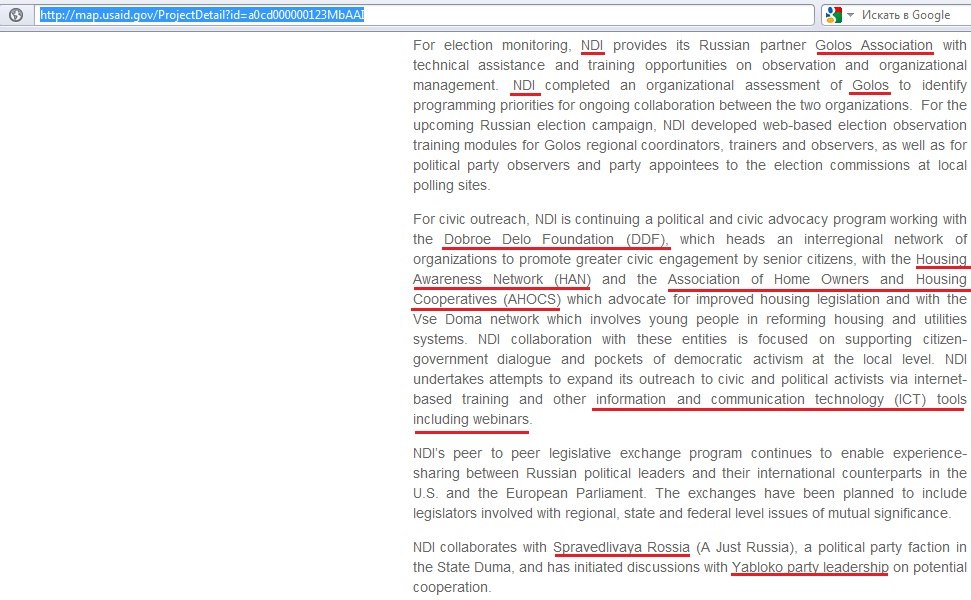
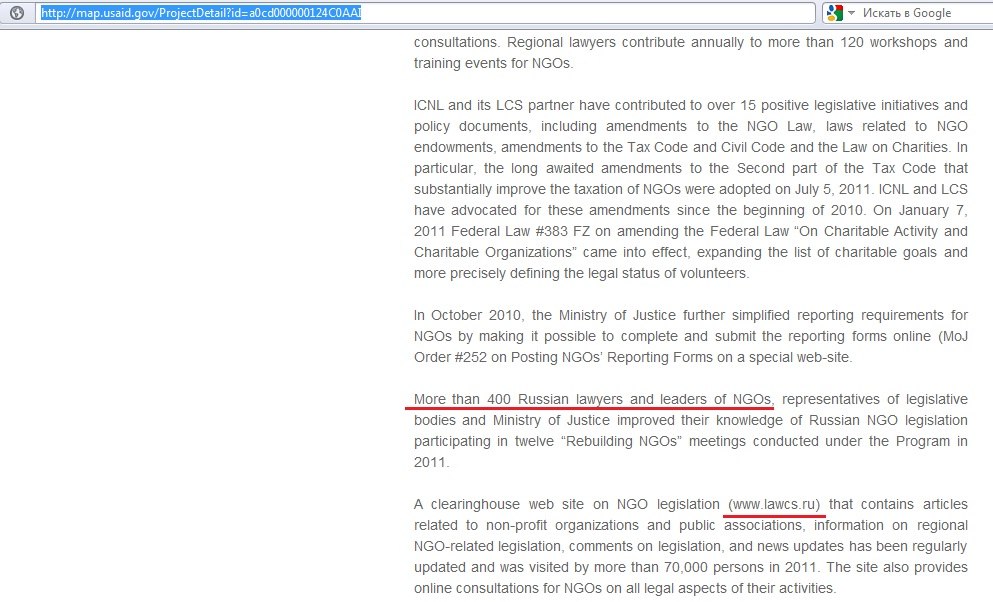
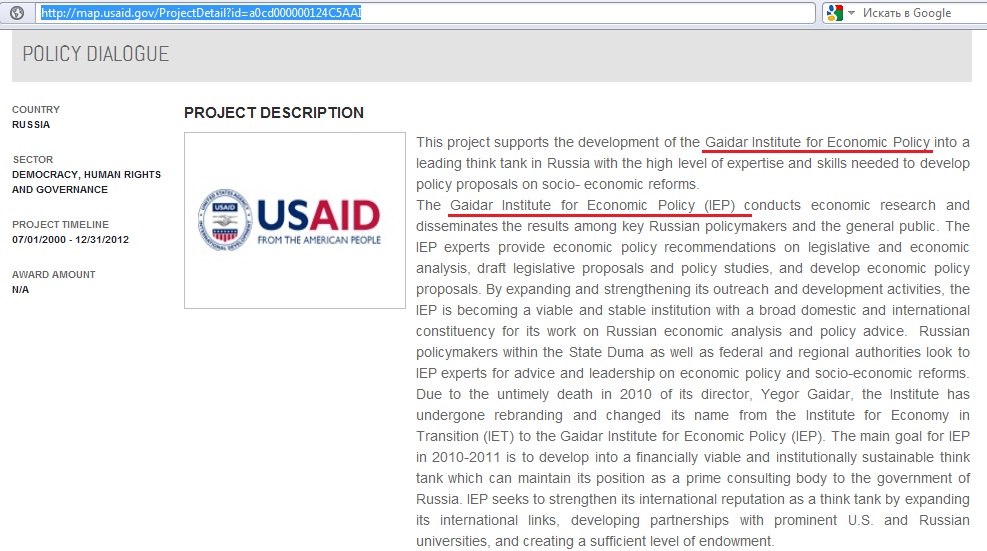
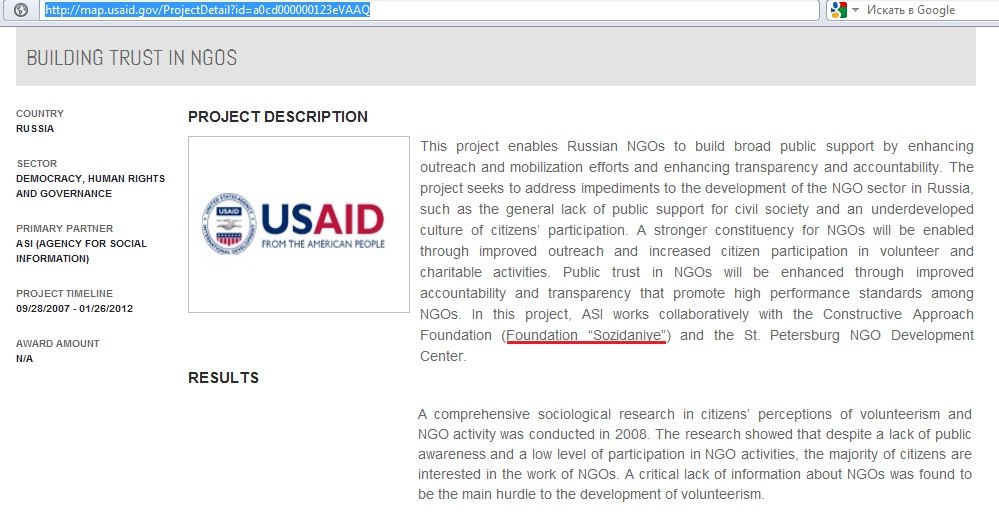
Partial list of Russian NGO financed from abroad

Do you remember the panic which spread recently among Russian non-government organizations when Putin passed a new law forcing any NGO which is financed from abroad to register as a "foreign agent"?

Russian bloggers have now compiled an initial list of these organizations.  Again, this is not an official list, only one compiled by savvy Russian bloggers who will now submit this list to the Russian security agencies.  Still, the list is very interesting, and I invite you to carefully parse it to get a feel for the scope of the US infiltration of the Russian society (since the list is long, I used google-translate to translate the names of the organizations).

The Saker

PS:

original source link in Russian: http://lenin-kerrigan.livejournal.com/486193.htmlhttp://lenin-kerrigan.livejournal.com/486193.html
google translated original source link: http://translate.google.com/translate?sl=ru&tl=en&js=n&prev=_t&hl=en&ie=UTF-8&layout=2&eotf=1&u=http%3A%2F%2Flenin-kerrigan.livejournal.com%2F486193.html&act=url
-------
List of "Russian" NGOs financed by the USA:

Voice of Beslan committee
http://www.golosbeslana.ru/
golosbeslana@gmail.com
8-906-494-97-98
NED - National Endowment for Democracy
link
American Center for International Labor Solidarity
http://www.solidaritycenter.org/
Information@solidaritycenter.org
NED - National Endowment for Democracy
Link
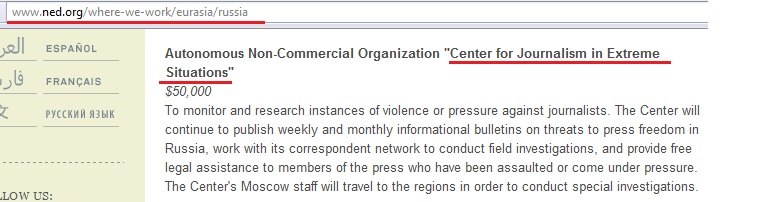
Center for Journalism in Extreme Situations
http://cjes.ru/
center@cjes.ru
+7 (495) 645-6123
NED - National Endowment for Democracy
Link
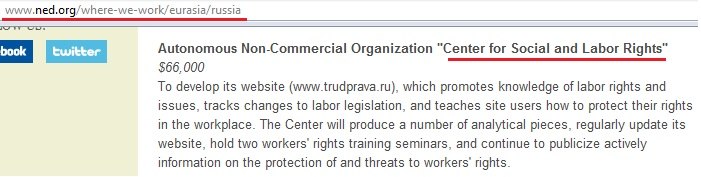
Center for Social and Labor Rights
http://trudprava.ru
info@trudprava.ru
8 (495) 721-9558
NED - National Endowment for Democracy
Link
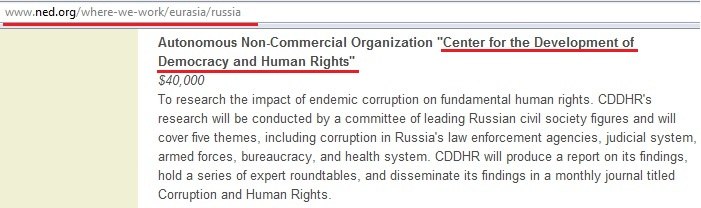
Center for Development of Democracy and Human Rights
http://www.demokratia.ru/
Not found
+7 495 9161006
NED - National Endowment for Democracy
Link
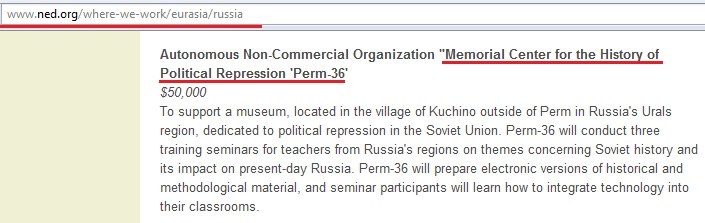
Museum of the History of Political Repression "Perm-36"
http://perm36.ru/
perm36@list.ru
8 (342) 212-61-29
NED - National Endowment for Democracy
Link
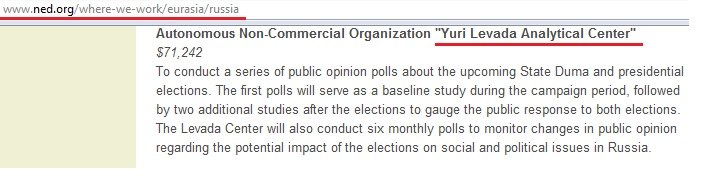
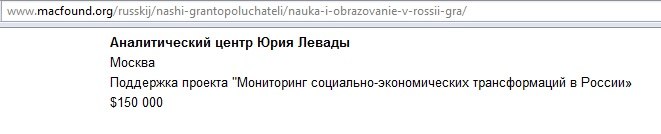
Levada Center
http://www.levada.ru/
direct@levada.ru
8 (495) 229-38-10
NED - National Endowment for Democracy , the MacArthur Foundation
NED link , Link MacArthur
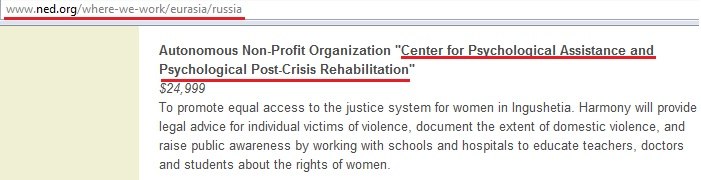
Center for Psychological Assistance and Psychological Post-Crisis Rehabilitation
Russian company name unknown
NED - National Endowment for Democracy
Link
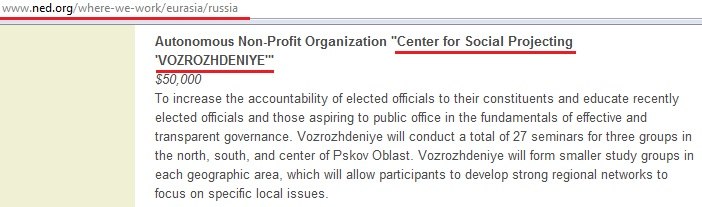
Center for Social Projects "Revival"
NED - National Endowment for Democracy
Link
The human rights organization "Mashr"
http://www.mashr.org/
ingmashr@gmail.com
NED - National Endowment for Democracy
Link
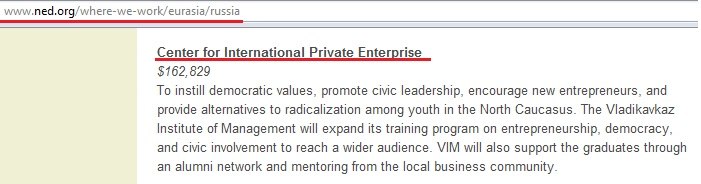
Center for International Private Enterprise
http://www.cipeeurasia.org/
Cipe@cipe.ru
7 (495) 380 2571
NED - National Endowment for Democracy
Link
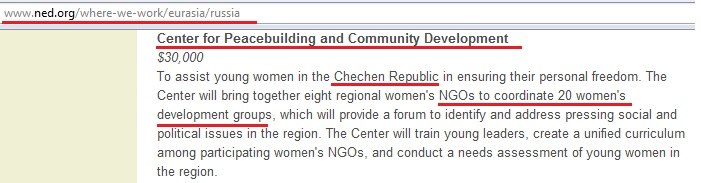
Center building peace and development communities (Coordinator non-profit organization in Chechnya)
NED - National Endowment for Democracy
Link
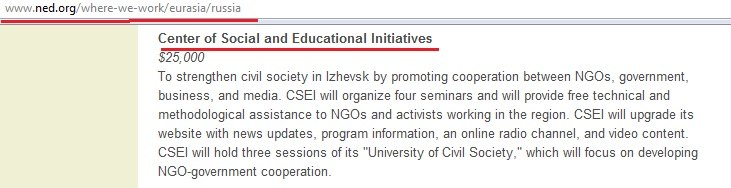
Izhevsk city public organization "Center for Social and Educational Initiatives"
http://www.linia.udm.net/
csei@udmnet.ru
8 (3412) 52-52-87
NED - National Endowment for Democracy
Link
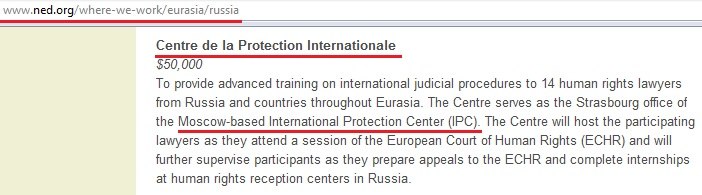
Center for International Protection
http://www.ip-centre.ru/
inbox@ip-centre.ru
7 (495) 938 75 34
NED - National Endowment for Democracy
Link
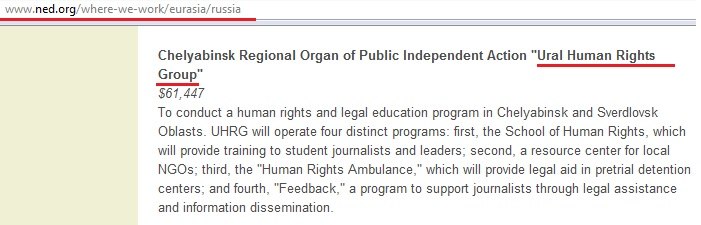
Urals Regional Center for the Protection of Human Rights and Freedoms
http://uralc.ru/
zentrprav@gmail.com
+7 (351) 77-66-205
NED - National Endowment for Democracy
Link
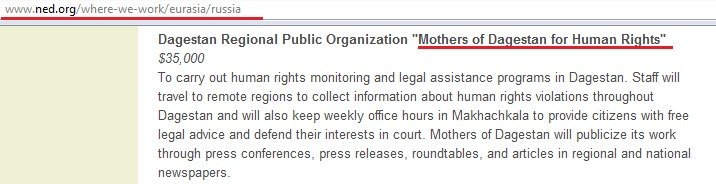
Mothers of Dagestan for Human Rights
http://materi-dagestana.nethouse.ru/
materi-dagestana@gmail.com
+7 (8722) 60-25-20
NED - National Endowment for Democracy
Link
Information and Analytical Center "Perspective"
http://www.rakursdag.org/
junusov@xtreem.ru
8 (8722) 63-06-43
NED - National Endowment for Democracy
Link
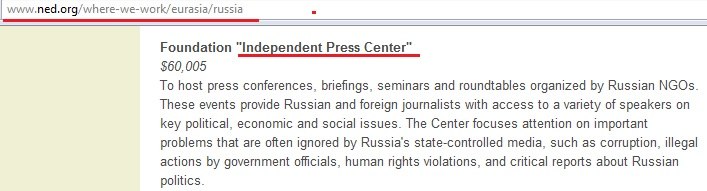
Independent Media Center
http://infolegal.ru/
yakovleva@infolegal.ru
8 (495) 232 2891
NED - National Endowment for Democracy
Link
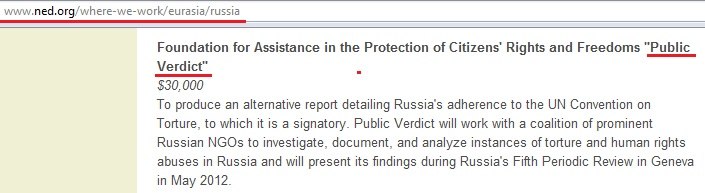
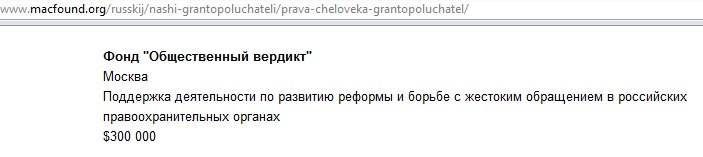
Fund "Public Verdict"
http://publicverdict.ru/
info@publicverdict.org
8 (495) 951-12-01
NED - National Endowment for Democracy , the MacArthur Foundation
NED link , Link MacArthur
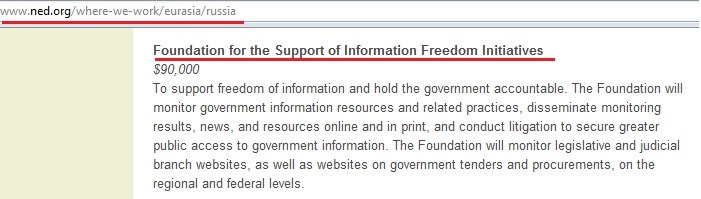
Foundation for Information Freedom
http://www.svobodainfo.org
info@svobodainfo.org
7 (812) 766 03 66
NED - National Endowment for Democracy
Link
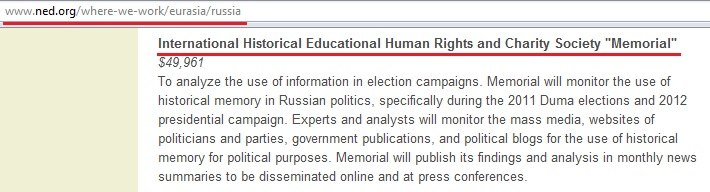
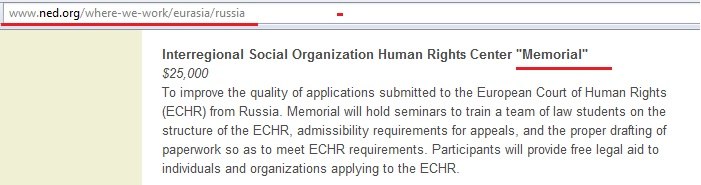
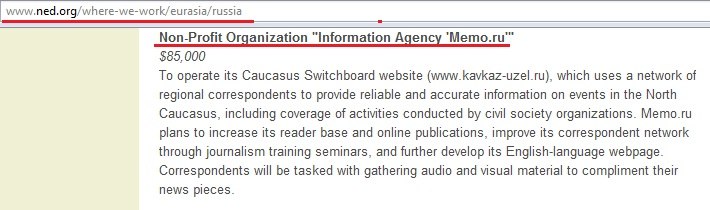
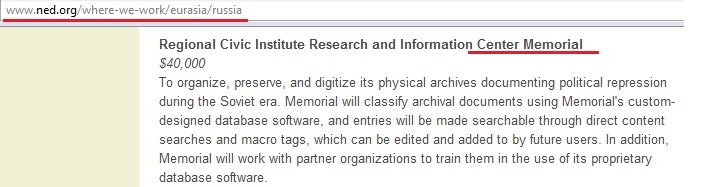
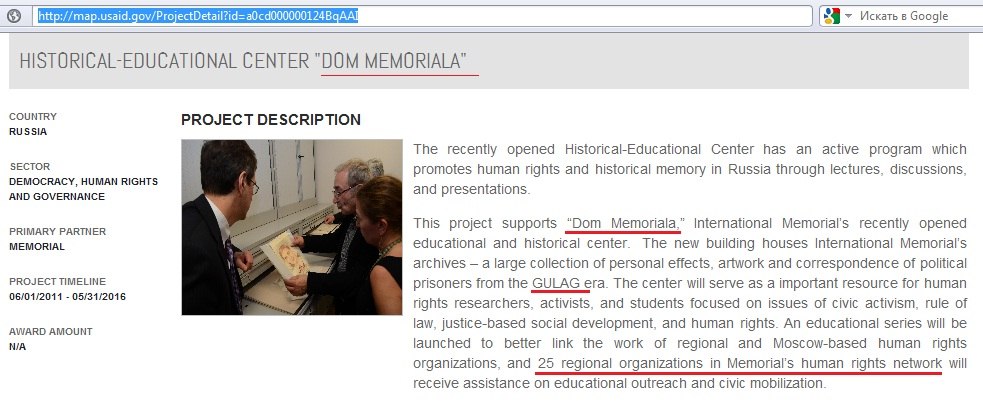
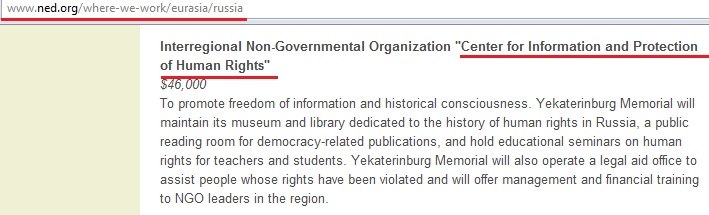
Memorial Human Rights Center
http://www.memo.ru
info@memo.ru
8 (495) 699 11 80
NED - National Endowment for Democracy , USAID
link - 1 , reference - 2 , reference - 3 , Link - 4 , reference - 5 , USAID link
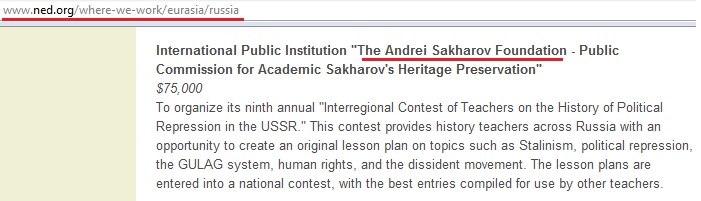
Center Andrei Sakharov
http://www.sakharov-center.ru/
Not found
8 (495) 623 4401
NED - National Endowment for Democracy , the MacArthur Foundation
NED reference link McArthur
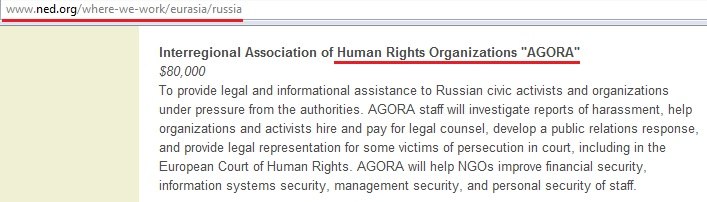
The human rights organization "Agora"
agora-club@yandex.ru
8 (9600) 47-27-96
NED - National Endowment for Democracy , the MacArthur Foundation
NED link , Link MacArthur
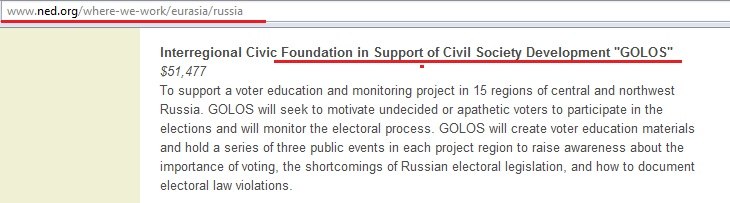
Association "VOICE"
http://www.golos.org/
golos@golos.org
8 (495) 234-59-39
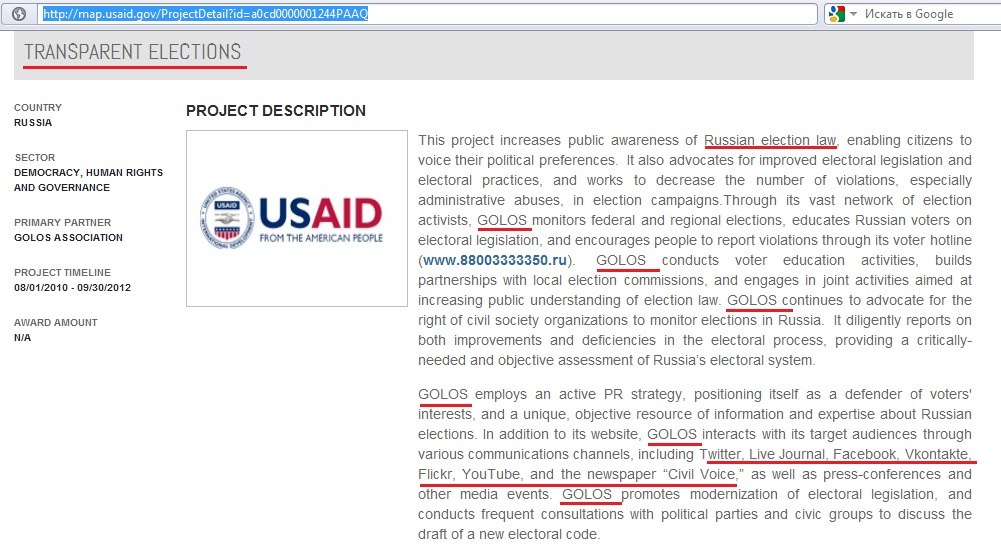
NED - National Endowment for Democracy , USAID
Link , Link - 2 , Link USAID
Information Center for Human Rights
http://www.lichr.ee/main/
e-mail: centre@lichr.ee
8 (372) 64 64 270
NED - National Endowment for Democracy
Link
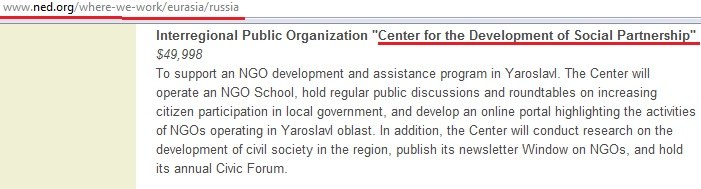
Center for Social Partnership
http://www.csp-yar.ru/
cspyar@gmail.com
8 (4852) 72-65-33
NED - National Endowment for Democracy
Link
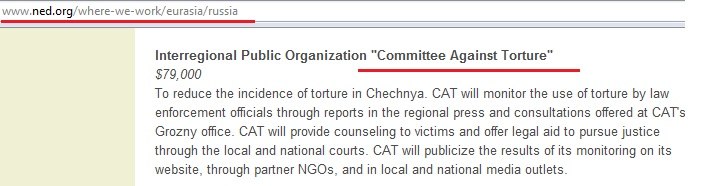
Committee against Torture
http://www.pytkam.net/
komitet@pytkam.net
8 (831) 433-14-04
NED - National Endowment for Democracy , the MacArthur Foundation
NED link , link McArthur
Kabardino-Balkar Republic Advocacy Center
http://zapravakbr.ru/
NED - National Endowment for Democracy
Link
Public organization "Baltic migrants'
klokova1@yandex.ru
8 (4012) 46-05-14
NED - National Endowment for Democracy
Link
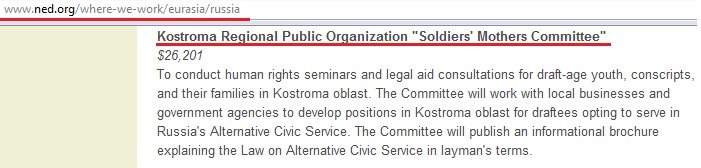
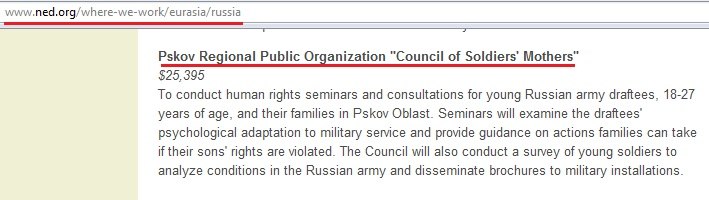
Committee of Soldiers' Mothers
http://www.soldiers-mothers-rus.ru/
ksmruss@yandex.ru
8 (499) 369-52-18
NED - National Endowment for Democracy
-1 Link , link - 2 , reference - 3 ,
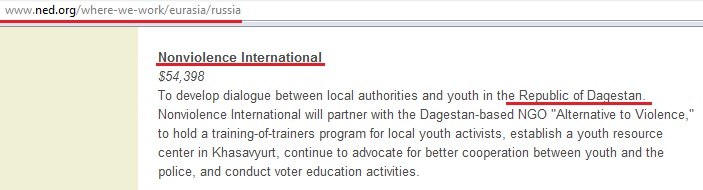
Dagestan Regional Public Organization "Alternative to Violence"
NED - National Endowment for Democracy
Link
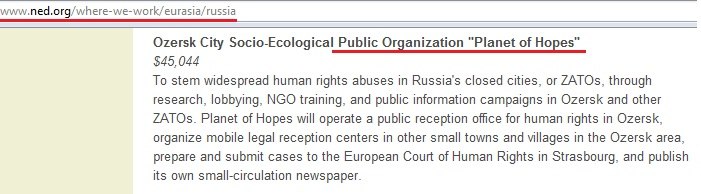
Planet Hope, Ozerskaya urban socio-environmental NGO
8 (35130) 4-68-29
NED - National Endowment for Democracy
link
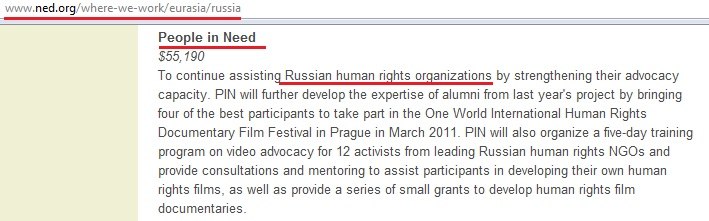
People in Need, Czech organization People in Need to work ( 1 , 2 ) in Russia
http://www.clovekvtisni.cz/indexen.php
mail@clovekvtisni.cz
8 420 226 200 400
NED - National Endowment for Democracy
link
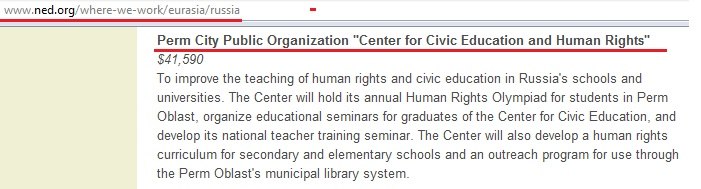
Centre for Civic Education and Human Rights of Perm
http://www.cgo.perm.ru/
civeducat@gmail.com
7 (342) 2-195-590
NED - National Endowment for Democracy
Link
Perm PGOO "Center to the victims of violence and trafficking in human beings"
http://www.cavt.ru/
no-violence@narod.ru
(912) 494-42-94
NED - National Endowment for Democracy
Link
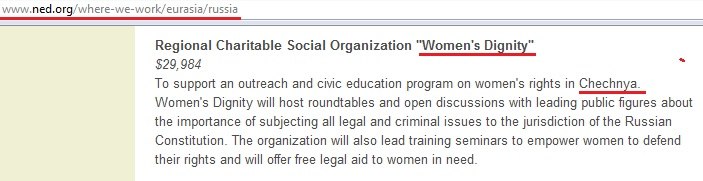
NGO «Women's Dignity" Chechnya
NED - National Endowment for Democracy
Link
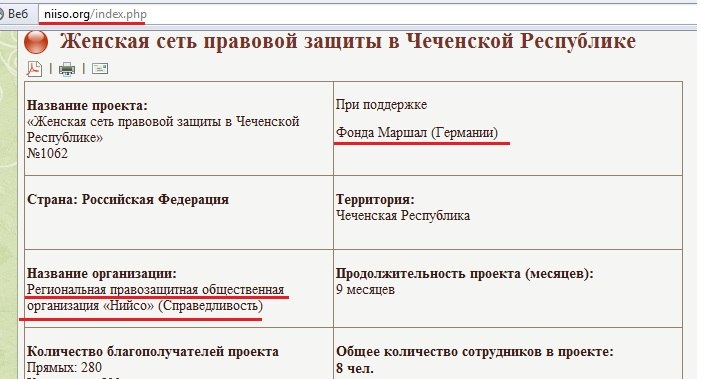
Regional human rights NGO "Niyso" (Justice)
http://niiso.org
niiso2001@gmail.com
8 (928) 745 04 40
Marshall Foundation (Germany). Samopriznanie.
Link
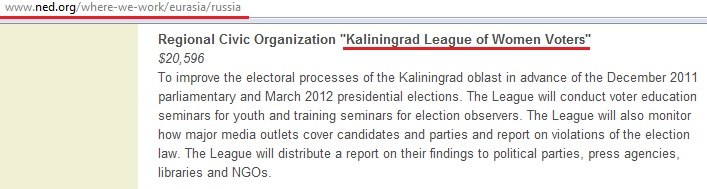
League of Women Voters of the Kaliningrad region and St. Petersburg
http://www.liga-rf.ru/
lwv@liga-rf.ru
+7 (812) 407-41-61
NED - National Endowment for Democracy
link - 1 , reference - 2 ,
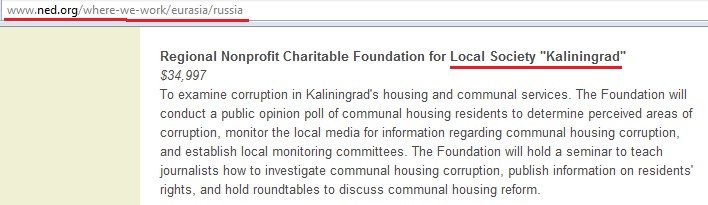
Community Foundation "Kaliningrad"
http://www.fond-kaliningrad.ru/
fond-kld@mail.ru
7 4012 98 81 98
NED - National Endowment for Democracy
link
Regional Public Movement "Chechen Committee of National Consent"
http://www.savechechny.narod.ru/
ngo.chkns @ gmail.com
8 (8732) 22-24-00
NED - National Endowment for Democracy
link
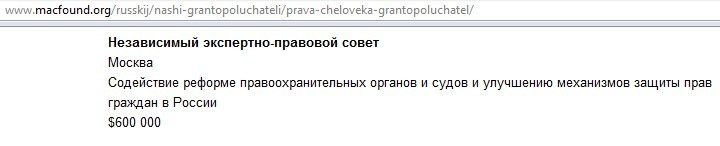
Independent Council of Legal Expertise
http://www.neps.ru/
sovet@neps.ru
NED - National Endowment for Democracy , the MacArthur Foundation
NED link , Link MacArthur
Information and research center "Panorama"
http://www.panorama.ru/
info@panorama.ru
7 (495) 787-63-38
NED - National Endowment for Democracy
Link
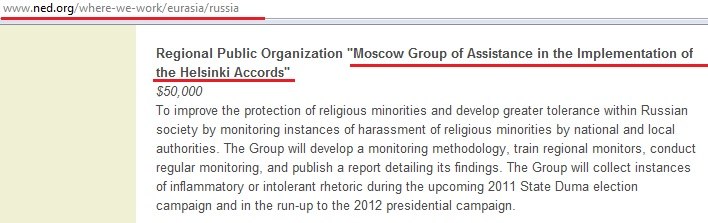
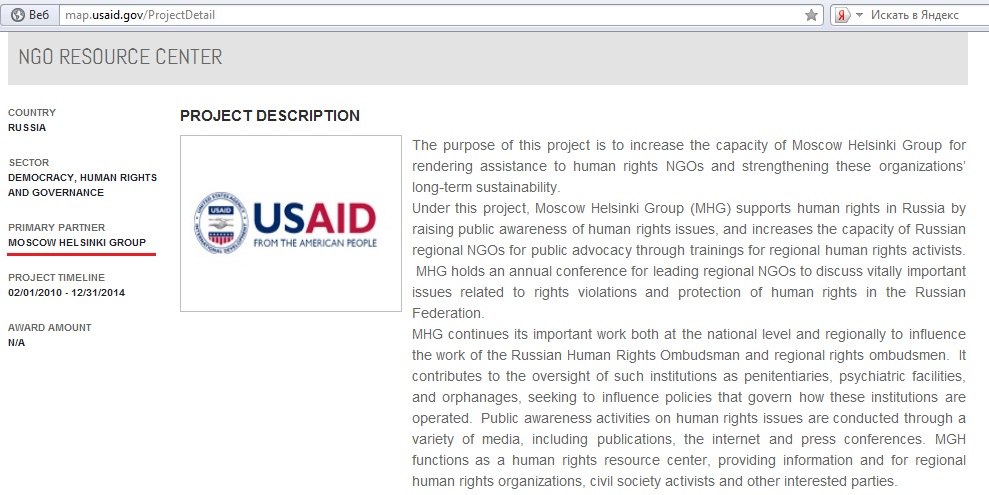
Moscow Helsinki Group
http://www.mhg.ru/
mhg@mhg.ru
8 (499) 553-03-12
NED - National Endowment for Democracy , the MacArthur Foundation , USAID
NED link , Link MacArthur , USAID Link
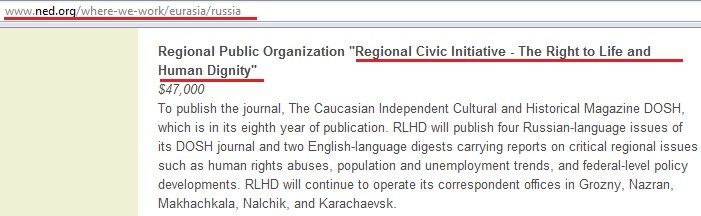
"Regional Civic Initiative - the right to life and human dignity"
Not available, data on the organization here
Louchnikov per. 4, kom. 19 103982 Moscow
8 (095) 206-8589
NED - National Endowment for Democracy
Link
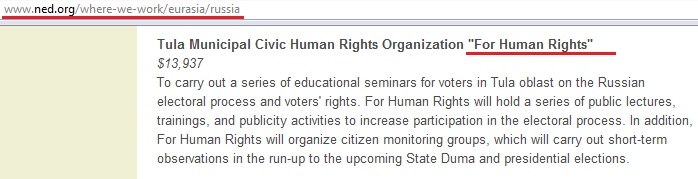
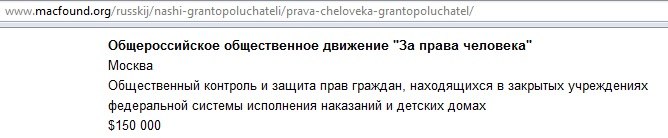
All-Russian Public Movement "For Human Rights"
http://www.zaprava.ru
news@zaprava.ru
8 (495) 691 62 33
NED - National Endowment for Democracy , the MacArthur Foundation
NED link , link - 2 weeks , Link - 3 McArthur
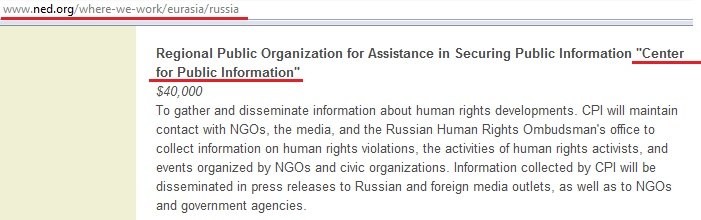
Public Information Center
http://newcpi.wmtest.ru/
8 (499) 553-0312
NED - National Endowment for Democracy
Link
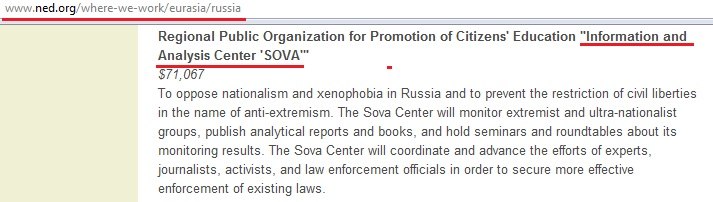
Information-analytical center "SOVA"
http://www.sova-center.ru/
mail@sova-center.ru
7 (495) 517-9230
NED - National Endowment for Democracy
Link
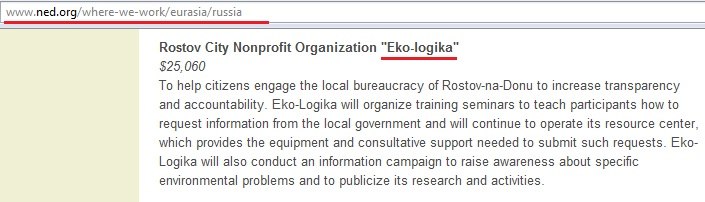
RGOO "Eco-Logic"
http://ecologic.aaanet.ru/
ecolog@ic.ru
8 (8632) 67-44-20
NED - National Endowment for Democracy
Link
The Russian-Chechen Friendship Society (The organization banned by the court of the Russian Federation as an extremist. Despite what the media reported that the organization was abolished by the Supreme Court RFv 2007, in 2011, the organization received grants.
NED - National Endowment for Democracy
Link
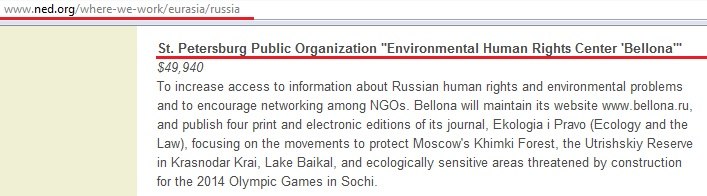
Environmental Rights Center "Bellona"
http://www.bellona.ru/
mail@bellona.ru
+7-812-275 77 61, 61 25 +7-812-702
NED - National Endowment for Democracy
Link
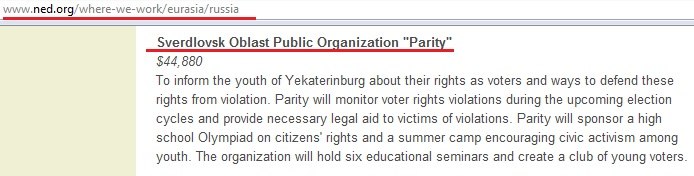
Sverdlovsk Regional Public Organization "Parity"
http://paritet-ngo.ru/ (non-performing)
NED - National Endowment for Democracy
link
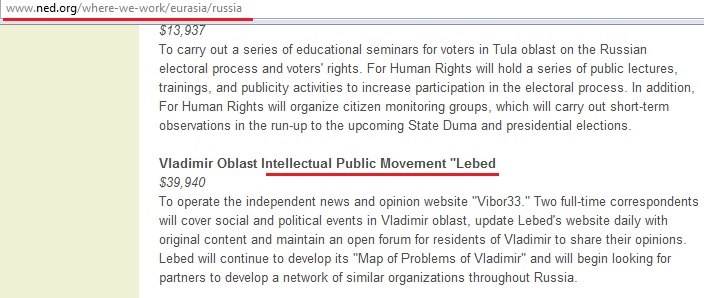
Intelligent Motion "Swan"
http://vldlebed.ru/
8 (4922) 37-33-18
NED - National Endowment for Democracy
link
Yaroslavl Regional Public Organization for Support of Civil Initiatives "Dialog"
http://www.dialog-yar.ru/
dialogyar@gmail.com
Yaroslavl city code 32-82-06, 08/11/73
NED - National Endowment for Democracy
link
Center for Energy and Security
http://ceness-russia.org/
MacArthur Foundation
Link
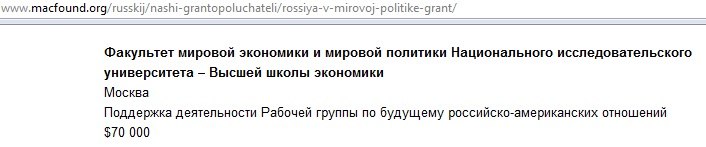
Higher School of Economics
http://www.hse.ru/
hse@hse.ru
8 (495) 771-32-32
MacArthur Foundation
link
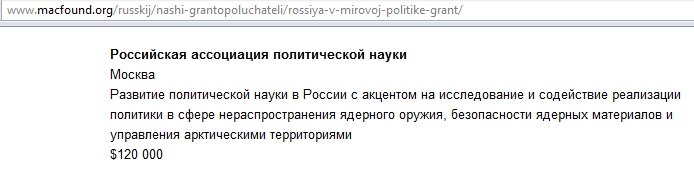
Russian Political Science Association
http://www.rapn.ru/
MacArthur Foundation
link
Carnegie Moscow Center
http://carnegie.ru/
info@carnegie.ru
+7 (495) 935-8904
MacArthur Foundation
link
Centre for Independent Social Research
http://www.cisr.ru/
centre@indepsocres.spb.ru
8 (812) 718-3796
MacArthur Foundation
link
The Union of Russian Journalists
http://www.ruj.ru/
ruj@ruj.ru
8 (495) 637-52-84
MacArthur Foundation
Link
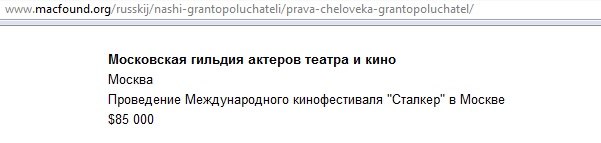
Moscow Guild of film and theater actors
http://www.stalkerfest.org/
info@kinogildia.ru
8 (499) 251 58 89
MacArthur Foundation
link
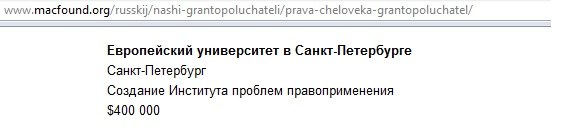
European University at St. Petersburg
http://www.eu.spb.ru/
8 (812) 386-7637,
MacArthur Foundation
link
Consortium of Women's Non-Governmental Associations
http://www.wcons.org.ru/ru/main.php
wcons@wcons.org.ru
8 (495) 690-63-48
MacArthur Foundation
link
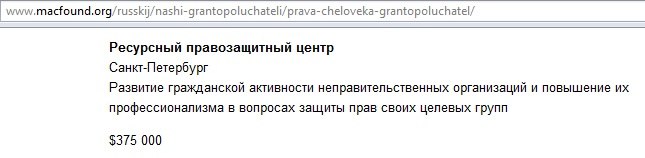
Resource Rights Center
http://www.hrrcenter.ru/
spb@hrrcenter.ru
(812) 369-04-93, 716-24-64
MacArthur Foundation
link
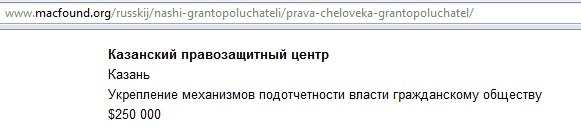
Kazan Human Rights Center
http://www.investigation.ru/
bulat_hrc@mail.ru
(843) 277-03-86, (843) 2-78-87-10
MacArthur Foundation
link
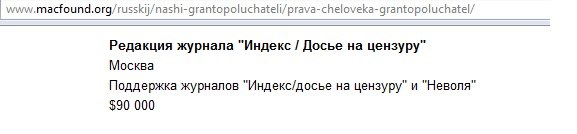
Magazines "index / file on censorship" and "Bondage"
http://www.index.org.ru/ & http://index.org.ru/nevol/
index@index.org.ru
8 (495) 637-50-86
MacArthur Foundation
Link
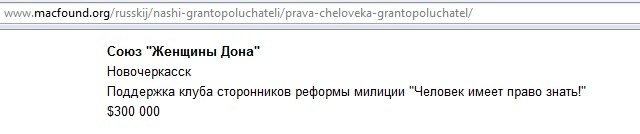
Regional public organization Union "Women of the Don"
http://www.donwomen.ru/
donwomen@novoch.ru
(8635) 22-48-15
MacArthur Foundation
link
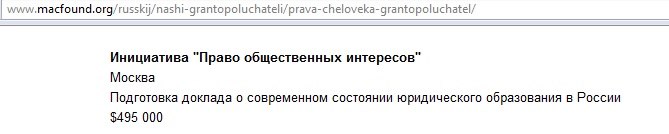
Institute "Public Interest Law"
http://www.pili.org/russian (not working)
MacArthur Foundation
link
Public association "Sutyazhnik"
http://sutyajnik.ru/
MacArthur Foundation
Link
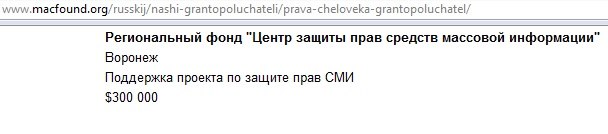
Regional Fund 'Rights Center of the media "
7 (4732) 563623
MacArthur Foundation
link
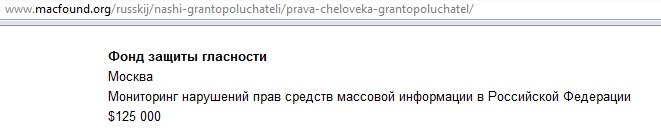
The GDF
http://www.gdf.ru/
fond@gdf.ru
+7 (495) 637-32-42, fax: +7 (495) 637-44-20
MacArthur Foundation
link
Voronezh Interregional Human Rights Group / Black Earth
http://www.irhrg.ru/
irhrg@hrworld.ru
+7 (4732) 54 55 30
MacArthur Foundation
Link
"Combining ombudsmen"
http://www.aombu.ru (CLOSED)
asso-obm@mail.ru
(49622) 42940
MacArthur Foundation
link
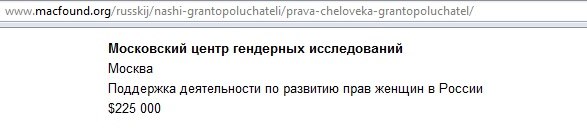
Moscow Center for Gender Studies
http://www.gender.ru/
mcgs2008@yandex.ru
Temporarily disable 725-2123
MacArthur Foundation
link
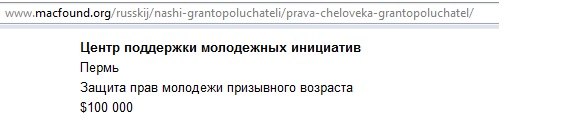
Support Center of Youth Initiatives
http://mol-center.ru
MacArthur Foundation
Link
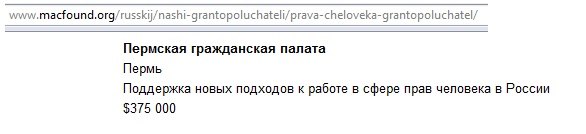
Perm Civil Chamber
http://www.pgpalata.ru/
palata@prpc.ru
(342) 233-40-63
MacArthur Foundation
link
Southern Regional Resource Center
http://www.srrccs.ru
srrc@list.ru
(861) 210 16 48, 210 16 49
MacArthur Foundation
link
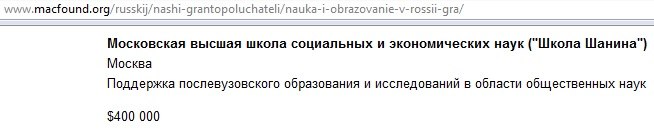
Moscow School of Social and Economic Sciences ("School Shanina")
http://www.msses.ru/
(495) 434-72-82
MacArthur Foundation
Link
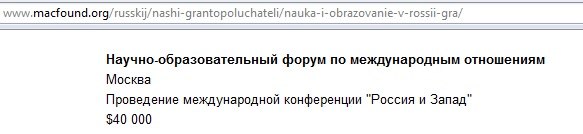
Scientific and Educational Forum on International Relations
http://www.obraforum.ru/
info@obraforum.ru
8 (495) 650 12 16
MacArthur Foundation
link
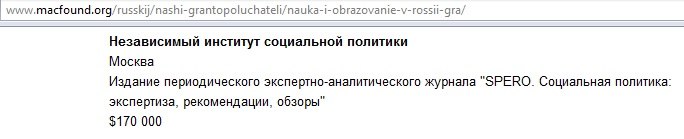
Institute of Social Policy
http://www.socpol.ru/
info@socpol.ru
(495) 786-67-18
MacArthur Foundation
link
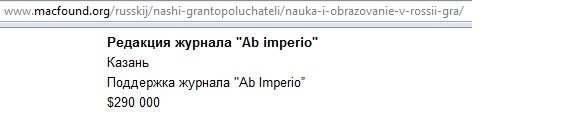
magazine "Ab imperio"
http://abimperio.net/
office@abimperio.net
MacArthur Foundation
link
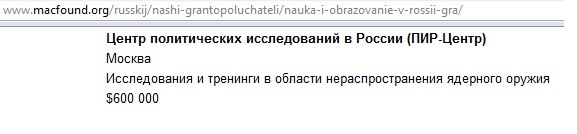
Center for Policy Studies in Russia (PIR Center)
http://www.pircenter.org/
7 (495) 987-19-15
MacArthur Foundation
link
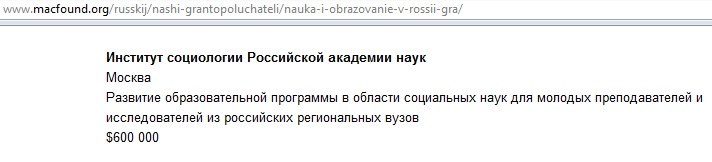
Institute of Sociology of the Russian Academy of Sciences
http://www.isras.ru/
(495) 719-09-40, fax: (495) 719-07-40
MacArthur Foundation
Link
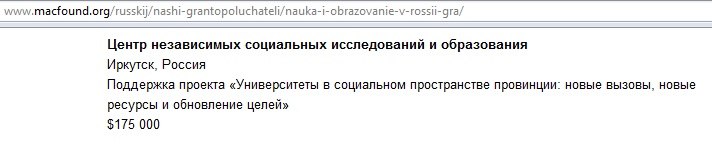
Centre for Independent Social Research and Education
http://www.irk-center.ru/
cnsio@angara.ru
(3952) 333-721
MacArthur Foundation
link
Center for Applied Research and Programs, "adapted"
http://www.prisp.ru/
info@prisp.ru
89104193054, 89268634808
MacArthur Foundation
link
Center for Social Policy and Gender Studies
http://socpolicy.ru/
admin@socpolicy.ru
7 8452 998529, fax: +7 8452 998528
MacArthur Foundation
link
Charities Aid Foundation (CAF)
http://www.cafrussia.ru/
MacArthur Foundation
link
Institute of International Studies of the family at the HSE
http://demoscope.ru & http://www.hse.ru/org/hse/demo
demoscope@demoscope.ru
(495) 772-95-90
MacArthur Foundation
link
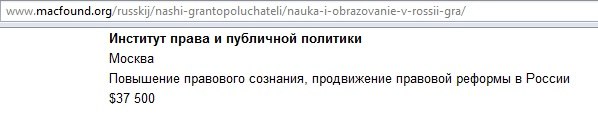
Institute of Law and Public Policy
http://ilpp.ru/
Unknown
Phone: (495) 608 6959, 608 6635
MacArthur Foundation
link
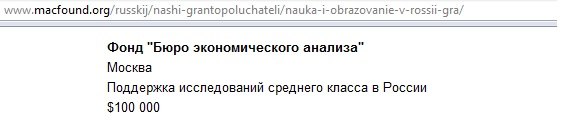
Foundation "Bureau of Economic Analysis"
http://www.beafnd.org/ru/
bureau@beafnd.org
(495) 937 67 50
MacArthur Foundation
link
Gorbachev Foundation
http://www.gorby.ru/
gf@gorby.ru
8 495 945-78-99
MacArthur Foundation
link
Fund "New Eurasia"
http://www.neweurasia.ru/
reception@neweurasia.ru
8 (495) 970-1567
USAID
Link
Foundation for Information Policy
http://www.old.frip.ru/newfrip/cnt/news
frip@frip.ru
8-901-542-32-46, 8-901-539-68-38,
USAID
link
Good Deed Foundation
Fund information on wiki
USAID
link
Noncommercial Partnership "Lawyers for Civil Society"
http://www.lawcs.ru/
info@lawcs.ru
7 (495) 984-88-01, 984-88-02
USAID
link
Economic Policy Institute named Gaidar
http://www.iep.ru/
wwwiet@iet.ru
(495) 629-64-13
USAID
link
Public Association Foundation "Creation"
http://www.fondsozidanie.ru/
Sozidanie@co.ru
USAID
link
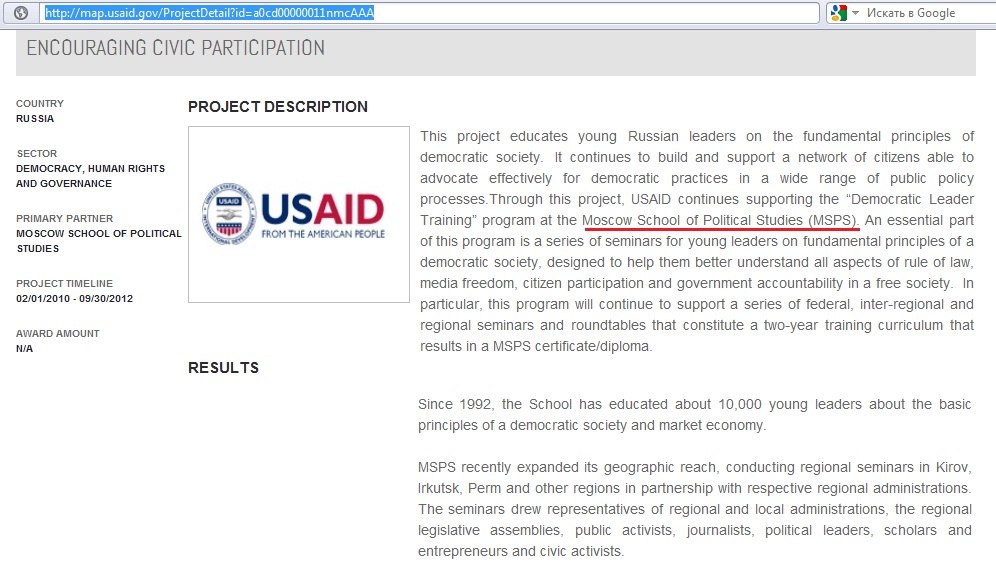
Moscow School of Political Studies
http://www.msps.su/
Not Specified
7 (495) 699-01-73
USAID
Link
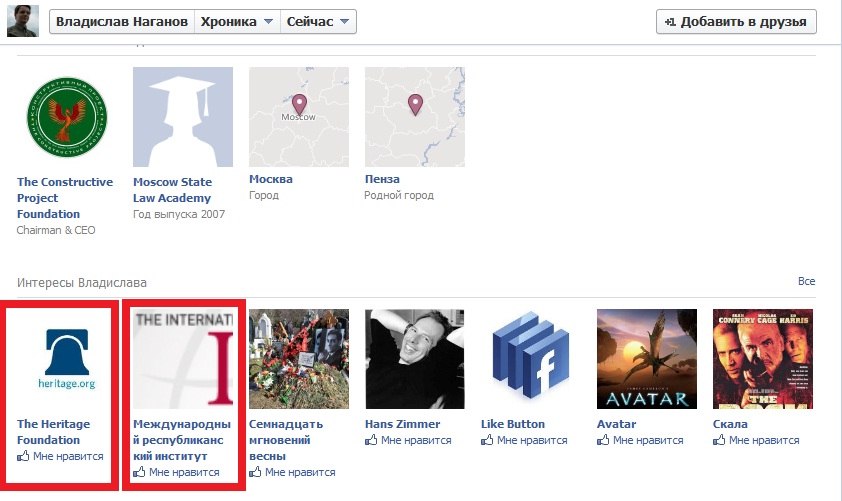
Fund "Design Project"
http://constructive-project.org
info@constructive-project.org
+7 (495) 657-86-59
IRI, Heritage Foundation
link

Thursday, April 8, 2010

Kyrgyzstan And The Battle For Central Asia

by Rick Rozoff for Stop NATO

Kyrgyz President Kurmanbek Bakiyev was deposed five years after and in the same manner as he came to power, in a bloody uprising.

Elected president two months after the so-called Tulip Revolution of 2005 he helped engineer, he was since then head of state of the main transit nation for the U.S. and NATO war in Afghanistan.

The Pentagon secured the Manas Air Base (as of last year known as the Transit Center at Manas) in Kyrgyzstan shortly after its invasion of Afghanistan in October of 2001 and in the interim, according to a U.S. armed forces publication last June, “More than 170,000 coalition personnel passed through the base on their way in or out of Afghanistan, and Manas was the transit point for 5,000 tons of cargo, including spare parts and equipment, uniforms and various items to support personnel and mission needs.

“Currently, around 1,000 U.S. troops, along with a few hundred from Spain and France, are assigned to the base.” [1]

The White House’s Special Representative for Afghanistan and Pakistan Richard Holbrooke paid his first visit in his current position to Kyrgyzstan – and the three other former Soviet Central Asian republics which border it, Kazakhstan, Tajikistan and Uzbekistan – in February and said “35,000 US troops were transiting each month on their way in and out of Afghanistan.” [2] At the rate he mentioned, 420,000 troops annually.

The U.S. and NATO also established military bases in Tajikistan and Uzbekistan for the war in South Asia, but on a smaller scale. (U.S. military forces were ordered out of the second country following what the government claimed was a Tulip Revolution-type armed uprising in its province of Andijan less than two months after the Kyrgyz precedent. Germany maintains a base near the Uzbek city of Termez to transit troops and military equipment to Afghanistan’s Kunduz province where the bulk of its 4,300 forces is concentrated.)

In February of 2009 the Bakiyev government announced that it was also evicting U.S. and NATO forces from its country, but relented in June when Washington offered it $60 million to reverse its decision.

Kyrgyzstan borders China.

It not only borders China, Kazakhstan, Tajikistan and Uzbekistan, but is only separated from Russia by a single nation, Kazakhstan. To gain an appreciation of Russian and Chinese concerns over hundreds of thousands of U.S. and NATO troops passing through Kyrgyzstan, imagine a comparable amount of Chinese and Russian soldiers regularly passing through Mexico and Guatemala, respectively. For almost nine years and at an accelerating rate.

It is not only a military “hard power” but also a “soft power” threat that the Western role in Kyrgyzstan poses to Russia and China.

The nation is a member of the post-Soviet Collective Security Treaty Organization (CSTO) along with Russia, Armenia, Belarus, Kazakhstan, Tajikistan and Uzbekistan – seen by many as the only counterpart to NATO on former Soviet space – and of the Shanghai Cooperation Organization (SCO) with China, Russia and the three above-mentioned Central Asian nations.

According to U.S. officials, during and after the Tulip Revolution of 2005 not a single U.S. or NATO flight into the Manas Air Base was cancelled or even delayed. But a six-nation CSTO exercise scheduled for days afterward was cancelled.

The uprising and the deposing of standing president Askar Akayev in March of 2005 was the third self-styled “color revolution” in the former Soviet Union in sixteen months, following the Rose Revolution in Georgia in late 2003 and the Orange Revolution in Ukraine in late 2004 and early 2005.

As the Kyrgyz version was underway Western news media were asking the question “Who’s next?” Candidates included other former Soviet states like Armenia, Azerbaijan, Belarus, Kazakhstan, Moldova and Uzbekistan. And Russia. Along with Georgia, Ukraine and Kyrgyzstan those nations accounted for ten of the twelve members of the post-Soviet Commonwealth of Independent States (CIS).

As Agence France-Presse detailed in early April of 2005: “The CIS was founded in December 1991 on the very day the Soviet Union disappeared….But over the past year and a half, three faithful Kremlin allies were toppled in…revolutions: Eduard Shevardnadze in Georgia, Leonid Kuchma in Ukraine, and, last week, Askar Akayev in Kyrgyzstan….Even though Kyrgyzstan’s new interim leaders have vowed to continue their deposed predecessor’s Moscow-friendly policies, the lightning toppling of the government there has spawned speculation that the CIS would soon collapse.” [3]

The leader of the “color revolution” prototype, Georgia’s Mikheil Saakashvili, gloated over the Kyrgyz “regime change,” attributing the “brave” actions of the opposition in Ukraine and Kyrgyzstan “to the Georgia factor,” and added, “We are not waiting for the development of events, but are doing our best to destroy the empire in the CIS.” [4]

Shortly after the uprising former Indian diplomat and political analyst M.K. Bhadrakumar wrote of the then seemingly inexorable momentum of “color” revolts in the former Soviet Union:

“[A]ll the three countries [Georgia, Ukraine, Kyrgyzstan] are strategically placed in the post-Soviet space. They comprise Russia’s ‘near abroad.’

“Washington has been expanding its influence in the arc of former Soviet republics — in the Baltics…the Caucasus, and Central Asia – in recent years with a tenacity that worries Moscow.

“Ever since 2003 when Mr. Akayev decided on allowing Russia to establish a full-fledged military base in Kant he knew he was on the American ‘watch list.’ The political temperature within Kyrgyzstan began to rise.

“The Americans made it clear in many ways that they desired a regime change in Bishkek….The ‘revolution’ in the Central Asian state of Kyrgyzstan has already thrown up surprises. A comparison with the two earlier ‘colour revolutions’ in Georgia and Ukraine will be a good starting point.

“First, the striking similarities between the three ‘revolutions’ must be duly noted. All three are meant to signify the unstoppable spread of the fire of liberty lit by the United States in Afghanistan and Iraq in the aftermath of 9/11.

“But behind the rhetoric, the truth is that the U.S. wanted regime change in Georgia, Ukraine and Kyrgyzstan because of difficulties with the incumbent leadership. The leaders of all the three countries — Eduard Shevardnadze in Georgia, Leonid Kuchma in Ukraine, and Askar Akayev in Kyrgyzstan — had enjoyed the support of the U.S. during most of their rule.

“Washington had cited them repeatedly as the beacons of hope for democracy and globalisation in the territories of the former Soviet Union.

“Their trouble began when they incrementally began to edge towards a resurgent Russia under Vladimir Putin.” [5]

Seven weeks after Bhadrakumar’s column appeared his analysis would be confirmed by no less an authority on the matter than U.S. President George W. Bush.

Visiting the capital of Georgia a year and a half after its “Rose Revolution,” he was hosted by his counterpart Mikheil Saakashvili, former State Department fellowship recipient and U.S. resident, who seized power in what can only be described as a putsch but nevertheless said:

“Georgia will become the main partner of the United States in spreading democracy and freedom in the post-Soviet space. This is our proposal. We will always be with you in protecting freedom and democracy.”

Bush reflected Saakashvili’s inflated estimate of himself: “You are making many important contributions to freedom’s cause, but your most important contribution is your example. Hopeful changes are taking places from Baghdad to Beirut and Bishkek [Kyrgyzstan]. But before there was a Purple Revolution in Iraq or Orange Revolution in Ukraine or a Cedar Revolution in Lebanon, there was a Rose Revolution in Georgia.” [6]

A few days after the Kyrgyz coup Bush welcomed Ukraine’s “orange” president Viktor Yushchenko – who this January only received 5.45 per cent of the vote in his reelection bid – and applauded his U.S.-assisted ascent to power, saying it “may have looked like it was only a part of the history of Ukraine, but the Orange Revolution represented revolutions elsewhere as well….We share a goal to spread freedom to other nations.” [7]

Beyond the threat of the dissolution of the CIS and of the CSTO, in April of 2005 Der Spiegel featured a report with the title “Revolutions Speed Russia’s Disintegration.”

In part it revealed the prime movers behind the events in Kyrgyzstan:

“As early as February,” Roza Otunbayeva – now the apparent head of the provisional government – “pledged allegiance to a small group of partners and sponsors of the Kyrgyz revolution, to ‘our American friends’ at Freedom House (who donated a printing press in Bishkek to the opposition), and to George Soros, a speculator who previously helped unseat Edward Shevardnadze’s government in Georgia.

“Trying to help the democratic process, the Americans poured some $12 million into Kyrgyzstan in the form of scholarships and donations – and that was last year alone. Washington’s State Department even funded TV station equipment in the rebellious southern province town of Osh.” [8]

In June George Soros was obliging enough to confirm Otunbayeva’s gratitude was not without foundation by stating, “I provided for Georgian public servants to get $1,200 a month….And now I am ready to support the creation of a fund like this in Kyrgyzstan.” [9]

The two Georges – Bush and Soros – were not alone in fathering the “color” geostrategic transformations from the Balkans to the former Soviet Union and the Middle East. They received generous assistance from the likes of Freedom House, the National Endowment for Democracy, the National Democratic Institute, the International Republican Institute and other alleged non-governmental organizations.

A week after the “tulip” takeover the project director for Freedom House, Mike Stone, summed up the role of his organization with two words: “Mission accomplished.” [10]

A British newspaper that interviewed him added, “US involvement in the small, mountainous country is higher proportionally than it was for Georgia’s ‘rose’ revolution or Ukraine’s ‘orange’ uprising. [11]

Assistance also was provided by Western-funded and -trained “youth activists” modeled after and trained by those organized in Yugoslavia to topple the government of Slobodan Milosevic in 2000:

Compare the names:

Yugoslavia: Otpor! (Resistance!)
Ukraine: Pora! (It’s Time!)
Georgia: Kmara (Enough)
Kyrgyzstan: KelKel (Stand Up and Go)

Behind them all, deposed Kyrgyz president Askar Akayev identified the true architects of his ouster. On April 2 he stated “There were international organisations who supported and financed the Tulip Revolution in Kyrgyzstan.

“A week before these events I saw a letter on the internet signed by the US ambassador to Kyrgyzstan. It contained a detailed plan for the revolution.” [12]

The Kyrgyz Tulip (formerly Lemon, Pink and Daffodil) Revolution was as unconstitutional and as disruptive to the nation as its Georgian and Ukrainian predecessors were, but far more violent. Deaths and injuries occurred in the southern cities of Osh and Jalal Abad (Jalalabad, Jalal-Abad) and in the capital of Bishkek.

It was also the first “color” revolt in a nation bordering China. Not only did Russia and China voice grave concerns over the developments in Kyrgyzstan, Iran did also, seeing where the trajectory of “regime change” campaigns was headed.

….

In the four decades of the Cold War political changes through elections or otherwise in any nation in the world – no matter how small, impoverished, isolated and seemingly insignificant – assumed importance far exceeding their domestic effects. World political analysts and policy makers asked the key question: Which way would the new government align itself, with the U.S. or the Soviet Union?

In the post-Cold War period the question is no longer one of political philosophy or socio-economic orientation, but this: How will the new administration support or oppose U.S. plans for regional and global dominance?

With Roza Otunbayeva as chief spokesperson if not head of a new Kyrgyz “people’s government,” there is reason to believe that Washington will not be dissatisfied with the overthrow of her former “tulip” partner Bakiyev. She has already confirmed that the American base at Manas will not be closed.

Less than two months after the 2005 coup Otunbayeva, then acting foreign minister, met with her U.S. counterpart Condoleezza Rice in Washington during which the latter assured her that “the U.S. administration will continue to help the Kyrgyz government promote democratic processes in the country.” [13]

Shortly after the March “democratic transformation,” its patron saint, Georgia’s Mikheil Saakashvili, boasted that “Roza Otunbayeva worked in Tbilisi in recent years and was the head of UN office in Abkhazia. During the Rose Revolution she was in Georgia and knew everything that was happening…the Georgian factor was a catalyst of many things going on there [in Kyrgyzstan].”[14]

From the U.S. perspective she appears to have reliable bona fides.

Russia has put its air base in Kyrgyzstan on high alert, though comments from leading Russian government officials – Prime Minister Vladimir Putin in particular – indicate an acceptance of the uprising which has already caused 65 deaths and hundreds of injuries.

But Russia attempted to put the best face on the revolt five years ago also.

Which direction the next Kyrgyz government takes will have repercussions far beyond the nation’s small size and population (slightly over five million).

It could affect U.S. and NATO plans for the largest military offensive of the Afghan war scheduled to begin in two months in Kandahar province.

It could determine the future of the Collective Security Treaty Organization and the Shanghai Cooperation Organization, the two major potential barriers to Western military penetration of vast tracts of Eurasia.

The stakes could hardly be higher.

1) Stars and Stripes, June 16, 2009
2) Agence France-Presse, March 4, 2010
3) Agence France-Presse, April 3, 2005
4) The Messenger, March 31, 2005
5) The Hindu, March 28, 2005
6) Civil Georgia, May 10, 2005
7) Associated Press, April 4, 2005
8) Der Spiegel, April 4, 2005
9) Russian Information Agency Novosti, June 16, 2005
10) The Telegraph, April 2, 2005
11) Ibid
12) Associated Press, April 2, 2005
13) Interfax, June 15, 2005
14) Civil Georgia, March 30, 2005

Monday, February 8, 2010

The abject failure of the Ukrainian color-coded revolution

by Lisa karpova and Timothy Bancroft-Hinchey for Pravda.Ru

How things have changed. The People Power colour revolutions have spluttered and now faded away as reality starts to bite, as it becomes increasingly apparent that people are not easily duped by pie-in-the-sky promises and crucially, as it becomes blatantly obvious that each nation occupies a cultural space that has to be respected. It therefore comes as no surprise that Viktor Yanukovych has won the Ukrainian Presidential election against Yulia Tymoshenko. And even less of a surprise that the darling of the West, the pock-marked face of the Orange Revolution, outgoing President Viktor Yushchenko is a political nobody in no-man's land. The Ukrainians did not want to join NATO, the Ukrainians did not want to be colonised by the European Union. They want jobs, they want schools, they want hospitals, they want to eat.

The first results from exit polls would indicate a clear victory for Viktor Yanukovych with around 49.42% of the vote, with Yulia Timoshenko garnering around 44.46%, a lead of five points. Will we once again witness a sea of protesters in Independence Square, Kiev, chanting "Razom nas bahato! Nas ne podolaty!" (Together we are many! We cannot be defeated!), as was the case in November 2004? In a word, no. Independence Square is empty, the Orange revolution has run out of steam; in fact it never came to the boil.

Why? Because it never amounted to anything more than hype created by meddlesome Western influences which wanted Ukraine in NATO. Ukraine and the Ukrainians were used by the arms lobby and Yushchenko was the pawn, the wrong man in the wrong place at the wrong time.

President Viktor Yushchenko stepped on thin ice the final days of the campaign: He named a controversial nationalist a "Hero of Ukraine." Only after collecting a humiliating 5% of the vote in the first round of the elections did he make his declaration. In Ukraine's most avidly Western-leaning, anti-Russian city, news that the rare honor had been bestowed on Stepan Bandera was met with jubilation. Disgust and dismay swept the Russian-speaking provinces, where Bandera is remembered for what he really was: a Nazi collaborator.

In a letter to Ukraine's ambassador to the United States, the Simon Wiesenthal Center expressed "deepest revulsion" over the decision to honor Bandera, "who collaborated with the Nazis at the beginning of World War II, and whose followers were linked to the murders of thousands of Jews and others."

Yushchenko has been a petty, inept, corrupt dictator. He lost almost all voter support during a long series of feuds with prime minister and one-time ally,Yulia Tymoshenko. They both engaged in a competition of who could undo the other's actions. The result: total disaster and imminent economic collapse for Ukraine.

In the January election, President Yushchenko received less than six per cent of the vote. For some reason. Firstly, Viktor Yushchenko is an academic. He belongs behind the cloistered walls of a University, not in real life. His foray into the real world saw him destroy any political credibility and saw his power base shrink from half of the electorate to a handful of people with poor judgement. Hence his total isolation from the people, his isolation in parliament.

Viktor Yushchenko's idea for the Ukrainian people was to take pot-shots at Moscow, hoping in the process to carve out a national identity. Blind to the problems that his pro-NATO stance would cause not only with Moscow but among the Ukrainians themselves (66% of the population are strongly opposed to any notion of joining the Organization), blind to the effects his russophobic measures would have (33% of Ukrainians speak Russian as their mother tongue), blind to the fury his move to evict the Russian Black Sea Fleet from Sevastopol would cause, the result of his failed policies is staring him in the face.

Yushchenko's foolish policies saw Ukraine lose its energy subsidies from Russia and saw his country humiliated in the international community as the Ukrainians started stealing Russian energy supplies in transit to Western Europe. He armed Georgia in its murderous act of aggression against Russians, siding with the war criminal Saakashvili.

At home, he promised economic prosperity but shamefully mismanaged the economy to such an extent that the Hryvnia lost half its value and managed to become indebted to the IMF, receiving loans which always have neo-conservative and anti-social strings attached.

Where now?

Tymoshenko's calls of foul play have been dismissed as officials said they had not received any reports of serious violations during the voting. "The second round got underway smoothly, without blatant violations of public order," Volodymyr Mayevsky, the head of the Ukrainian Interior Ministry's public security department, told a news conference in Kyiv.

Petulant Tymoshenko called for street demonstrations, but apparently Ukrainians have had enough of her crying wolf constantly. The results of responding to her calls have turned out quite badly for them.

As all exit polls indicated no less than a 5 percent advantage for Viktor Yanukovich in the election, Tymoshenko's threats and sour grapes might throw the election into the courts. The Orange Revolution spelt five years of paralysis for Ukraine. It was an abject failure.
-------
Commentary: this is yet another opportunity to appreciate the fate which Venezuela and Iran have avoided thanks primarily to the people of these two countries which, unlike the Ukrainians, did not buy into the propaganda of the US color-coded revolution machine (check out Eva Gollinger's latest piece Colored Revolutions: A New Form of Regime Change, Made in USA for more info on this). Does this mean that the era of color-coded revolutions is finally over? I think that such optimism is still very premature.

Under the Obomb'ya Administration all the "imperial" budgets (aggression, subversion, covert operations, terrorism, sabotage, etc.) have gone up, not down. Furthermore, the Empire already had two major successes in less than one year: Honduras and Chile have fallen back into the ranks of US client states. Add to this that both Venezuela and Iran are showing signs of economic difficulties (mainly due to the falling prices of oil) and the outlook looks bleak.

Frankly, I think that both Venezuela and Iran will be tough to crack as both countries have a powerful security establishment which is fully aware that it is the target to a total struggle for survival. Still, there is no doubt in my mind that the CIA is running a huge and systematic program to co-opt key figures in the security structures of Iran and Venezuela. Both Iran and Venezuela are hard to invade, so a direct military invasion does not seem a doable option. That does, however, not mean that all "kinetic" options are off the table. In Iran a military aggression could be justified by the "nuclear" canard, in Venezuela by "support for terrorism". One thing is beyond any doubt: the Empire is clearly taking all the necessary step to prepare the region around Iran and Venezuela for a major military clash. That does not mean that the Empire will necessarily strike out, but it does mean that this option is still very much on the table and executable at any moment.