Showing posts with label Gaza. Show all posts

Friday, November 23, 2012

Is the Palestinian Islamic Jihad becoming the core of the Palestinian resistance?

Tonight, an anonymous poster, to whom I am most grateful, drew my attention to two very interesting pieces by Amal Saad-Ghorayeb:
One of the articles also references this article:
This is all very interesting. 

According to its Wikipedia entry, the Palestinian Islamic Jihad (PIJ) only has about 1000 members.   I would have to assume that the military wing of PIJ, called the al-Quds Brigades (aQB) would be even smaller.  One "terrorism study" website claims that the aQB receive about 2 million dollars from Iran annually but does not give any sources or fact in support of that figure.  Either way, 2 million dollars annually for an organization of less than 1000 is really not very much.  And yet, this is what representatives of the aQB have declared during a press conference today:

"The Brigades fired 620 rockets on the occupied territories including dozens of Grad missiles and Fajr 5 rockets in addition to Fajr 3 rockets during the operation “Blue Sky”.  It added that its fighters used for the first time Kornet rockets, anti-warships missiles and advanced rockets launchers
Meanwhile, the spokesman stressed that al-Quds Brigades’ military depot was fine, adding that the resistance didn’t use but a simple amount of its abilities.  “The enemy had acknowledged that dozens of its occupation soldiers have been killed and injured as a result for the qualitative operation, in addition to destroying communication networks.”  “The intelligence weapon was also engaged during this war. We were able to penetrate 5000 mobiles for Zionist officers and soldiers took part in the offensive on Gaza,” the spokesman said, adding that ten mujahedeen (fighters) were martyred during the offensive.  “Today, one of the rounds of the conflict with the Israeli enemy has ended. In this round the resistance dictated its word, will and determination.  In this round the resistance dictated a new style of confrontation and a qualitative weapon that has changed the deterrence equation,” the statement said.
If this is true - and I have seen no other source supporting these claims - this is quite amazing.  The hacking into the Israeli phone network is a typical Hezbollah tactic, as is the use of the advanced Russian Kornet anti-tank missile (which can defeat even the most advanced versions of the Israeli Merkava tank).  I did not see any reports of anti-ship missiles fired from Gaza, but that does not mean that this is not true.

Of course, at this point, the firstpriority is to check how much truth there is to these claims, or whether this is again an example of the type of empty grandstanding we have so often seen from various Palestinian groups.  My gut feeling is that these claims will prove to be true and, if that is the case, then indeed something very interesting might be happening: the appearance of a sophisticated and mature Palestinian resistance movement, something which the Palestinian people desperately need.

A request to all of you now:

PLEASE, IF YOU FIND ANY INTERESTING INFORMATION ABOUT THE PALESTINIAN ISLAMIC JIHAD, THE AL-QUDS BRIGADES, OR ANY GOOD ANALYTICAL MATERIALS ABOUT THIS TOPIC, PLEASE FORWARD IT TO ME

Many thanks in advance and kind regards,

The Saker

PS: I found some recent footage of today's declaration by the aQB along with some footage of aQB rocket launches:


Thursday, June 30, 2011

Freedom Flotilla 2.0 - so far so good, but I am worried

It appears that the organizers of the Freedom Flotilla 2 have decided to ignore the various intimidations made by Israeli and US politicians and that the Freedom Flotilla 2 (FF2) is about to sail to Gaza.  Predictably, Netanyahu's threat to deport all journalists on the FF2 for 10 years and Hillary Clinton's threat to arrest any US citizens involved in "aiding Hamas" had no effect at all the the FF2 organizers.  It also appears that, just as with the first Flotilla, some Israeli spooks have sabotaged one of the ships in Greece while the Greek government attempted to keep a ship in port under spurious pretexts.

As always, the Zionists showed their total inability to understand public opinion (some even accused the FF2 of carrying chemical weapons!) and the US ZPC, having just given Netanuahu its most abject display of subservience (29 standing ovations), reacted with its usual Zio-piety.  Hardly a surprise.

As for the FF2 organizers, they succeeded in gathering a beautifully diverse flotilla, including US citizens, EU politicians, Holocaust survivors and enough reporters to cover it all.  They also came up with an absolutely brilliant slogan "Stay Human!".  Their website is decent, though too gimmick heavy and not up to date.  Their is another website, Freegaza, which also is well designed.

All in all, I would say "so far, so good".  And yet I am still worried.

First, there is absolutely no information anywhere on what exactly the FF2 will do when the Israelis intercept it.  True, the Israelis have also remained very vague about their exact plans, hinting only that they will "avoid physical contact" as much as possible.  But while I can see how the Israelis could keep their plans secret, I cannot imagine how the FF2 organizers could also do so.

Second, I see no mention at all of Ken O'Keefe in connection with the FF2.  I know that he was recently the object of political attacks, and that the last update on his blog is of June 5th.  Now, I am not saying that without O'Keefe the FF2 is doomed, but I will notice that a person whose thinking about what to do when the FF2 is boarded next time is now conspicuously absent and that worries me a great deal.  Here is why:

The Israelis are stupid, of course, but they are clever idiots and I do trust them to come up with some way to prevent the FF2 from reaching Gaza.  How? Well, that would depend on the size and type of each boat, but the basic choices are a) disabling the boat or b) literally pushing it off its course (both options have been successfully used past maritime confrontations when it the use of conventional firepower was deemed undesirable by political authorities).  My question is this: has the FF2 prepared for such a response?  Even more relevantly: how could the FF2 be ready for such a contingency without numerous rehearsals, drills or clear chain of command, etc?  Do we even know who is in charge of the FF2 or will this be a "democratic" exercise?

There are many sound tactical options available to the FF2 including fake movements towards Gaza followed by withdrawals, coordinating boat movements (which seems not to have been done last time), "hardening" the boats against landing commandos (pretty easy to do, in particular if the attacking side cannot use regular firepower), launching small speedboats, using Egyptian coastal waters, or even waiting far off the Gaza coast in the high seas without moving much at all, or while constantly changing course (that kind of behavior will rapidly wear down the Israeli defense perimeter).  But all such options require careful planning and endless training.

Or take this simple question: what will the FF2 do when the Israelis begin to jam the entire electromagnetic spectrum? Have provisions been made to communicate by light, sonar or laser

While civilians tend to believe that good intentions and idealism prevail, military men know that only endless practice, drills and training make it possible to "train hard, fight easy".  Has the FF2 trained hard enough to meet the Israelis on the high seas?   Unfortunately,  I very much doubt it.  The absence of O'Keefe - or other men with a similar mindset - could well turn into a great weakness of the entire FF2 "engagement doctrine" (I assume - and hope! - that there is one).

As for the Israelis - they had a full year to prepare for FF2 and I am quite sure that they have done so carefully and systematically and that they will not simply engage in another wanton massacre as was the case with the Mavi Marmara.  Of course, if things do not go their way, they will sooner or later fall-back on their usual policy of indiscriminate atrocities to teach the guilty goyim not to mess with the Chosen People, but that will probably not be their first choice this time.

Yes, I am worried.  The Establishment's corporate media is already in total lockstep with the Israeli propaganda machine.  Worse, not a single high-visibility personality has joined the FF2: no Nelson Mandela, no famous Rock singer, no Nobel Peace Prize winner, not a single major religious leader (not even the Dalai Lama - but that was predictable), no Danielle Mitterrand, no Jimmy Carter, not even a popular rap singer or sport hero (Ann Wright or Ray McGovern are great people, but they cannot be considered "high visibility").  Let's face it - the list of participants in the FF2 is completely lacking any kind of recognizable public figure and that, in itself, is a major victory for the Israelis: just as with the 9-11 Truth movement, the Zionists will easily dismiss all the FF2 participants as deluded or manipulated folks as easily as anybody daring to doubt the official propaganda about 9-11 found himself dismissed as a part of the "lunatic fringe".  Ken O'Keefe understood that, and that is why he said that having such well-known public figures on board was essential.  Alas, the organizers of the FF2 either disagreed, or did not have the resources to attract any public figure.

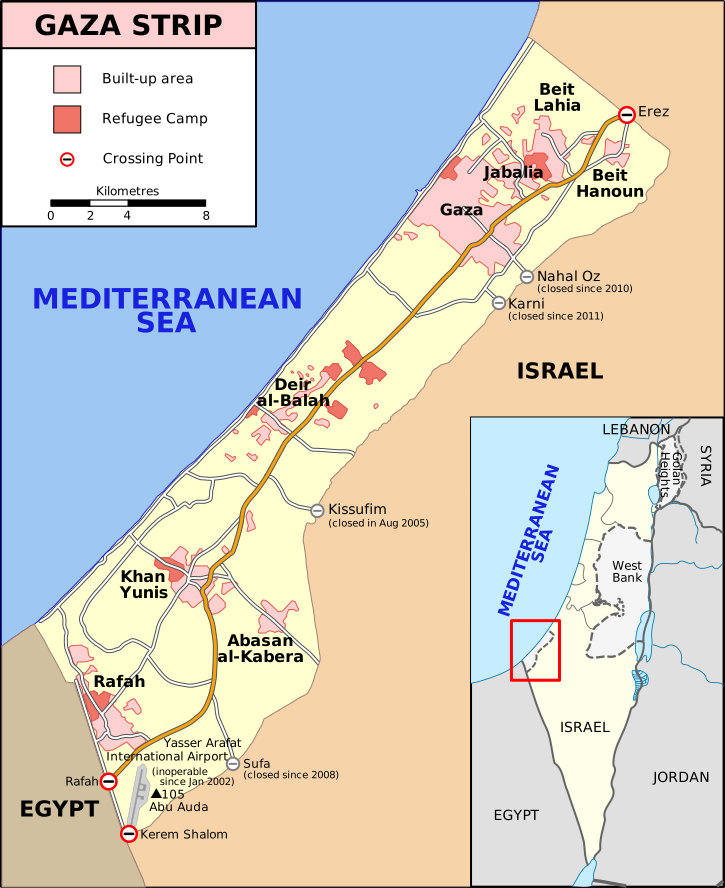
One more thing: what will Hamas or the folks in Egypt do to make maximum use of the FF2 operation?  Surely they understand that now is the time to overwhelm the Israeli security forces, not later.  Soon the Israelis will have their full attention on the FF2 and if something "big" happens in Rafah or even along the other crossing points into Israel the Israelis will be overwhelmed.  The Israelis typically expect the Arabs to act passively and I am confident that if Hamas decided to engage into a surprise operation (say large civilian protest in North Gaza combined with a simultaneous commando sortie on Israeli positions along the Khan Yunis or Rafah districts) they would rapidly panic.  Sure, they will eventually re-group and regain control of the situation, but that will be too late to prevent a deepening of the sense of doubt,  fear, and insecurity in the Israeli general public.

Unlike the FF2 organizers, Hamas has the means to secretly plan and prepare a coordinated operation.  But does it have the strategic vision to do so?  So far, Hamas has shown some excellent tactical skills combined with an appalling strategic blindness and my hopes are not very high that Hamas will do anything at all to help the FF2 or even use this opportunity to weaken the Israeli grip on Gaza.

As I said above - so far so good.  And I hope that all my fears are unjustified, that they are an expression of my natural paranoia and not of how things are shaping up.  When I feel really discouraged, I remind myself that I can always count on the boundless arrogance of the Israelis who are clever, of course, but who are only clever fools whose racist delusions only serve to hasten the inevitable demise of their ugly experiment in a racially pure "Jewish state".  They are their own worst enemies.

In the meantime, my thoughts and prayers are now with all the decent and courageous people on the FF2.  May God keep them safe!

The Saker

Tuesday, June 1, 2010

Breaking News: Mubarak opens the Rafah crossing

According to Le Monde Mubarak has just ordered the opening of the Rafah crossing into Gaza.

Ynet and al-Jazeera confirm. Ynet adds:

It remains unclear whether the move has to do with the failed aid flotilla to Gaza, because the crossing opens once a month for a few days. Palestinian and Arab officials are pressuring Cairo to keep the crossing open indefinitely.

Saturday, May 29, 2010

The Freedom Flotilla is approaching Gaza!

Follow all the developments live by clicking on this link:


"Join us as we travel to Gaza. Witness what happens on board the boats. Watch our videos everyday. Stay tuned for WitnessGaza"

Thursday, May 27, 2010

Humanitarian Flotilla Vs Evil Navy

by Gilad Atzmon

Haaretz reports today that Israel will attempt to block the humanitarian Freedom Flotilla heading toward Gaza. However, according to the Israeli paper, the humanitarian cargo would then be unloaded, inspected and sent to Gaza overland via the United Nations.

Typical for Israel, it tries to win a lost battle. On the one hand, by stopping the flotilla Israel attempts to maintain its regional status as an omnipotent super power that controls the land, the air and the sea. On the other hand, the Jewish state pathetically also wants to evoke sympathy for being ‘sensitive’ to humanitarian issues and the Palestinian plight.

The Israeli government fails to gather that the tide has changed. We see through them. We all know what the Jewish state stands for. We all know about the devastation in Gaza, we know about the siege, the destruction and the crimes against humanity. We all watch the Israeli separation wall cutting through Palestinian family's houses and olive orchards. We also follow the racist ethnic cleansing in East Jerusalem. The Israelis better save us from their spins and manipulations.

In case the Israelis still fail to see it, they are dealing this time with an international flotilla that is sailing under Turkish and Greek flags, a fleet that carries 800 enthusiast activists from all over the world. The Israelis are dealing with peace lovers who are determined to break through the siege and deliver medical aid, cement, paper and food. On the deck we have 35 European parliamentarians who must have decided to say NO to Zionist fund raisers. This flotilla is a clear signal to Israel that the game is over. Israel is now all but officially isolated. All that is left for Israel is to come to terms with its true nature: a shameless racist, murderous and terrorist state.

Militarily and politically Israel locked itself into a limbo. For the Israelis it is a “no win situation. The Israelis may have the military means to stop the flotilla from accomplishing its humanitarian mission. The Israeli Navy can easily block the flotilla's way, it can also impose an electronic blackout around the ships, such an act may lead to the loss of communication with the humanitarian mission. Israel would then have to act militarily.

Yet, taking control over 8 ships and 800 activists armed with relentless will and backed by many cameras is not going to serve the Israeli interest. If Israel dare use force, this will backfire. We also have to bear in mind that this time the Turkish Government is closely monitoring the situation and openly supporting the mission (350 Turkish nationals are onboard these ships - VS). Israeli aggression at sea could lead to an evolving incident with some unpredictable consequences. Israel better give up on any attempt to stop the flotilla.

On a further note, the Israeli Government and the Israeli people better start to come to terms with the fact that the game is soon to be over. The Zionist project and the Israeli state is in a state of moral bankruptcy. From that perspective the flotilla is not just a humanitarian mission, it is actually a reminder for all of us of the true meaning of humanism.

Thursday, January 29, 2009

Israel officials face war crimes investigation in Spain

Ha'aretz reports: A Spanish judge has opened a probe of seven current or former Israeli officials over a 2002 bombing in Gaza that killed a Hamas militant and 14 other people, including nine children.

Judge Fernando Andreu said the attack by Israel, which targeted militant Salah Shehadeh in a densely populated civilian area, might constitute a crime against humanity.

The judge is acting under a doctrine that allows prosecution in Spain of such an offense or crimes like terrorism or genocide even if they are alleged to have been committed in another country.

Andreu announced the probe in a writ issued Thursday. The people named in the suit include Dan Halutz, former Israel Defense Forces Chief of Staff and Israel Air Force commander at the time, as well as Benjamin Ben-Eliezer, then defense minister and now the minister of infrastructure.

Meanwhile, Israel is preparing for a wave of lawsuits by pro-Palestinian organizations overseas against Israelis involved in the latest Gaza fighting, claiming they were responsible for war crimes due to the harsh results stemming from the IDF's actions against Palestinian civilians and their property.

Senior Israeli ministers have expressed serious fears during following the war about the possibility that Israel will be pressed to agree to an international investigation of the losses among non-combatants during Operation Cast Lead; or alternately, that Israelis will be faced with personal suits, such as happened to Israeli officers who were accused of war crimes in Britain for their actions during the second intifada.

Saturday, December 27, 2008

Israel begins its much announced assault on Gaza - what is next? (UPDATED!)


Israel's lack of options - sympathy with the devil?


After weeks of rumors, speculations and not so veiled threats, Israel has finally begun its assault on the Gaza strip. Predictably, it began with F-16 airstrikes at "Hamas targets" and, equally predictably, the hospitals in Gaza are filling up with many casualties (190+ killed and many more wounded). Actually, this is the "least-bad" strategy for Israel as it makes it possible to achieve a number of simple objectives:

  • Destroying as much as possible of the Hamas infrastructure in Gaza thereby "softening up" Hamas in preparation of a ground assault
  • Killing a number of Hamas officials with the same aim as in above
  • Scaring the Palestinians in Gaza, think of it as an Israeli version of "shock and awe"
  • Exposing as little Israeli lives as possible (Hamas has proved that it can destroy Merkavas)
  • Scoring political brownie points with the Israeli public opinion by appearing "firm" and "doing something"

So far so good, but what comes next?! There the outlook for Israel looks much much bleaker and the choice of easy options rapidly shrinks to very little. Let's look at four basic possible options the Israelis can pick from:

Gradually phasing out the attacks and come back to some kind of deal with Hamas:

While otherwise not unreasonable, this option is unlikely to be very attractive for the Israelis for a simple reason: it solves nothing, it only freezes the conflict and pushes the hard and inevitable decisionmaking time further in the future. In this logical, the current airstrikes are just a way to bring Hamas to the negotiating table assuming, of course, that that kind of strikes would somehow inspire the Palestinians to accept living in the biggest concentration camp on the planet.

Sustaining an air campaign against Gaza for a long(er) period of time:

Think of it has "crowd control with F-16s", only unlike what the Americans are doing in Iraq and Afghanistan. For the Israeli politicians this is always an attractive choice - killing Palestinians in great numbers while not risking spilling "Jewish blood". First problem with this option: F-16 tend to run out of targets very fast, at least when they are used for crowed control. Second problem, this gives no incentive whatsoever to Hamas to do anything but increasing the tempo of its missile strikes at Isarel. Third, this is a PR disaster for the already universally despised "only democracy in the Middle-East". Lastly, this "solution" really solves nothing, it's just a more brutal version of the first option (freezing the conflict).

Initiated a limited invasion of Gaza

The danger of that option is immediately apparent to any Israeli politician: the loss of "Jewish life". Even a limited invasion of Gaza is absolutely guaranteed to result in the death of Israeli soldiers. Still most Jews could be convinced to accept these deaths if they believe that less Jewish lives would be at risk from doing something than from doing nothing. Problem - even once postulated that some limited Jewish casualties are acceptable this option seems devoid of any real military rationale. Think of it, what could be achieved in such a limited attack? As the example of Falludjah has shown, Hamas forces will have no difficulty redeploying deep into Gaza if pressed hard and while in normal warfare retreats are very dangerous to execute, in the mostly urban condition of the Gaza strip Hamas forces will, no doubt, be able to pull back very safely when needed (remember how much time Hamas had to prepare for this invasion). Just "squeezing" Gaza around the edges makes no sense at all, and its not like Hamas needs to get right to the edge of Gaza to fire its rockets (and even short range rockets could then be re-directed at Israeli forces participating in the operation). As with all the options above, the "limited invasion" option achieves nothing real. It could be a feel-good "psychotherapy" for the insecure Israeli public, but the feel-good effect would not last very long.

A full-scale invasion of Gaza

That's the big one, the option which definitely change the situation on the ground, doubt here, but would it change it for better?

First, that means taking on about 15'000 Hamas fighters plus another 1'000-1'5000 Iz al-Din al-Qassam operators and taking them on in a highly prepared urban environment in the midst of 1'500'000 Palestinians fully supportive of Hamas. Even if Hamas fighter are nowhere near the level of capability of Hezbollah operators, taking them on inside Gaza is a highly nontrivial task. This could also take a lot of time with no easy, fast, victory to show for. Even if the Israelis managed to fully occupy Gaza and take control of all its main objectives, there would be enough Hamas fighters left in the Strip to immediately initiate a resistance campaign. Then there is the issue of the inevitable civilian toll that such an invasion would result in. Of course, Israeli Jews don't give a damn about killing Palestinians, but just imagine the PR disaster such a butchery would result in for the "only democracy in the Middle East which shares our Western values"! No amount of alarmist warnings about the "new Antisemitism" or the "next Holocaust" will help cover up the horrors of a full-scale invasion of Gaza (although a major war elsewhere, say between India and Pakistan, or another well-timed "9/11" might do the trick).

A full-scale invasion of Gaza also begs the question of the end result sought. To put the Israelis back in charge of a Mega-prison with 1'500'000 Palestinian inmates? That would mean taking on the responsibility of the conditions inside the strip - a logistical nightmare even if taken on only for propaganda purposes.

No, short of simply killing them all, or at least most of them, there is no workable "solution" for the Gaza problem the Israelis are faced with. Nor do they have a solution for the "Hezbollah problem" in Lebanon, or the "Arab problem" inside Israel problem. Heck, I would even argue that Abbas and his Fatah thugs have outlived their utility and that soon there will be an equally frustrating "West Bank problem" for the Israeli leaders to tackle.

The reality is simple - Israel is running straight into the wall of reality: there is no way a state based on racism and violence can survive in the long term. To cling on to their racist dream of a "Jewish state" the Israeli Jews need to come to terms with the fact that the only way to achieve this is to kill or deport the vast majority of Palestinians and that is simply not an achievable goal to begin with. Even more importantly - there is only one viable alternative to the murder or deportation of most Palestinians: giving up the sick dream nightmare of a "Jewish state" and accepting the inevitability of the "One State Solution" of a single, unitary state based on the simple "one man one vote" (the "Two State" nonstarter has already petered out before even coming into existence).

I don't think that the Israeli Jews are anywhere near coming to accept the inevitability of a non-racist "one state", not by a long margin, thus the utterly senseless violence with continue *without* any kind of real strategy or vision behind it.

Remember who is ruling Israeli today (at least formally): Ehud Olmert, the guy who totally FUBARed Israel's idiotic war against Lebanon in 2006. This guys is a born looser, somebody in the same league as Dubya or Saakashvili - expect nothing even remotely reasonable from him. Would Livni & Co. do any better? I don't think so. I think of Livni as the "Israeli Obama", "racist imperialism with a human face": same ugly policies - different person in charge of promiting them.

Olmert and Livni will kill Palestinians simply because that is what they are capable of. There is no need at all for any long-term strategy: the Israelis are not "result oriented" - they have, for a long while already, become purely "activity oriented" with a basic and simple rationale: if there is a problem - let's just kill more Palestinians.

What is going on in Gaza is senseless. It is also an disgrace for all of civilized mankind who mostly just sits there and watches how the Zionists are going berserk killing and maiming thousands of people in the futile pursuit of a sick racist fantasyland which will never happen.

And the end of this is nowhere in sight.

The Saker

UPDATE 1: According to al-Manar, the number of victims is now as high as 225+ dead and another 700+ wounded. There can be no doubt now that Israel has committed major war crimes (again, what else is new?).


Al-Jazeera report about the first day of bombings in the Gaza strip:


Hamas press conference video:


Iranian TV reports about the carnage in Gaza:

Thursday, December 25, 2008

Is Israel about to re-invade Gaza?

al-Manar reports:

Israeli Army Gets Green Light for Gaza Operation

The Israeli defense establishment is currently preparing for a military move against Hamas targets in Gaza after it received the green light Wednesday from the Israeli Cabinet.

During a cabinet meeting about the situation in and outside the Gaza Strip, a senior Israeli occupation army officer gave ministers in attendance an overview of the potential retaliatory moves that the defense establishment is planning against Hamas' regime. A media blackout was declared on the deliberations.

By late morning Wednesday, the Magen David Adom rescue service declared its highest level of alert.

An Israeli official told Israeli daily Haaretz that Israel's response will go beyond the air raid, "Our response will be substantial and painful to Hamas," the official said.

Most strikes will come from the air and be aimed at facilities believed to be of strategic importance to Hamas' political and military leadership. However, the officer said that weather conditions are currently preventing the air force from launching the raids.

According to officials in Tel Aviv, the overview also included a special reference to the possible implications of attacking Hamas.

"We are not eager to strike, but we will not hesitate to act," one official said. "If Hamas is looking for noise, we will make Gaza very noisy."

Prime Minister Ehud Olmert's government claimed it had shown restraint until now but vowed to act if the salvoes continued.

The same official said that Israel would be willing to extend the June cease-fire, which expired last week, if Hamas would agree to resume it.

Israeli Foreign Minister Tzipi Livni is expected to arrive on Thursday in Cairo for a meeting with Egyptian President Hosni Mubarak, whose administration helped facilitate the cease-fire. Sources close to Livni said she intended to tell Mubarak that Israel will not accept Hamas' current terms for a ceasefire. Hamas' statements also contained a similar mix of threats and assurances.

Meir Yifrach, head of Sdot Negev Regional Council, said that the current situation was intolerable and that "the people of the southern region of Israel are demanding that the government order the army to act in Gaza so that civilian life may be allowed to return to normal."

Israeli Defense Minister Ehud Barak said Wednesday night that he had ordered the Israeli army to prepare itself to deliver a "response" to the rocket attacks fired by the Islamic resistance groups in Gaza. He said Hamas was responsible and would pay a price.

"Anyone who hurts Israeli civilians or soldiers will pay the price in a big way," Barak said in an interview on a Channel 2 talk show. "We will bring the solution, and we will not let this situation continue."

Israeli defense officials said the army now had approval for a number of operations that would likely include heavy air strikes against Hamas and Islamic Jihad targets, as well as pinpoint ground operations against resistance infrastructure.

The ambiguity about the timing of an army operation was in line with what Olmert told the security cabinet on Sunday - that Israel would not give Hamas a "promo" of when and how it would respond.

However, hints that Israel's response was well on the way could be found in a statement a government official released after the four-hour security cabinet meeting.

"Hamas bears sole responsibility for the deterioration in the South. They deliberately undermined the understandings reached through Egypt, and they acted to destroy the calm," the official said, in what sounded like an explanation to the world of why Israel needed to act.

Meanhile, the Palestinian resistance factions said that more than 70 mortar shells and Katyusha and Kassam rockets pounded the Negev. The barrage hit communities throughout the South, reaching as far north as Ashkelon and as far south as Kerem Shalom. At least two Grad-model Katyusha rockets were fired into Ashkelon on Wednesday, and a Kassam with extended range hit Netivot. Nearly 60 settlers were treated for emotional trauma and anxiety.

"Hamas will hit not only Sderot, but also what lies beyond Sderot," Hamas legislator Mushir al-Masri said, in a possible reference to extended ballistic capabilities.

Other spokespeople said the organization will agree to "resume" the ceasefire, if the organization's conditions are met. Hamas is demanding an improved ceasefire agreement that also includes the West Bank.

In a statement by Hamas' military wing, Iz al-Din al-Qassam, a spokesperson warned that "thousands of additional Israelis will soon be within the range of our rockets if Israel continues with its aggression."

"The residents of the south will stay in the bomb shelters for a long time," the Hamas statement continued, adding that "threats of an [Israeli] military offensive don't scare us because we are more prepared than ever."

All Israeli towns within a 30-kilometer radius of the Gaza Strip were hooked up on Wednesday to an early warning system designed to deliver rocket launch alerts. Among the newly-connected towns and cities are Ofakim and Netivot.

Ashdod, with its center just outside the 30-kilometer mark, is expected to be connected to the system within the next 24 hours. Some towns are already connected to the "Color Red" system, which alerts residents living within a seven-kilometer radius of the Strip.

Friday, December 19, 2008

Lebanon Raises The Voice: Freedom for Gaza!

Al-Manar reports:

Action to end the inhumane Gaza siege has started from Lebanon…

Lebanon, the country of Resistance and patriotism, raised on Friday the voice in response to Hezbollah Secretary General Sayyed Hasan Nasrallah’s call, expressing solidarity with the Palestinian people amid a "suspicious" Arab and international calm.

On Monday, Hezbollah Secretary General Sayyed Hasan Nasrallah called upon all Arabs and Muslims to start actions against the siege. His eminence has called on all Lebanese, regardless of the political affiliations, to take part in the action given the importance of the central cause of Palestine. "I call on all the Lebanese, regardless of whether they are loyal to March 8 or 14, to participate in the demonstration that Hezbollah will organize on Friday at 2 PM," Sayyed Nasrallah said.

The response was quick. Lebanese, from all regions, answered on Friday the call… Tens of thousands of Lebanese and Palestinians took part in the first announced step in the massive movement to protest the inhumane siege, call for freedom of Gaza and reject the Arab official calm.

The central protest took place at the southern suburb of Beirut. Even before 2 PM, protesters flocked to the Sayyed al-Shouhadaa' complex from where they marched throughout the streets of Dahiye.

Hezbollah Deputy Secretary General Sheikh Naim Kassem delivered Hezbollah’s speech and criticized Arab silence saying Gaza should not be treated like this. "The child of Gaza is more honourable than you and your positions and he will triumph, God willing…The people of Gaza will never be defeated because they’ve chosen the path of resistance." His eminence stressed that "we are not with the humiliating settlement…We are with the resistance."

"Freedom for Gaza" was the main slogan. "Death for America, Death for Israel," they shouted in one high voice. "Palestinians will stay in Palestine, Zionists are the ones who will go out," the protestors also shouted.

The splendid scene witnessed in the southern suburb of Beirut was also reflected in other regions from the North to the South, where the Lebanese and the Palestinians answered the call and raised their voice.

In this context, Saida, the capital of the South, witnessed one of the major movements. MP Oussama Saad addressed the crowds and saying that officials in all Arab states should possess the will of confrontation and resistance, the will of safeguarding Arab dignity as well as the blood of the martyrs. He called on all free and noble people in Lebanon and the Arab world to stay united against the Gaza siege.

The Bekaa region also witnessed massive rallies in solidarity with besieged Gaza. Under the slogan "silence was siege in itself," the Lebanese and the Palestinians took part in the demonstration and called on their fellow Arabs and Muslims to join them. Hezbollah Shoura Council member Sheikh Mohamad Yazbek stressed Allah will undoubtedly render Gaza victorious as its people has shown a high level steadfastness and patience. His eminence also underlined the fact that Israel will cease to exist. “Gaza is decrying the weakness that has plagued the Arab and Islamic nations and regimes. Arab silence is encouraging the others to do what they are doing now.” Sheikh Yazbek expressed regret that the government of Egypt continues to close the Rafah crossing.

In Tripoli, north of Lebanon, the head of the Islamic Work Front Sheikh Fatho Yakan urged all Palestinians to unite and stop internal blood shedding. He called on the Palestinians to engage in a united resistance project “to gain back honor,” by following the example of the resistance in Lebanon. The Front’s branch in Beirut observed a sit-in in solidarity with Gaza. Sheikh Dr. Abdul Nasser Jabri stressed the necessity to support the Palestinian people with every possible means. “We should press all Arab and Islamic regimes as well as the free international community to end the siege of Gaza,” he said.

Several villages in the Iqlim Kharroub region in south of Beirut observed a sit-in following Friday prayers with the participation of opposition party officials.

Thursday, December 18, 2008

Hamas announces end to truce with Israel

Press TV reports:

The Palestinian resistance movement Hamas, has announced the cessation of the six-month-old ceasefire with Israel in the Gaza Strip.

"The calm, which was reached with Egyptian sponsorship on June 19 and expires on December 19, is finished because the enemy did not abide by its obligations. The calm is over," Hamas official, Ayman Taha, said on Thursday.

The announcement raises the prospect of an escalation in cross-border fighting.

Hamas had earlier ruled out renewal of truce in and around Gaza and insisted that authorities in the Palestinian territory have a duty to respond to any attack by Israel.

"There is no possibility of renewing the truce which ends on December 19 (Friday). The Zionist enemy destroyed it. We at Hamas have the right to respond to any Zionist aggression against the Palestinian people. It's a national duty," Hamas spokesman Fawzi Barhum said on Thursday.

He noted that the movement would act according to the situation on the ground.

The Egypt-mediated ceasefire between Israel and Gaza came into effect on June 19, under which Israel promised to stop attacks on Gaza and ease the blockade in exchange for an end to retaliatory homemade rocket attacks.

Israel, however, has carried out several military incursions into the Gaza Strip and has kept all Gaza's border crossings closed since November 4.

In response to a stepped-up blockade of the costal strip and the killing of an Islamic Jihad Movement member, Palestinians in the besieged Gaza Strip on Wednesday fired 10 Qassam rockets at the southern Israeli town of Sderot during which three people suffered slight wounds.

Gaza Strip is experiencing a humanitarian crisis which has left more than 1.5 million residents in the region without basic supplies, including food. Patients are dying due to a shortage of vital medical supplies.

Friday, December 12, 2008

Iran holds Egypt liable for Israeli crimes

Press TV reports:

A senior Iranian official says Egyptian support for Israel makes Cairo accountable for any crime committed in the Gaza Strip.

"Egypt has closed the Rafah crossing and tightened the siege (of Gaza)," said Ayatollah Seyyed Ahmad Khatami, a member of the Iranian Assembly of Experts, at Tehran's Friday prayers.

Tel Aviv placed the Gaza Strip under a blockade after the democratically-elected Palestinian government of Hamas took control of the coastal area in mid-June 2007.

The UN Human Rights Council declared on Tuesday that Israeli policies against the Palestinians and the blockade of the Gaza Strip as "crime(s) against humanity."

In response to the UN report, Israeli ambassador in Geneva Aharon Leshno Yaar said Tel Aviv "remains committed to reinforcing areas in which we are succeeding and bettering those areas that need improvement."

According to UN human rights rapporteur Richard Falk, however, Tel Aviv was responding to what he described as low-level criticism by "normally cautious UN officials". Falk suggested Israeli crimes to be worthy of an International Criminal Court investigation.

Despite its objection, Israel was forced to permit deliveries of humanitarian aid and gas to Gaza on Tuesday after days of full closure of all Gaza crossings.

On Friday, Ayatollah Khatami said "certain Arab leaders" should also be investigated by international courts for aiding and abetting Tel Aviv in its crimes.

"Certain Arab leaders should be tried as 'betrayers' for all Israeli crimes in the occupied lands and the Gaza Strip," the Iranian cleric continued.

Records show that since the imposition of the blockade, 260 patients have died, 75 percent of Palestinian kids are suffering from malnutrition, and 40 percent of ambulances have stopped working due to the lack of gas, Khatami added.

The Hamas movement has urged the international community to force Israel to lift the siege after the release of the UN Human Rights report.

"If the UN says that the tight siege on the Gaza Strip is a war crime, we wonder why Arab leaders do not demand the reopening of the Rafah crossing," said Barhoum.

The Rafah crossing connects Egypt to the Gaza Strip inhabited by some 1.5 million Palestinians.

Thursday, November 27, 2008

Gaza - humanitarian aid VERBOTEN!

Wednesday, June 11, 2008

Egyptian traitors train in Texas

Ha'aretz as published an article entitled "U.S. Army training Egyptians to find, destroy smuggling tunnels" which describes how Egyptian soldiers are trained by the US Army to prevent any tunnels being dug out of the open air prison of Gaza. Ha'aretz writes:

The United States Army has begun training Egyptian soldiers to locate and destroy tunnels, in an effort to improve the Egyptian army's ability to cope with arms-smuggling from Sinai to the Gaza Strip. A second, larger group of Egyptian soldiers is also due to arrive shortly for training, which is taking place at a U.S. Army base in Texas. The U.S. Army Corps of Engineers is teaching the Egyptian troops how to use advanced technological equipment to find and destroy the tunnels, including instruments that measure ground fluctuations and signal that a tunnel is being dug. There has already been some improvement in Egypt's anti-smuggling activity, said (Israeli) Brigadier General Yossi Baidatz, who heads the Military Intelligence research division.

When I read this I wondered how these soldiers would be greeted in Egypt upon their return from this training and how they would be seen once they begin to use their newly learned skills to choke their imprisoned Palestinian brothers and sisters in Gaza.

It is customary to consider the collaborators of an invading force as traitors and collaboration is usually seen as a capital offense. These Egyptians do not even have the excuse of living under an occupation and one has to conclude that they are willing collaborators of what is a war crime and, possibly, a genocide in progress. Are they denounced as such in the Arab press? Does any Muslim religious authority denounce them as apostates? Has Hamas ever stigmatized them for being traitors?

Wednesday, May 21, 2008

Major developments in the Middle-East

A deal has finally been reached in Doha.

The BBC reports that the Western-backed government and the pro-Syrian opposition arrived at the deal after days of talks in Qatar. Under the deal, the opposition - led by the Hezbollah political and militant group - will have the power of veto in a new cabinet of national unity. It also paves the way for parliament to elect a new president. The post has been empty since November.

Correspondents say the agreement is a major triumph for Hezbollah, whose key demands have been met.

At the same time, Israel and Syria are holding peace talks in Turkey. According to Press TV Israel promised to return the Golan Heights to Syria.

Lastly, al-Manar reports that Israel is planning a major military operation in Gaza. According to this version, Israel would launch a major attack on Gaza if the current negotiations with Hamas (via Egypt) fail.

Tuesday, April 15, 2008

Sadr City is being "Gazatized", turning it into yet another Imperial Gulag

We all now that Gaza was, until now, the biggest open air prison in the world, a Gulag for Palestinians, so to speak. Now the Empire is in the process of "Gazatizing" (as in "Gitmoize Abu Ghraib") and creating an even bigger (3'000'000+ people!) Gulag for Iraqis.

Check out Pepe Escobar's report for Real News Network:


One needs to remember that the Empire just suffered a rather humiliating defeat in the battle of Basra. As Clinton had done after failing in Kosovo, and just as Olmert did after having his "elite" forces defeated by Hezbollah, Bush is now making the civilians pay for their support for the Sadrists.

It is also quite apparent that the Zio-Americans have learned their lesson from the Hamas election debacle and that they have no intention of allowing the Sadrist to participate in the next elections. So in this sense, the upcoming Iraqi elections are also being
Gazatized.

So there we have it. The Israelis have taught their American puppets well: Gaza has become the nightmarish "model home" for the many Gulags in which the Empire intends to house all those who dare oppose it.

Tuesday, March 25, 2008

Saker interview with the Palestinian Pundit

It is a great honour and long awaited pleasure for me to interview a real expert on Palestine and the rest of the Middle-East: Tony, the author of what is definitely one of the best Palestinian blogs - Palestinian Pundit, a "must visit daily" for anybody interested in the Palestinian drama.

I have been reading Tony's posts for quite a while already (many thanks to datta for drawing my attention to it) and I had planned to interview Tony for several months already, but the situation in Palestine took such a turn for the worse that neither Tony nor I had any time left to work on an interview. Things have not improved, Palestinians are still being murdered on a daily basis by the Israeli occupation forces, and since things are only likely to get worse, I have decided not to wait any further and ask Tony for his insight about the current situation and its likely development.

I am deeply grateful to Tony for taking the time to answer my questions. I know that he is immensely busy in his professional life and that, on top of that, he still manages to be a (quasi) full time "blogging machine" (as datta once put it to me) on his 'free' time.

-------

Tony, please introduce yourself to our readers and tell us under what circumstances you decided to start a blog which became one of the most informative and interesting blogs among all the Palestinian blogs. For the sake of full disclosure, how would you define your political sympathies in the Palestinian context.

I am a Palestinian who was born in Jaffa Palestine in 1945; the family was expelled from there in 1948 when Israel was established and about 800,000 Palestinians became refugees. Grew up as a refugee in Gaza; went to college in Cairo, Egypt; came to California to do graduate work in 1967 (right after the so-called 6-day war), and stayed here since.

I have been, like many Palestinians, an outspoken defendant of Palestinian rights and I do what I can to expose Israeli crimes against the Palestinians and the US full complicity in these crimes.

Actually, I did not set up the blog. I used to frequently visit the blog of professor As’ad Abu Khalil (Angry Arab) and make various comments. I guess I was outspoken enough and made enough noise that one of the regular visitors, who happened to be Jewish but a supporter of the Palestinians, told me to start a blog. I told her that I was not interested and I had no time! She, on her own, set up the blog, and chose the name. In the beginning she used to contribute to the blog but she opted out later on. The blog was started in July 2006.

My political sympathies in the Palestinian context are secular, nationalist, pan-Arab and leftist. I am not opposed to nationalist, progressive anti-imperialist Islamic forces as long as they concentrate on fighting occupation and defend their own people from foreign intervention and domination.

Could you please outline your view of the situation in Palestine and, in particular, the situation in the West Bank about which so little is written. How strong and stable do you believe the power of Fatah to be there? Do you see a replacement of Abbas by either one of the Barghoutis (Mohammad or Marwan) something which could salvage Fatah's power in the West Bank? Does Hamas still operate as an organization in the West Bank or is it totally underground?

The situation in the West Bank is that of tightly controlled occupation with rapidly expanding colonization. The goal is to imprison the remaining Palestinians (after squeezing out as many as possible, through very repressive policies of arrests, confiscation, home demolitions, control of movement, outright terror by Zionist colonizers, etc) in a few cantons or reservations if you will.

The so-called Palestinian Authority (PA) has been fully inducted as a collaborating quisling entity which fully coordinates with the Israeli occupiers the hunting down, arrests, disarming and killing of Palestinian resistance elements. Through the so-called Oslo-process, ensuring the security of Israel is considered the key role of the PA. For that purpose the US, through its designated coordinator of security General Keith Dayton, arms, finances and trains puppet PA forces to assist the Israeli occupation. The policies of the PA in the W.B. have been very repressive, where journalists have been arrested, demonstrations and public opposition banned by lethal force, and key figures of the opposition arrested and tortured, some to death. Corruption is rampant in order to buy the loyalties of the few. The PA in the W.B. has best been described as a police state without a state.

Fatah is very fragmented and weak and many observers doubt if it will survive. The collaboration of its leadership with the occupation and their participation in the siege and starvation of fellow Palestinians in Gaza have totally discredited Fatah in the eyes of most Palestinians.

Since the Oslo ”process” and its Annapolis sequel have accomplished absolutely nothing, Abbas, the PA and Fatah who placed all their bets on negotiations only, are living their worst nightmares. Many observers believe that the PA is on the verge of collapse. Israel and the US might decide to keep some rump quisling entity as a replacement, but who knows. If the PA faces collapse, USrael will seek to find some younger “leader” who could be sold to the Palestinians as their new “leader.” I believe that Marwan Barghouti, who is in Israeli jail serving more than one life sentence will be that figure. Some Israeli leaders have been calling for his release; why now?

Hamas is openly fought in the W.B. by the PA, and even charities and orphanages have been closed down and their assets confiscated. There is still a lot of support for Hamas in the W.B. but the armed elements remaining had to go underground to survive.

The Hamas operation of bringing down the Wall was nothing short of brilliant and, for a while, it looked that it would be impossible to bring it back up and that Mubarak would risk his own political future if he tried to do this. Alas, he did bring it right back with and without any visible Hamas response. Why is this? Why did Hamas not fight as hard as can be to keep the Wall down? Has the Hamas leadership been corrupted/coopted by the Empire?

As you said toppling the wall with Egypt was brilliant and the jail break was breathtaking and unprecedented. Why was the momentum not maintained? One can speculate:

1. Egypt made some promises to buy time and I think that some within Hamas were a bit naive and bought those promises. After gaining the needed time to re-close the border, Egypt reneged on the promises.
2. The people in Gaza, Hamas included, are exhausted not just by the siege but by the relentless Israeli attacks which lately killed over 130 Palestinians in less than a week. So, Hamas needed a respite.
3. The US has asked Egypt to play a role in order to calm the situation between Hamas and Israel a bit. There was a concern that with the images of slaughtered Palestinians being shown day after day by Al-Jazeera, among others, that there was some risk of boiling over in the Arab street. The US wants to line up the Arab street behind its plans to attack Iran. So, Hamas was playing the game through Egypt of trying to arrange a calming down with Israel. Therefore, Hamas could not confront Egypt at the same time that Egypt was “mediating.”
4. Part of the agreement involved in a possible ceasefire with Israel is the re-opening of the Rafah crossing. This has been a Hamas demand. There has been talk of a trial opening soon with the crossing operating 3 days a week. It remains to be seen, if it is another empty promise.
5. Hamas can mobilize the people and storm the new barrier again, if all of these maneuvers lead to nothing. I don’t believe that Hamas has been corrupted or coopted. One of Hamas’ strengths is its collective leadership and decision making.

What is Hamas' game plan? What does Hamas hope to achieve with the continuing Qassam attacks on Sderot? Why is Hamas willing to risk an Israeli invasion of Gaza (and the inevitable arrest, torture and mass-murder of Hamas officials by Fatah thugs) for the sake of rocketing Sderot, but is not willing to openly engage Mubarak's forces to keep the Wall down?

There is a big difference between Hamas shelling Israeli targets and Hamas fighting the Egyptian forces. The first has contributed to the support that Hamas is receiving as the main party leading the fight against the occupation. The second would do just the opposite: it would discredit Hamas in the Arab street and be a gift to those who want to portray Hamas as agent of Iran and who is fighting fellow Arabs rather than Israel; Hamas would never do that.

Hamas, on a smaller scale is trying to copy Hizbullah through the use of simple rockets. In time, the hope is that these would become more effective. Hamas is not using the rockets without a plan. When Israel scales down its attacks, so does Hamas. Hamas is trying, by using the rockets, to deter Israel to the extent possible.

Whether Israel fully invades Gaza is a decision independent of the issue of Qassams. The Qassams are just an excuse. The problem of invading Gaza is what to do next? Israel occupied Gaza before and it could not control the situation. Now it will be much harder. Also, Israel does not want to be responsible for feeding 1.5 million Palestinians, and wants to maintain the illusion that the occupation has ended.

Do you think the Israelis will invade Gaza and what do you predict will be the consequences of such an invasion?

I think that a full scale invasion and occupation of Gaza is directly linked to a bigger question: that of the US and Israeli plans towards Iran, Syria and Hizbullah. If and when a decision is made to attack Iran, which has to be preceded by an attempt to eliminate Hizbullah in Lebanon, then it would be the time to fully invade Gaza. Until that time, the American plan is to keep the Arab street focused on Iran and not on Israeli slaughtering of Palestinians. But after the attack on Iran/Hizbullah/Syria is underway, then a full invasion of Gaza is quite likely.

After such invasion and occupation of Gaza, USrael is likely to set up some NATO/UN force in Gaza so that Israeli forces would withdraw. Similar to what happened in south Lebanon. In such an invasion, total elimination of Hamas and its leadership would likely to be a key objective. For Hamas to survive, and it will, it will go underground. By doing so, Hamas could actually become more effective.

What do you know about the situation among half a million plus Palestinians with Israeli citizenship living inside Israel proper? Are they sympathies with Fatah or Hamas? Why is there no visible resistance or show of solidarity on their part with their fellow-Palestinians in Gaza and the West Bank? Do you believe that Hamas can establish itself among these Israeli Palestinians as an organization capable of organizing any type of resistance?

The situation of the Palestinians within Israel itself (so-called Israeli Arabs), who actually number about a million (20%), is quite complicated. It is not the arena for either Hamas or Fatah to operate in, for obvious reasons. There is an independent and separate Islamic organization that seeks to speak for those Palestinians and to defend their rights. They have to walk a very narrow path lest the Israeli government accuse them of treason and to try them or expel them, as happened with Knesset member Azmi Bishara.

The best contribution of these Palestinians is to struggle for their own rights as equal citizens in a secular, democratic state for all of its citizens. Ultimately, the Palestinians in the occupied areas will find themselves in the same boat, with the demise of the two-state solution, as the Palestinian citizens of Israel. Then the struggle becomes one for both groups which is the struggle for one secular, democratic state for all of its citizens, Jewish and Arab.

The Palestinians in Israel do what they can to help the Palestinians in the occupied areas. They demonstrate in solidarity and speak out. They have organized some medical and other relief for Gaza recently as well as for the W.B. before. They challenge Israel’s courts and defend Palestinians in the occupied territories. However, within the racist state of Israel there is a limit of what they can do.

It is out of the question for Israel to allow Hamas to organize and operate among the Palestinian citizens of Israel.

How do you assess the current prospects for war in the rest of the Middle-East? The Israelis have openly bombed Syria, they have murdered Mughniyeh (whether with or without Syrian help), Lebanon is at the edge of another civil war, the USA is arming the Sunnis in Iraq and Admiral Fallon has been retired due to his opposition to an attack on Iran. What does all this mean for the Palestinian people? Do they see risks or opportunities here? What do you expect Hamas to do, if anything, in case of a war involving Israel?

I personally believe that Israel wants to attack Iran and to eliminate Hizbullah and Hamas as viable organizations. Within the US there are those who share this goal and a few (like Fallon) who do not. Israel will likely get its way and drag the US into such an attack. Hizbullah will be attacked first because it represents a first strike capability for Iran. There is a question mark about Syria. So far, Syria has avoided engaging the Israelis militarily; even when a Syrian site was bombed recently. That was humiliating for Syria. A similar thing happened in the summer of 2006 when scores of Syrian workers were killed by Israeli aircraft bombing Lebanon, very close to the Syrian border. Again, Syria did nothing. So there is a question of whether Syria would again stay out if a bigger attack on Hizbullah is attempted this time.

Hizbullah will retaliate for Mughniyeh, for sure. Whether this will trigger the USraeli attack on Hizbullah is a good question. Some believe that the assassination itself was a provocation to trigger such a war.

Iran would not be involved directly if the attack focuses on Hizbullah alone. However, an incident will be created to implicate Iran and trigger a US attack on Iran. I am convinced that Israeli leaders do not want to see Iran as a competing regional power.

How does Hamas fare in all of this? As I said earlier, the USraeli objective is to eliminate any resistance and to kill the very idea of resistance. Besides the Iraqi resistance, Hizbullah and Hamas represent the only other resistance. To finalize the total dispossession of the Palestinians an attempt to eliminate Hamas will have to be made.

Hamas and the Palestinians see the solution for the Palestinians dependent on the larger Arab context. In other words the Palestinian struggle combines with the resistance in Lebanon and in Iraq, because the enemy is the same. Hamas resists but also is buying time; it is not suicidal. The dynamics in the area will bring changes we can’t clearly see now. For example the situation in Egypt is precarious, with bread riots breaking out and a lot of discontent with the regime’s oppression of its opponents, especially the Muslim Brothers. The situation in Jordan is not much better with rampant inflation, high unemployment and open collaboration by the puppet king. Opposition forces (again mostly Muslim Brothers) have been demanding the closure of the Israeli embassy and abrogation of the treaty with Israel. So, a new large scale war involving Iran/Syria/Hizbullah/Hamas has many possible repercussions.

Why does Hamas persist in holding Gilad Shalit? What can be gained by a detention which is clearly illegal whether under the terms of the law of war (which apply during an international conflict) or human rights law (which apply during an internal conflict). Would a release of Gilat Shalit not serve to give Hamas the moral high ground? Is such a detention legal under Islamic law?

Shalit was a captured Israeli soldier. His unit was involved in shelling Gaza at that time. So, he is a clear prisoner of war. In contrast, Israel holds about 11,000 Palestinians, most of them are civilians kidnapped in the middle of the night. That includes 46 Palestinian MPs!

How can you say that holding Shalit is illegal, or un-Islamic? This is not true at all. As I said he is a prisoner of war, to be exchanged for Palestinian prisoners if and when Israel agrees to negotiate terms. Releasing him without release of at least some Palestinian prisoners would amount to treason on the part of Hamas, in my opinion, not taking the high moral ground, as you put it.

Hamas is a majority Sunni organization. Have the ideas of the Muslim Brotherhood or Saudi Salafism penetrated into the Hamas worldview and policies? What is Hamas' position concerning Shia Muslims or, probably more relevant in the Palestinian context, Arab Christians? Does Hamas share the strong hostility towards the Shia and the Christians which is so obvious among the followers of Sayyid Qutb or Muhammad ibn 'Abd al-Wahhab at-Tamimi ? Are there Christians inside Hamas and, if yes, what is their status?

Hamas’ roots and connections are to the Muslim Brotherhood and not Saudi Salafis. Hamas has a view that all Palestinians are in this together, including Christians. Hamas has gone out of its way to protect Christians and their churches and properties in Gaza. I do believe that Hamas’s leadership is enlightened and inclusive. I don’t think that there are Christians in Hamas, but in the last PLC elections, Hamas supported at least one independent, Christian candidate.

Hamas does not play on the Sunni-Shia divide; to the contrary it believes that all Arabs and Muslims should pool their resources and efforts to fight the common enemy and not each other. Hamas has excellent relations with the Shiite Hizbullah and has received at least some support from Iran. Hamas welcomes support from all those willing to help.

The debate on the "One State" versus "Two State" solution has recently heated up with Micheal Neumann, Jonathan Cook and others weighing in. Has Hamas taken a clear stand on this issue and, if yes, what is it? What about yourself, which side of this debate do you support?

Without using labels, I interpret Hamas’ position as supporting both solutions. While that sounds contradictory, it is not. What Hamas is saying is that it would accept a long term Hudna (truce) during which time a two-state solution, with a real independent Palestinian state, would be acceptable. After that, Hamas is calling for ultimately dismantling the racist, Zionist state, paving the way for one democratic state for all, including Palestinian Jews willing to live as equal in one Palestine.

While a one state solution is being advocated more and more, it is meaningless without dismantling Zionism. That dismantling is going to take time, and it would be unreasonable to expect the Palestinians to endure under the present horrible conditions. So, if a two-state solution can emerge in the interim, then that would be more just and humane for the Palestinians, but not as a permanent and just solution. That would not solve the problems of the refugees and their right of return nor would it address the status of Palestinians within Israel. Those issues can only be resolved within a one-state solution that would evolve after dismantling Zionism. This is my view.

Monday, March 17, 2008

Survey: Haniyeh more popular than Abbas in PA

By Reuters (via Ha'aretz)

Israel Defense Forces attacks in the Hamas-controlled Gaza Strip have boosted the popularity of the Islamist group's leader Ismail Haniyeh among Palestinians in that territory and in the West Bank, according to a poll released Monday.

The survey by the West Bank-based Palestinian Center for Policy and Survey Research showed that if new presidential elections were held, Haniyeh would receive 47 percent of the vote compared with 46 percent for President Mahmoud Abbas of the rival Fatah faction.

The figures represented a sharp strengthening of Haniyeh's popularity. He served as prime minister in the Hamas-led government Abbas dismissed after Hamas seized the Gaza Strip from Fatah in June.

But the survey also found that Fatah leader Marwan Barghouti, imprisoned in Israel and seen as a possible Abbas successor, would defeat Haniyeh by a clear margin. The poll gave him 57 percent of the vote, compared to Haniyeh's 38 percent.

The center's previous poll, in December, gave Gaza-based Haniyeh just 37 percent of a potential presidential vote compared with 56 percent for Abbas, whose peace efforts with Israel are opposed by Hamas.

The latest poll was conducted shortly after Israel ended an offensive in the Gaza Strip in early March that killed more than 120 Palestinians, almost half of them were identified as civilians.

Israel said the operation was aimed at stopping cross-border rocket fire from the Gaza Strip.

According to the survey, Hamas's breaching of the Gaza Strip's Rafah border crossing with Egypt in January also contributed to Haniyeh's popularity among Palestinians.

"These developments managed to present Hamas as successful in breaking the siege and as a victim of Israeli attacks," commentary accompanying the poll said.

Lack of progress in Abbas's peace negotiations with Israel also gave Hamas a boost, the poll indicated.

The survey found that if new parliamentary elections were to take place, Hamas would receive 35 percent of the vote and Fatah 42 percent, compared to 46 percent for Fatah and 34 percent for Hamas in an opinion poll in January.

The current survey polled 1,270 Palestinians in Arab East Jerusalem, the West Bank and the Gaza Strip. It had a margin of error of three percentage points.

Hamas and Fatah far apart ahead of Yemeni mediation bid

Meanwhile, delegations from rival Palestinian factions Hamas and Fatah will travel to Yemen this week to discuss reconcilation, but the groups' leaders will not attend the talks, officials said on Monday.

The groups will meet separately with Yemeni President Ali Abdullah Saleh, but the absence of Hamas leader-in-exile Khaled Meshal and Palestinian President Mahmoud Abbas of Fatah casts doubt on any success in ending hostilities between the factions.

Hamas Islamists routed Fatah forces to seize control of the Gaza Strip in June. After the takeover, Abbas dismisssd a Hamas-led government and appointed a new Western-backed cabinet in the occupied West Bank.

Officials loyal to Abbas said the Yemeni initiative calls on Hamas to hand over control of Gaza and agree to early presidential and parliamentary elections, conditions endorsed by Abbas but rejected by Hamas.

Meshal was initially expected to lead the Islamist group's delegation, but a Hamas spokesman said the Damascus-based leader's deputy, Moussa Abu Marzouq, would be sent instead.

The spokesman gave no reason for the change.

Senior Abbas aide Azzam al-Ahmed will head the Fatah team.

Hamas spokesman Fawzi Barhoum said Hamas would only be willing to discuss reconciliation with Fatah in a "non-conditional dialogue".

"We will respect any agreements that would result from that non-conditional and open meeting, if it takes place," Barhoum said.

Tuesday, March 11, 2008

The Meaning of Gaza’s ‘Shoah’: Israel Plots Another Palestinian Exodus

by Jonathan Cook in Nazareth for Counterpunch

Israeli Deputy Defense Minister Matan Vilnai’s much publicized remark last week about Gaza facing a “shoah” -- the Hebrew word for the Holocaust -- was widely assumed to be unpleasant hyperbole about the army’s plans for an imminent full-scale invasion of the Strip.

More significantly, however, his comment offers a disturbing indication of the Israeli army’s longer-term strategy towards the Palestinians in the occupied territories.

Vilnai, a former general, was interviewed by Army Radio as Israel was in the midst of unleashing a series of air and ground strikes on populated areas of Gaza that killed more than 100 Palestinians, at least half of whom were civilians and 25 of whom were children, according to the Israeli human rights group B’Tselem.

The interview also took place in the wake of a rocket fired from Gaza that killed a student in Sderot and other rockets that hit the centre of the southern city of Ashkelon. Vilnai stated: “The more Qassam fire intensifies and the rockets reach a longer range, they [the Palestinians of Gaza] will bring upon themselves a bigger shoah because we will use all our might to defend ourselves.”

His comment, picked up by the Reuters wire service, was soon making headlines around the world. Presumably uncomfortable with a senior public figure in Israel comparing his government’s policies to the Nazi plan to exterminate European Jewry, many news services referred to Vilnai’s clearly articulated threat as a “warning”, as though he was prophesying a cataclysmic natural event over which he and the Israeli army had no control.

Nonetheless, officials understood the damage that the translation from Hebrew of Vilnai’s remark could do to Israel’s image abroad. And sure enough, Palestinian leaders were soon exploiting the comparison, with both the Palestinian president, Mahmoud Abbas, and the exiled Hamas leader, Khaled Meshaal, stating that a “holocaust” was unfolding in Gaza.

Within hours the Israeli Foreign Ministry was launching a large “hasbara” (propaganda) campaign through its diplomats, as the Jerusalem Post reported. In a related move, a spokesman for Vilnai explained that the word “shoah” also meant “disaster”; this, rather than a holocaust, was what the minister had been referring to. Clarifications were issued by many media outlets.

However, no one in Israel was fooled. “Shoah” -- which literally means “burnt offering” -- was long ago reserved for the Holocaust, much as the Arabic word “nakba” (or “catastrophe”) is nowadays used only to refer to the Palestinians’ dispossession by Israel in 1948. Certainly, the Israeli media in English translated Vilnai’s use of “shoah” as “holocaust”.

But this is not the first time that Vilnai has expressed extreme views about Gaza’s future.

Last summer he began quietly preparing a plan on behalf of his boss, the Defence Minister Ehud Barak, to declare Gaza a “hostile entity” and dramatically reduce the essential services supplied by Israel -- as long-time occupier -- to its inhabitants, including electricity and fuel. The cuts were finally implemented late last year after the Israeli courts gave their blessing.

Vilnai and Barak, both former military men like so many other Israeli politicians, have been “selling” this policy -- of choking off basic services to Gaza -- to Western public opinion ever since.

Under international law, Israel as the occupying power has an obligation to guarantee the welfare of the civilian population in Gaza, a fact forgotten when the media reported Israel’s decision to declare Gaza a hostile entity. The pair have therefore claimed tendentiously that the humanitarian needs of Gazans are still being safeguarded by the limited supplies being allowed through, and that therefore the measures do not constitute collective punishment.

Last October, after a meeting of defense officials, Vilnai said of Gaza: "Because this is an entity that is hostile to us, there is no reason for us to supply them with electricity beyond the minimum required to prevent a crisis.”

Three months later Vilnai went further, arguing that Israel should cut off “all responsibility” for Gaza, though, in line with the advice of Israel’s attorney general, he has been careful not to suggest that this would punish ordinary Gazans excessively.

Instead he said disengagement should be taken to its logical conclusion: “We want to stop supplying electricity to them, stop supplying them with water and medicine, so that it would come from another place”. He suggested that Egypt might be forced to take over responsibility.

Vilnai’s various comments are a reflection of the new thinking inside the defense and political establishments about where next to move Israel’s conflict with the Palestinians.

After the occupation of the West Bank and Gaza in 1967, a consensus in the Israeli military quickly emerged in favour of maintaining control through a colonial policy of divide and rule, by factionalizing the Palestinians and then keeping them feuding.

As long as the Palestinians were too divided to resist the occupation effectively, Israel could carry on with its settlement program and “creeping annexation” of the occupied territories, as the Defence Minister of the time, Moshe Dayan, called it.

Israel experimented with various methods of undermining the secular Palestinian nationalism of the PLO, which threatened to galvanize a general resistance to the occupation. In particular Israel established local anti-PLO militias known as the Village Leagues and later backed the Islamic fundamentalism of the Muslim Brotherhood, which would morph into Hamas.

Rivalry between Hamas and the PLO, controlled by Fatah, has been the backdrop to Palestinian politics in the occupied territories ever since, and has moved centre stage since Israel’s disengagement from Gaza in 2005. Growing antagonism fuelled by Israel and the US, as an article in Vanity Fair confirmed this week, [and as described by Kathleen Christison here http://www.counterpunch.org/christison07262007.html on July 26, 2007, Editors] culminated in the physical separation of a Fatah-run West Bank from a Hamas-ruled Gaza last summer.

The leaderships of Fatah and Hamas are now divided not only geographically but also by their diametrically opposed strategies for dealing with Israel’s occupation.

Fatah’s control of the West Bank is being shored up by Israel because its leaders, including President Mahmoud Abbas, have made it clear that they are prepared to cooperate with an interminable peace process that will give Israel the time it needs to annex yet more of the territory.

Hamas, on the other hand, is under no illusions about the peace process, having seen the Jewish settlers leave but Israel’s military control and its economic siege only tighten from arm’s length.

In charge of an open-air prison, Hamas has refused to surrender to Israeli diktats and has proven invulnerable to Israeli and US machinations to topple it. Instead it has begun advancing the only two feasible forms of resistance available: rocket attacks over the fence surrounding Gaza, and popular mass action.

And this is whence the concerns of Vilnai and others emanate. Both forms of resistance, if Hamas remains in charge of Gaza and improves its level of organization and the clarity of its vision, could over the long term unravel Israel’s plans to annex the occupied territories -- once their Palestinian inhabitants have been removed.

First, Hamas’ development of more sophisticated and longer-range rockets threatens to move Hamas’ resistance to a much larger canvas than the backwater of the small development town of Sderot. The rockets that landed last week in Ashkelon, one of the country’s largest cities, could be the harbingers of political change in Israel.

Hizbullah proved in the 2006 Lebanon war that Israeli domestic opinion quickly crumbled in the face of sustained rocket attacks. Hamas hopes to achieve the same outcome.

After the strikes on Ashkelon, the Israeli media was filled with reports of angry mobs taking to the city’s streets and burning tyres in protest at their government’s failure to protect them. That is their initial response. But in Sderot, where the attacks have been going on for years, the mayor, Eli Moyal, recently called for talks with Hamas. A poll published in the Haaretz daily showed that 64 per cent of Israelis now agree with him. That figure may increase further if the rocket threat grows.

The fear among Israel’s leaders is that “creeping annexation” of the occupied territories cannot be achieved if the Israeli public starts demanding that Hamas be brought to the negotiating table.

Second, Hamas’ mobilization last month of Gazans to break through the wall at Rafah and pour into Egypt has demonstrated to Israel’s politician-generals like Barak and Vilnai that the Islamic movement has the potential, as yet unrealized, to launch a focused mass peaceful protest against the military siege of Gaza.

Meron Benvenisti, a former deputy mayor of Jersualem, noted that this scenario “frightens the army more than a violent conflict with armed Palestinians”. Israel fears that the sight of unarmed women and children being executed for the crime of trying to free themselves from the prison Israel has built for them may give the lie to the idea that the disengagement ended the occupation.

When several thousand Palestinians held a demonstration a fortnight ago in which they created a human chain along part of Gaza’s fence with Israel, the Israeli army could hardly contain its panic. Heavy artillery batteries were brought to the perimeter and snipers were ordered to shoot protesters’ legs if they approached the fence.

As Amira Hass, Haaretz’s veteran reporter in the occupied territories, observed, Israel has so far managed to terrorize most ordinary Gazans into a paralysed inactivity on this front. In the main Palestinians have refused to take the “suicidal” course of directly challenging their imprisonment by Israel, even peacefully: “The Palestinians do not need warnings or reports to know the Israeli soldiers shoot the unarmed as well, and they also kill women and children.”

But that may change as the siege brings ever greater misery to Gaza.

As a result, Israel’s immediate priorities are: to provoke Hamas regularly into violence to deflect it from the path of organizing mass peaceful protest; to weaken the Hamas leadership through regular executions; and to ensure that an effective defense against the rockets is developed, including technology like Barak’s pet project, Iron Dome, to shield the country from attacks.

In line with these policies, Israel broke the latest period of “relative calm” in Gaza by initiating the executions of five Hamas members last Wednesday. Predictably, Hamas responded by firing into Israel a barrage of rockets that killed the student in Sderot, in turn justifying the bloodbath in Gaza.

But a longer-term strategy is also required, and is being devised by Vilnai and others. Aware both that the Gaza prison is tiny and its resources scarce and that the Palestinian population is growing at a rapid rate, Israel needs a more permanent solution. It must find a way to stop the growing threat posed by Hamas’ organized resistance, and the social explosion that will come sooner or later from the Strip’s overcrowding and inhuman conditions.

Vilnai’s remark hints at that solution, as do a series of comments from cabinet ministers over the past few weeks proposing war crimes to stop the rockets. Prime Minister Ehud Olmert, for example, has said that Gazans cannot be allowed “to live normal lives”; Internal Security Minister, Avi Dichter, believes Israel should take action “irrespective of the cost to the Palestinians”; and the Interior Minister, Meir Sheetrit, suggests the Israeli army should “decide on a neighborhood in Gaza and level it” after each attack.

This week Barak revealed that his officials were working on the last idea, finding a way to make it lawful for the army to direct artillery fire and air strikes at civilian neighbourhoods of Gaza in response to rocket fire. They are already doing this covertly, of course, but now they want their hands freed by making it official policy, sanctioned by the international community.

At the same time Vilnai proposed a related idea, of declaring areas of Gaza “combat zones” in which the army would have free rein and from which residents would have little choice but to flee. In practice, this would allow Israel to expel civilians from wide areas of the Strip, herding them into ever smaller spaces, as has been happening in the West Bank for some time.

All these measures – from the intensification of the siege to prevent electricity, fuel and medicines from reaching Gaza to the concentration of the population into even more confined spaces, as well as new ways of stepping up the violence inflicted on the Strip – are thinly veiled excuses for targeting and punishing the civilian population. They necessarily preclude negotiation and dialogue with Gaza’s political leaders.

Until now, it had appeared, Israel’s plan was eventually to persuade Egypt to take over the policing of Gaza, a return to its status before the 1967 war. The view was that Cairo would be even more ruthless in cracking down on the Islamic militants than Israel. But increasingly Vilnai and Barak look set on a different course.

Their ultimate goal appears to be related to Vilnai’s “shoah” comment: Gaza’s depopulation, with the Strip squeezed on three sides until the pressure forces Palestinians to break out again into Egypt. This time, it may be assumed, there will be no chance of return.

Jonathan Cook is a writer and journalist based in Nazareth, Israel. His new book, “Israel and the Clash of Civilisations: Iraq, Iran and the Plan to Remake the Middle East”, is published by Pluto Press. His website is www.jkcook.net