Last week Kamitsuki Toyohisa, the Japanese Foreign Ministry counselor for European Affairs, said that the relationship between his country and Russia is “at its worst point in decades.”
In fact the dramatic ratcheting up of rhetoric – and corresponding actions – on both sides over the Kuril Islands are more evocative of the situation preceding the Russo-Japanese War of 1904-1905 and the two nations’ conflict on the Manchurian border in 1938-1939 than any previous developments after the Second World War.
On February 15 Japan’s Kyodo News reported that the Russian coast guard had fired on a Japanese fishing vessel off the Kurils, a charge denied by the Russian side. However, a Russian news agency lately revealed the potential for a serious confrontation in recalling that a year ago last month “two Japanese fishing vessels entered Russia’s territorial waters off Kunashir Island and ignored warning shots from a Russian guards’ helicopter. As a result, the guards had to open direct fire at the vessels. The fishing boats returned to their port of Rausu with numerous bullet holes on their hulls.” [1]
On the same day the same Russian press source announced that Russia would deploy short- and long-range air defense missile systems, including the advanced S-400 Triumf system with long-range surface-to-air missiles, to the South Kuril Islands, located between Russia’s Kamchatka Peninsula and Japan’s Hokkaido island. The S-400 is designed for use against aircraft (including stealth warplanes), cruise missiles and ballistic missiles.
An official from the nation’s General Staff of the Armed Forces confirmed that “S-400 missile defense systems could be deployed to the islands to protect them from possible attacks.” [2]
A week earlier Japanese Prime Minister Naoto Kan spoke at this year’s National Rally to Demand the Return of the Northern Territories – Northern Territories is the Japanese, and as will be seen shortly, the U.S. name for the South Kurils – in Tokyo and referred to Russian President Dmitry Medvedev’s visit to one of the four South Kuril Islands last November (the first by a Russian or Soviet head of state) as an “unforgivable outrage.”
Two days afterward, in a meeting with Defense Minister Anatoly Serdyukov and Regional Development Minister Victor Basargin, who had recently returned from the Kurils, Russian President Medvedev ordered the deployment of military hardware to the islands, stating “the additional weapons to be deployed there must be sufficient and modern in order to ensure the security of the islands as an integral part of Russia”. [3]
On February 11 Russian and Japanese foreign ministers Sergei Lavrov and Seiji Maehara met in Moscow for two hours, one-on-one for half of that time. Maehara is an advocate of revising Article 9 of his nation’s constitution (which states “the Japanese people forever renounce war”) and of securing the Kurils’ early return from Russia, which seized them in the waning days of the Second World War.
The Chinese press at the time quoted a Pacific affairs analyst as follows:
“During the rally in Tokyo on Monday [February 7], Maehara pledged that he would personally see to it that the islands are returned to Japan, in fact he staked his political career on the realization of this.
“Maehara fundamentally believes two things: firstly, the islands are legally Japanese territory and secondly, that Japan cannot completely end World War II until the islands are returned and a peace treaty signed.
“I don’t think this issue should be dismissed as merely a ‘territorial spat’ and let’s not forget that for all intents and purposes Japan and Russia are still at war.” [4]
In the words of Agence France-Presse, the meeting, “marked by an icy atmosphere,” ended in “acrimonious failure.” Russia’s top diplomat told his Japanese counterpart: “To be honest, I expected to receive you in Moscow against a better backdrop. Your visit comes against the background of a series of completely unacceptable actions.” [5]
The allusion was to the Northern Territories Day events of four days earlier in Tokyo and Hokkaido, in the second case within eyesight of the southernmost of the Kurils, during which, in addition to the prime minister’s revanchist statement, Japanese nationalists desecrated a Russian flag and a bullet was mailed to the Russian embassy.
Maehara rejected Lavrov’s suggestions for a historical commission to examine the issue of the contested islands and for turning the Kurils into a free trade zone, stating that Japan would consider the second proposition only if it did not “alter Japan’s legal position” on what it calls its Northern Territories. The Japanese foreign minister was conspicuously not invited to meet with President Medvedev and Prime Minister Vladimir Putin.
While Maehara was in Moscow the chief of staff of the Russian Presidential Executive Office informed him that the events on the February 7th Northern Territories Day, including Prime Minister Kan’s comments on the occasion, “could not but meet with an adequate reaction on the Russian side.”
On the day of the envenomed and ill-fated meeting of the two countries’ foreign ministers, a Russian commentary appeared on a major news site entitled “Russia to boost Kuril defense to ward off war,” which stated in part:
“Russia’s unresolved conflict with Japan over the Kuril Islands, which has been simmering since WWII, may reach a boiling point now that Russian authorities are set to go ahead with their plan to build up the disputed territory’s defense potential.
“The plan, unveiled by President Dmitry Medvedev and Defense Minister Anatoly Serdyukov as part of a comprehensive development program for Russia’s Pacific Coast, envisages, among other things, the deployment of modern armaments to defend the country’s eastern borders against a hypothetical military attack.”
The article went on to say that “In conventional armaments, Japan now enjoys numerical supremacy over the Russian Far Eastern forces, and it also boasts a higher percentage of modern hardware in the navy, the air force, and the army.” [6]
The author advocated the resumption of a permanent deployment of combat aircraft on Sakhalin Island northwest of the South Kurils and “a forward-based airfield” on the islands themselves with “a squadron of jet fighters on standby.”
Using the expression si vis pacem, para bellum (if you wish peace, prepare for war), the writer concluded his piece by reflecting: “All these plans to reinforce the Kuril Islands’ defense potential should be translated into reality so as to discourage the most radical of Japanese politicians from contemplating regaining the possession of the South Kuril Islands through the use of military force.”
On February 15 Feng Shaolei, professor at and dean of the School of Advanced International and Area Studies at the East China Normal University was interviewed by a Russian news outlet and said:
“Certain changes have…taken place in the [East Asian] region in recent times, with the main one being the U.S. ‘comeback in Asia.’ In my view, U.S. military strategy is the key to understanding the current situation in the region, whether we talk about the possibility of building a defense system in the region or about the resolution of the Kuril conflict.” [7]
On February 19 Japanese Chief Cabinet Secretary Yukio Edano, also minister in charge of Northern Territories issues, visited Hokkaido to inspect the South Kuril Islands. Before he began his two-day trip he stated:
“The question of the Northern Territories is the problem of not only former residents of these islands, but also of the whole Japanese people. I would like to heighten attention to this problem with the Japanese public.”
During his stay he said, “Japan’s claims for the Northern Territories could have been much louder if only the people of Japan realized how close to them the islands are.”
Foreign Minister Maehara viewed the island from a plane in December and Prime Minister Kan is also planning to inspect them from Hokkaido in the near future.
On February 21 the American ambassador to Russia, John Beyrle, was summoned to the Russian Foreign Ministry where his “attention was drawn to the recent statement made by officials with the U.S. Department of State and of the U.S. Embassy in Moscow, which expressed support for Japan’s territorial claims to Russia,” the Foreign Ministry said in a statement posted on its official website. [8]
A spokesman for the Foreign Ministry added:
“We drew Mr. Beyrle’s attention to recent statements made by officials of the US State Department and the US embassy in Moscow, in which they expressed their support for Japan’s territorial claims to Russia. In this respect the Foreign Ministry reiterated Russia’s categorical and unwavering and unchanged position regarding its sovereignty over the South Kuril Islands.” [9]
After the meeting, the U.S. embassy released a statement reiterating Washington’s support for Japan’s territorial claims on the South Kurils, echoing comments made by State Department spokeswoman Joanne Moore among others that precipitated the summoning of the U.S. envoy. Moore had insisted “that the US government supports Japan and recognizes its sovereignty over the Islands.”
In the words of a recent Russian commentary, “current statements of the US State Department amid growing threats from Japanese radicals look like outright instigation.” [10]
The State Department spokeswoman’s affirmation of the American – which is to say the Japanese – position vis-a-vis the islands was reminiscent of that of Assistant Secretary of State for Public Affairs Philip Crowley on November 1 in which he supported Japanese territorial contentions and referred to the Kurils as the Northern Territories. His pronouncement followed by four days a pledge by Secretary State Hillary Clinton – in the presence of Japanese Foreign Minister Maehara in Hawaii – relating to an analogous territorial dispute between Japan and China over what the first calls the Senkaku and the second the Diaoyu islands:
“The Senkakus fall within the scope of Article 5 of the 1960 U.S.-Japan Treaty of Mutual Cooperation and Security. This is part of the larger commitment that the United States has made to Japan’s security. We consider the Japanese-U.S. alliance one of the most important alliance partnerships we have anywhere in the world and we are committed to our obligations to protect the Japanese.” [11] Earlier in the same month Secretary of Defense Robert Gates and Japanese Defense Minister Toshimi Kitazawa asserted “that their countries will jointly respond in line with a bilateral security pact toward stability in areas in the East China Sea covering the Senkaku Islands that came into the spotlight in disputes between Japan and China.” [12]
Though State Department spokesman Crowley made a distinction between the Senkaku/Diaoyu and Kuril islands in regards to honoring military commitments to Japan, as the former are currently administered by Japan and the latter are not, the door is left open for Washington to invoke Article 5 on behalf of Japan should an armed confrontation between it and Russia occur.
In the San Francisco Peace Treaty signed in 1951 to officially end World War Two, the U.S. recognized that Japan had lost any rights to reclaim the South Kurils as well as Sakhalin Island, although it did not recognize then-Soviet claims either. The treaty, to which the U.S. is one of 48 signatories, unequivocally states that “Japan renounces all right, title and claim to the Kuril islands, and to that portion of Sakhalin and the islands adjacent to it” acquired after the Russo-Japanese War.
The current American position on the Kurils, then, is what it is in relation to the South Caucasus nations of Abkhazia and South Ossetia: That they are “Russian-occupied territories” belonging to other sovereign nations. Japan in the first case and Georgia in the other two.
Washington’s role in exacerbating the conflict over the Kurils is a dangerous throwback to Cold War-era politicking.
Valery Kistanov, head of the Center for Japanese Studies at Russia’s Far East Institute, was quoted earlier this week as recalling:
“This is not the first time that the US has tried to drive a wedge between Russia and Japan….In 1955-1956, the USSR and Japan held talks on a peace treaty which resulted in the adoption of a Soviet-Japanese declaration. This declaration envisaged the restoration of diplomatic ties and the end of military action but did not resolve the territorial issue.
“At that stage Japan was considering abandoning its claims to the four South Kuril Islands. But Washington threatened Tokyo that if it did so, the US would not return Okinawa to Japan, the country’s southernmost island, which was occupied by the US at that time.” [13]
A Chinese analysis of the same date as the above appeared, February 22, illuminated the geostrategic significance of what might otherwise strike outsiders as an obscure island dispute. It disclosed that:
“Analysts say Russia will never make concessions to Japan on the islands, which it calls the Southern Kurils and Japan calls the Northern Territories, as they are the crux of Russia’s strategy for its Far East and beyond that to the Asia-Pacific region.”
“The islands are located in a key geographic position where they secure the entrance into the Pacific Ocean for Russia’s Pacific Fleet.
“If the four islands were regained by Japan and used as a natural barrier by Japan and the United States, Russia’s Pacific Fleet would be cut off from the Pacific and may face direct military threats from the two.
“Analysts said a ‘butterfly effect’ could mean the neighbouring Kamchatka Peninsula and Sakhalin region, both strategic to Russia’s ability to respond to attacks, would also be exposed.
“Local media held that the fairly sudden renewed interest in the Southern Kurils was a major move in Russia’s east-oriented strategy against the backdrop of the ongoing global readjustment in a new era.”
In addition, it is perceived in some Russian circles that “if the islands were regained by Japan, it would encourage other countries to pursue claims in other Russian regions and accomplish their conspiracy of altering the history of World War II.” [14]
The Russian Pacific Fleet is based in Vladivostok, south of the Sea of Okhotsk which is enclosed by Kamchatka to the northeast, Sakhalin Island to the southwest and the Kuril Islands to the southeast. But Russia maintains a submarine base in Vilyuchinsk on the Kamchatka Peninsula which hosts Russian strategic nuclear-powered submarines, including the new Borey class variety. Foreign control of the Kurils could impede the Russian navy’s ability to move part of its strategic nuclear triad, submarine-launched ballistic missiles, from the North Pacific Ocean in and out of the Sea of Okhotsk where they would be less exposed and vulnerable, especially in the event of hostilities.
“The Kurils are the gateway to the sea of Okhotsk, which lies off the coast of Russia’s far east. Control of the islands have been crucial for Russia, which has given it access to the Pacific Ocean.
“Russia has built a military base on Shikotan island [in the South Kuril chain], while also placing border forces on the four islands.
“On top of the military importance, the islands hold vast mineral wealth, together with about 160 million tons of natural gas and nearly 1,900 tons of gold and other valuable metals like silver, titanium, sulfur and rhenium. The total value of the four islands has been estimated to be 50 billion US dollars.” [15]
North of the Russian Kurils lies Sakhalin Island, which according to a U.S. Energy Information Agency estimate contains seven billion barrels of oil and 80 trillion cubic feet of natural gas [16] as well a wealth of other resources.
The Japanese government’s brazenness on the island conflict can only be understood within the context of the U.S. recruiting Japan as not only a strategic military ally in East Asia but internationally while reciprocating by backing Japan to the hilt against both Russia and China.
In mid-January U.S. Defense Secretary Gates was in Japan to meet with senior government leaders including Defense Minister Kitazawa – in 2007 the Japan Defense Agency was elevated to the status of Ministry of Defense – and stated:
“As our alliance grows and deepens further still, it will be important for Japan to take on an even greater regional and global leadership role that reflects its political, economic and military capacity.” [17]
In the past decade Japan has violated the spirit if not the exact letter of its constitution’s Article 9 by deploying troops to a combat zone for the first time since World War Two in Iraq and by supplying U.S. and North Atlantic Treaty Organization warships for the war in Afghanistan, where it has now assigned military personnel – medics – for NATO’s International Security Assistance Force. Joining U.S., French and other NATO nations’ forces there, it will soon open its first foreign military base since World War Two in Djibouti in northeastern Africa. [18]
In addition to recently joining a U.S.-engineered tripartite military alliance with South Korea [19] and extending its operational integration with the U.S. into the Indian Ocean, Japan is also forging defense ties with Georgia, which fought a five-day war with Russia in 2008. Earlier this month Hiroshi Oe, director general for International Affairs in the Bureau of Defense Policy of the Japanese Defense Ministry, visited Georgia and in a closed-door meeting with the country’s deputy foreign minister discussed “further prospects of military cooperation between Georgia and Japan.” [20]
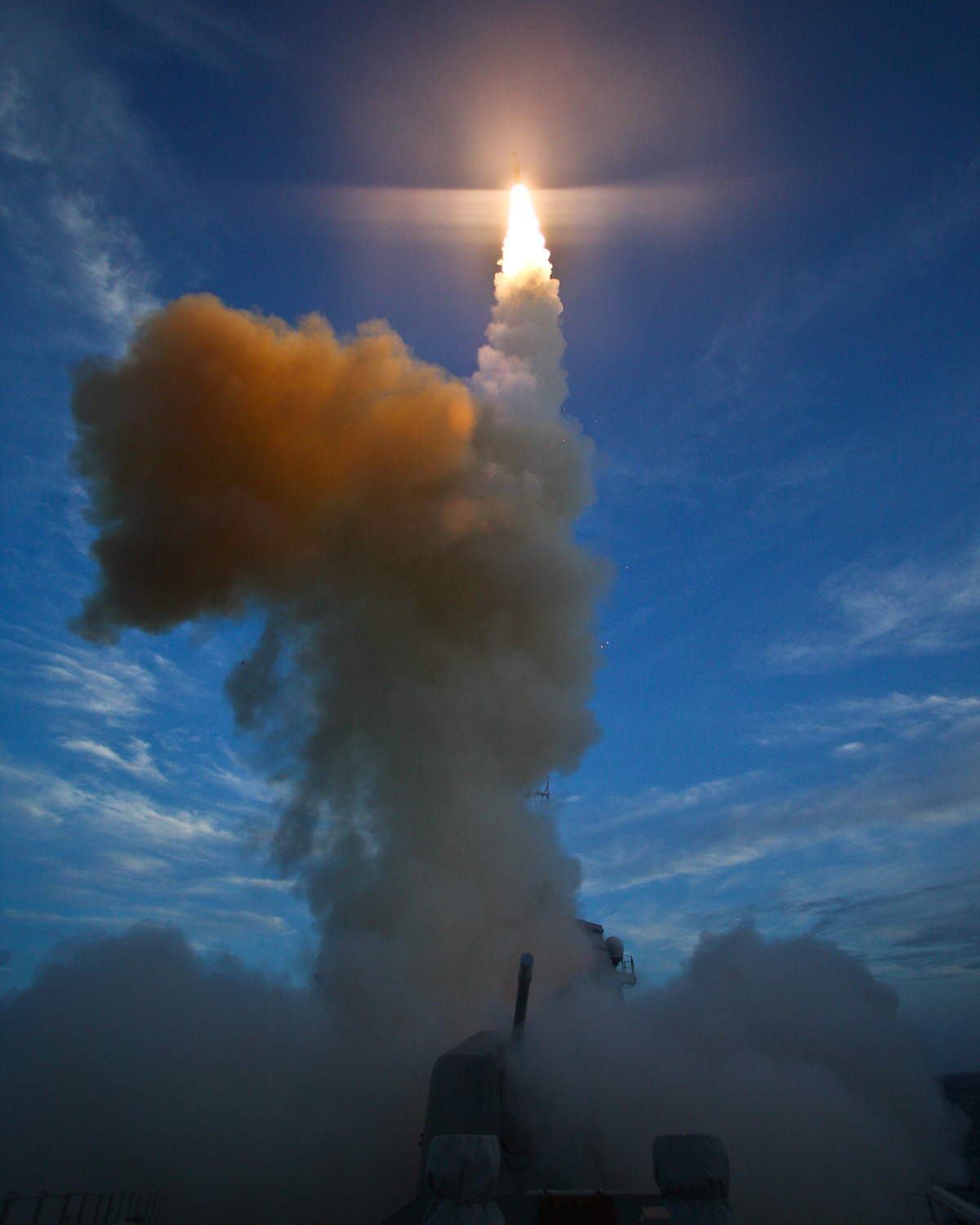
While Gates was in Japan he promoted further interceptor missile collaboration, which he praised as “one of the most advanced of its kind in the world” [21] – Japan is the U.S.’s only partner in developing the Standard Missile-3 interceptor for use on ships and for land-based deployments in Romania, Poland and the Eastern Mediterranean Sea – and advocated that “Japan consider three U.S. planes to upgrade their fleet”: The F-35 Joint Strike Fighter, the F/A-18 Hornet the F-15 Eagle. [22]
Regarding the development of an international missile shield, Gates and Defense Minister Kitazawa agreed “to speed talks on the possibility of providing jointly developed sea-based missile-shield systems to other countries….Japan and the U.S. jointly developed the ballistic missile interception system, the Standard Missile-3….The U.S. is keen to boost its missile defense in Europe and wants SM-3 interceptors there.” [23]
For there, read along Russia’s Western flank from the Baltic Sea to the Black Sea and eventually into the South Caucasus.
According to an official U.S. armed forces source, Gates also maintained that “The U.S. needs troops in Japan for the long term to keep China’s rising power in check and contain North Korea’s aggressive nuclear and missile aspirations.” [24]
Late last year the U.S. and Japan conducted their largest joint war games in history, Keen Sword 2011, with 60 warships, including the USS George Washington nuclear-powered aircraft carrier – whose home port is the Yokosuka Naval Base in Japan – accompanied by carrier and expeditionary strike groups, 400 aircraft and 44,000 troops.
Chairman of the Joint Chiefs of Staff Admiral Michael Mullen visited Tokyo last December, a week after Keen Sword 2011 ended.
The next month the USS Carl Vinson nuclear-powered supercarrier, equipped to carry 90 fighter jets and helicopters, and two guided missile destroyers and a guided missile cruiser engaged with the Japan Maritime Self-Defense Force in war games in the East China Sea.
In Late January the armed forces of the U.S. and Japan conducted the annual bilateral Yama Sakura command post exercise to “practice defending Japan” in the southwest of the country with the participation of 6,000 troops. Ahead of the event the spokesman for U.S. Army Japan and I Corps Forward, “the Army’s newest rapid-response contingency unit in Japan,” stated:
“We’re preparing for an enemy with all kinds of capabilities.” [25]
The U.S. is to spend $3.7 billion over the next five years to develop as many as 100 “new, stealthy, long-range, manned bomber[s] likely specifically intended to penetrate Chinese air defences.” The new warplane, as yet unnamed, is reported to be a long-range, nuclear-capable penetrating bomber with the option of being piloted remotely.
“The Pentagon’s bomber development coincides with the scripting of a new battle plan aimed at preserving US military capabilities in the Pacific. This so-called AirSea Battle plan is meant to help coordinate US Navy and Air Force ships and planes….” [26]
On February 21 the commander of the U.S. Seventh Fleet, which is based in Yokosuka, Japan and is the largest overseas navy fleet in the world, encompassing over 48 million square miles – the Western Pacific and Indian Ocean with the Kuril Islands at the northern tip of its area of responsibility – Vice Admiral Scott Van Buskirk was in Hong Kong where he said:
“The 7th Fleet has actually increased its capabilities in several significant ways. The ships and aircraft that we operate today are vastly more capable than they were just a few years ago. At the same time, we have enhanced our maritime partnerships with navies around the region, enabling us to work together cooperatively more than ever before.”
He said that at any given time there are 70 U.S. warships in his fleet’s area of responsibility and “cited the deployment to Japan of the nuclear-powered aircraft carrier USS George Washington…with greater speed, range, ammunition stowage and endurance, as an example of how the fleet’s capabilities have increased.”
The commander also highlighted “the deployment of the Ohio-class fleet ballistic missile submarines (SSBN), the 60-40 split of attack submarines from the Atlantic to the Pacific and the recent deployment of the Virginia-class submarine USS Hawaii (SSN 776), which reflects the fleet’s growing capability under the sea.”
Van Buskirk touted “upgrades to surface ships, including Ballistic Missile Defense capability and enhanced sonar suites, making them ‘increasingly potent,’” emphasizing that “Our alliance with Japan continues to be the cornerstone of our forward presence in Asia….” [27]
The U.S. recently completed this year’s Cobra Gold military exercise in Thailand. “The participation of Indonesia, Japan, South Korea, Singapore and Malaysia makes the 30th annual joint exercise one of the world’s largest multilateral military maneuvers.” As a testament to the dramatic expansion of a U.S.-led Asia-Pacific NATO, the exercise also included observers from India, Sri Lanka, Laos, Brunei, Mongolia, the United Arab Emirates and New Zealand among others.
Since the last Cobra Gold was held in June of 2010, “the US has held around 20 joint military maneuvers with nations in the Asia-Pacific region, including Japan and South Korea.” [28]
This month Lieutenant General Patrick O’Reilly, director of the Pentagon’s Missile Defense Agency, said that “The United States plans to deploy the Standard Missile-3 Block IIA upgrade by 2018″ in a letter to Nobushige Takamizawa, director general of policy at the Japanese Defense Ministry.
“The Pentagon’s Missile Defense Agency is pressing Tokyo to clear the sale of advanced missile interceptors, codeveloped with Japan, to third countries and to agree to joint production.” [29]
As noted above, Standard Missile-3 deployments are slated for nations like Poland, which borders Russian territory, and Romania, which lies across the Black Sea from Russia.
Early this month Japan announced that it will open its new Air Defense Command – with interceptor missile batteries – to Yokota, home to U.S. Forces Japan headquarters and the Fifth Air Force, this spring.
Last December Japan released its National Defense Program Guidelines for 2011, which detailed plans to increase the nation’s submarines from 16 to 22, acquire next-generation fighter jets, increase the number of Aegis class destroyers equipped with Standard Missile-3 interceptors from the present four to six and deploy Patriot Advanced Capability-3 interceptor missiles to 12 air bases throughout the country.
Japan is already one of the world’s major military powers. The U.S. is the world’s preeminent, having approved a World War Two-level $725 billion National Defense Authorization Act for Fiscal Year 2011 in December.
The two strategic military partners are preparing to confront their only competitors in East Asia and the Western Pacific: China and Russia. An altercation near a contested island grouping may prove the spark that sets off a conflagration involving the world’s two main nuclear powers.
Notes:
1) Russian Information Agency Novosti, February 16, 2011
2) Russian Information Agency Novosti, February 15, 2011
3) Interfax, February 9, 2011
4) News Analysis: Japan, Russia continue to lock horns over islands row
Xinhua News Agency, February 11, 2011
http://news.xinhuanet.com/english2010/world/2011-02/11/c_13728158.htm
5) Agence France-Press, February 11, 2011
6) Alexandr Grashenkov, Russia to boost Kuril defense to ward off war
Russian Information Agency Novosti, February 11, 2011
http://en.rian.ru/analysis/20110211/162553992.html
7) Russian Information Agency Novosti, February 15, 2011
8) Interfax, February 21, 2011
9) Voice of Russia, February 22, 2011
10) Russia-Japan-US – three’s a crowd
Voice of Russia, February 22, 2011
11) U.S. Supports Japan, Confronts China And Russia Over Island Disputes
Stop NATO, November 4, 2010
http://rickrozoff.wordpress.com/2010/11/04/u-s-supports-japan-confronts-china-and-russia-over-island-disputes
12) Kyodo News, October 11, 2010
13) Russia-Japan-US – three’s a crowd
Voice of Russia, February 22, 2011]
http://english.ruvr.ru/2011/02/22/45579622.html
14) Zheng Haoning and Wei Lianglei, Disputed islands: crux of Russia’s
regional strategy
Xinhua News Agency, February 22, 2011
http://news.xinhuanet.com/english2010/indepth/2011-02/22/c_13744452.htm
15) Backgrounder: Importance of Southern Kuril Islands
Xinhua News Agency/China Television
February 17, 2011
http://news.xinhuanet.com/english2010/video/2011-02/12/c_13729119.htm
16) U.S. Department of Energy
http://www.eia.doe.gov/emeu/cabs/Sakhalin/Background.html
17) Los Angeles Times, January 13, 2011
….
U.S. Builds Military Alliance With Japan, South Korea For War In The East
Stop NATO, December 14, 2010
http://rickrozoff.wordpress.com/2010/12/14/u-s-builds-military-alliance-with-japan-south-korea-for-war-in-the-east
18) Japanese Military Joins U.S. And NATO In Horn Of Africa
Stop NATO, April 25, 2010
http://rickrozoff.wordpress.com/2010/04/26/japanese-military-joins-u-s-and-nato-in-horn-of-africa
19) U.S. Builds Military Alliance With Japan, South Korea For War In The East
Stop NATO December 14, 2010
http://rickrozoff.wordpress.com/2010/12/14/u-s-builds-military-alliance-with-japan-south-korea-for-war-in-the-east
20) Trend News Agency, February 4, 2011
21) Stars and Stripes, January 13, 2011
22) United Press International, January 18, 2011
23) Japan Times, January 14, 2011
24) Stars and Stripes, January 13, 2011
25) Stars and Stripes, January 25, 2011
26) New US Bomber Aimed at China?
The Diplomat, February 22, 2011
http://the-diplomat.com/flashpoints-blog/2011/02/22/new-us-bomber-aimed-at-china/
27) Navy NewsStand, February 22, 2011
28) China Daily, February 15, 2011
29) Reuters, February 14, 2011