(Thanks to C. for pointing these out to me - VS)
Ukraine will receive a discount of $100 per 1,000 cu m at the natural gas price of $330 and a 30% discount on other prices, Russian President Dmitry Medvedev said on Wednesday. Medvedev's announcement came after a meeting with his Ukrainian counterpart Viktor Yanukovych in Kharkov in eastern Ukraine. "Discounts for Ukraine will come into effect from April this year," Yanukovych said.
Ukraine has agreed to extend the term of Russian Black Sea Fleet presence in the country's Crimea for 25 more years, the Russian president said on Wednesday. The new agreement, signed after talks between Russian President Dmitry Medvedev and his Ukrainian counterpart Viktor Yanukovych, also stipulates the extension for an additional five years after the term expires.
-------
Commentary: All this is excellent news. After years of NATO-sponsored folly, it does appear that Russia and the Ukraine are finally going to start to work together. Such a collaboration could be extremely beneficial for both countries, and the backlog of joint projects which needs to be revived is long (think, for example, of the AN-70). I just hope that the Ukrainians will never forget that bitter lesson: neo-Nazi nationalists and US/NATO agents have wrecked their country and set it back by at least a decade, if not more. I want to believe that the Ukrainians will not repeat that mistake again.
The Saker
PS: I just came across an interesting news item: looks like the Antonov company is now under Russian ownership!
Showing posts with label Black Sea Fleet. Show all posts
Showing posts with label Black Sea Fleet. Show all posts
Wednesday, April 21, 2010
Wednesday, January 6, 2010
Clashes in Crimea
According to Pravda.ru, Ukrainian nationalists have organized a congress in the center of the city of  Sevastopol in Crimea. About 1000 local residents demonstrated under the slogan "Fascism will not pass". Clashes ensued. About 300 demonstrators were able to break through the police barriers and were then violently engaged by police special forces. A number of arrests were made.
-------
Commentary: there we go, exactly as I predicted. The Ukrainian nationalists are staging their meetings in the city center of Sevastopol exactly under the same logic which brings the Israeli settlers to organize "religious" events smack in the middle of Palestinian villages: the point is to trigger a violent response which can then be legally crushed under the heading of "law and order".
For the Ukrainian nationalists an overt conflict with the Russian-speaking population is the best, if not only, way to bring the public's attention away from the absolute disaster in which 18 years of independence have resulted in and to focus all the attention on "patriotic" actions.
There is an very ugly historical precedent: the sudden and violent invasion of the Trans-Dniester Republic by Moldavian forces in 1992 resulting in the local Russian 14th Army being very reluctantly involved in the conflict, primarily because the officers' families were directly endangered by the assault. This could also happen in Crimea where the Russian Black Sea Fleet is based. A particularly ominous development in this situation was the demand made by the Ukrainian government that the Russian Federal Security Service (FSB) withdraw all its officers from Crimea by December 13, 2009. Needless to say, the Russian simply cannot let its Fleet and dependent civilians unprotected in such a dangerous context, thus this demand will simply force the FSB to operate illegally (and increase the force protection mission of the GRU).
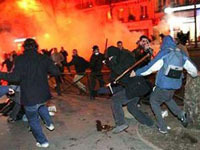 Sevastopol in Crimea. About 1000 local residents demonstrated under the slogan "Fascism will not pass". Clashes ensued. About 300 demonstrators were able to break through the police barriers and were then violently engaged by police special forces. A number of arrests were made.
-------
Commentary: there we go, exactly as I predicted. The Ukrainian nationalists are staging their meetings in the city center of Sevastopol exactly under the same logic which brings the Israeli settlers to organize "religious" events smack in the middle of Palestinian villages: the point is to trigger a violent response which can then be legally crushed under the heading of "law and order".
For the Ukrainian nationalists an overt conflict with the Russian-speaking population is the best, if not only, way to bring the public's attention away from the absolute disaster in which 18 years of independence have resulted in and to focus all the attention on "patriotic" actions.
There is an very ugly historical precedent: the sudden and violent invasion of the Trans-Dniester Republic by Moldavian forces in 1992 resulting in the local Russian 14th Army being very reluctantly involved in the conflict, primarily because the officers' families were directly endangered by the assault. This could also happen in Crimea where the Russian Black Sea Fleet is based. A particularly ominous development in this situation was the demand made by the Ukrainian government that the Russian Federal Security Service (FSB) withdraw all its officers from Crimea by December 13, 2009. Needless to say, the Russian simply cannot let its Fleet and dependent civilians unprotected in such a dangerous context, thus this demand will simply force the FSB to operate illegally (and increase the force protection mission of the GRU).

Thursday, August 28, 2008
The Black Sea Fleet flagship Moskva enters to port of Sukhum
For a better look at the Moskva guided missile cruiser, click on the picture below.
I would note that while the Mosvka's primary mission might be to monitor the movement of NATO vessels in the Black Sea (which be conducted from the Sukhum port mainly by electronic means), the Moskva also provides advanced anti-air capabilities to Abkhazia as it is equipped with long range anti air radars and missiles.

Friday, August 15, 2008
Inside the Battle for the Black Sea
By Noah Shachtman for Wired Magazine
This is the second post from naval blogger Galrahn. Go check out his site, Information Dissemination, when you're done here.
-------
Note: I would make two small comments here:
a) There appears to have been at least one other, second, Georgian ship sunk by the Russians while at sea. My guess is that is was sunk in another incident.
b) There are some indications that the ships in the port of Poti were not destroyed by artillery fire, but by Russian demolition teams (the Russians were already in control of Poti when the rest of the ships were destroyed).
The Saker
This is the second post from naval blogger Galrahn. Go check out his site, Information Dissemination, when you're done here.
While most of the world has focused primarily on the ground conflict in Georgia, the Russian Black Sea Fleet has been active off the coast. By now, you may have heard some isolated reports -- 4000 troops landed by sea at Ochamchire, a battle resulting in a Georgian coast guard ship sunk, and even claims by Georgia of minefields laid off the Georgian coast. Details have been hard to come by. But, piecing together the analysis and reporting, one can get a picture of some of these events.
While the speed of the Russian Army's response grabbed the attention of western observers, the fast response by the Russian Navy has been quite remarkable, too. The war started on Friday August 8th; the Black Sea Fleet was reported to arrive off the coast of Georgia on Saturday August 9th. That's pretty impressive, considering it is about 400 nautical miles from Sevastopol to Ochamchire. While the Moskva, Smetlivy, Muromets, and Aleksandrovets can make good speed and make the trip quickly, those ships sailed from Sevastopol with an assortment of support vessels that could only make 12-16 knots, at best. Simple math reveals that would make it a 25 hour trip, meaning the ships would have had to put to sea almost immediately after the fighting began. For any fleet to deploy that quickly is extraordinary readiness.
Then, on the early morning of August 10th, there was a battle at sea. The Russian Black Sea Fleet was engaged by four Georgian coast guard vessels, while conducting landing operations in Ochamchire. The Russians claimed to sink one ship, and the day after the battle the Moskva was reported to be in the Russian port of Novorossiysk.
New details have emerged that shed a bit of light on the action. A sailor interviewed in the Sevastopol on Wednesday gave the local press his recollection of the action. Here's my amateur translation:
"We took up station guarding the opposed landing on the Abkhaz shore when all of a sudden four high speed targets were detected. We sent out an IFF signal and the targets didn't react. Receiving a command from the flagship, we got into formation and right at that moment the unidentified targets opened fire on the ship formation and flagship. The cruiser was damaged and a small fire broke out aboard. Then, fearing for seaworthiness, the flagship withdrew from the firing area." - the sailor said.
"Right then the small missile boats clearly fired," the participant continued. "Taking up position, our MRK launched a "Malakhit" (SS-N-9) anti-surface missile, which literally cut the lead ship, the Tbilisi, to ribbons. After that, fire was shifted to the rest of the Georgian ships. Another ship was damaged, we couldn't finish it off, allowing it to leave the scene under its own power."
It's a bit of a questionable story. However, the sailor interviewed was appraently from the MRK Mirazh (617, project 12341, NATO - Nanuchka III). Why does that matter? Because the MRK Mirazh is the ship Russia has credited with the attack. Her Captain, Ivan Dubik, was reported to be in the Kremlin on Thursday accepting congratulations.
Some of the details of the sailor's story are slightly inaccurate -- call it fog of war. The Georgian ship sunk was not the Tbilisi, as the sailor suggests. Rather it was the Georgian patrol boat P-21 Georgy Toreli. A night battle in the littoral, the Georgians armed only with guns, yet the little flotilla of four was able to get in close to Moskva and start a little fire. Covering its withdraw, the Mirazh missile boat is reported to have sunk the ship in only 90 seconds in what was reported as 300 meters of water.
According to Al Jazeera, the Coast Guard base in Poti was attacked with artillery on Wednesday after the cease-fire, destroying the rest of the coast guard ships in port. The Tbilisi, which was reported to be in bad condition prior to the war, was sunk in that attack.
As for the 4000 troops? All indications are the Russian Navy reportedly used three amphibious ships to ferry the 4000 paratroopers from Novorossiysk-- reportedly without vehicles. Recent analysis tends to imply the vehicles came separately -- by rail.
-------
Note: I would make two small comments here:
a) There appears to have been at least one other, second, Georgian ship sunk by the Russians while at sea. My guess is that is was sunk in another incident.
b) There are some indications that the ships in the port of Poti were not destroyed by artillery fire, but by Russian demolition teams (the Russians were already in control of Poti when the rest of the ships were destroyed).
The Saker
Sunday, August 10, 2008
Russian Navy ships approach Georgia's sea border
RIA Novosti reports:
A group of ships from Russia's Black Sea Fleet including the flagship Moskva guided missile cruiser (click on photo for a better view) arrived on Sunday in the eastern part of the sea near the Georgian border, a high-ranking navy official said.
 "The purpose of the Black Sea Fleet vessels' presence in this region is to provide aid to refugees," the source in the Russian Navy's headquarters told RIA Novosti.
The move comes on the third day of fighting between Georgian and Russian troops in Georgia's breakaway republic of South Ossetia.
The source said the Moskva, accompanied by a patrol vessel and supply ships, traveled from the Russian naval base at Sevastopol in Ukraine's Crimea. The ships will join three large landing craft that earlier arrived in the area from Sevastopol and the Russian port of Novorossiysk.
The source denied media reports saying the Russian fleet's warships were blockading the Georgian coast.
"These reports are not true. A blockade of the coastline would mean war with Georgia, and we are not in a state of war with Georgia."
A group of ships from Russia's Black Sea Fleet including the flagship Moskva guided missile cruiser (click on photo for a better view) arrived on Sunday in the eastern part of the sea near the Georgian border, a high-ranking navy official said.
 "The purpose of the Black Sea Fleet vessels' presence in this region is to provide aid to refugees," the source in the Russian Navy's headquarters told RIA Novosti.
The move comes on the third day of fighting between Georgian and Russian troops in Georgia's breakaway republic of South Ossetia.
The source said the Moskva, accompanied by a patrol vessel and supply ships, traveled from the Russian naval base at Sevastopol in Ukraine's Crimea. The ships will join three large landing craft that earlier arrived in the area from Sevastopol and the Russian port of Novorossiysk.
The source denied media reports saying the Russian fleet's warships were blockading the Georgian coast.
"These reports are not true. A blockade of the coastline would mean war with Georgia, and we are not in a state of war with Georgia."
Subscribe to:
Posts (Atom)