So finally the US has published its "Magnitsky List" (see full list here). Russia instantly retaliated with its own list (see full list here). Now what?
Nothing.
Let's recap what happened. The US Republicans, now completely controlled by Jewish Neocons, tried to play electoral politics by showing that, unlike the Democrats, they are "tough on Russia". First, this caters to the traditional Jewish hatred of everything Russia and, second, it also caters to the instincts of those Americans who want to see their country like some kind of cop of the universe. So the country which has legalized torture and the extra-judicial murder of "enemies" was now seriously expressing its outrage at the death of one man in disputed circumstances.
Obama and his Democrats wanted none of that since they perfectly understood how ridiculous the entire scheme was. This is why the actual number of names on the US list has gone from 60 to 240 to 280 to a mere 18 in the final version. Not only was the list very short, but no major Russian figure was involved. Something of a wet firecracker, really.
The Russian "retaliatory" list was equally short and limited in scope. The Russians fully understood that Obama had nothing to do with this nonsense, so they kept their response to the required minimum.
Now that this kindergarten-level episode is over, at least until the next elections in the USA, its time to turn back to serious, adult, politics and, first and foremost, the upcoming trip of U.S. National Security Adviser
Thomas Donilon to Moscow were he will no doubt present a "grand bargain" to Putin: drop your support for Syria and we will re-deploy our anti-missile system further away from Russia and/or provide some written guarantees about its purpose.
This will be a tempting deal for Putin as it would appear to give him a big political victory. But, if my instincts about the man are correct, he will reject that deal because he is aware of two crucial facts:
a) the Russian "asymmetrical" response to the US deployment is a cost-effective way to deal with this threat.
b) if Syria falls to the US/NATO/al-Qaeda alliance, Iran and Russia are next.
There will probably be some very tough bargaining, but I want to believe that Putin will remain firm and reject the US offer.
We shall see soon.
The Saker
Saturday, April 13, 2013
Monday, April 8, 2013
Roger Waters' eulogy for Maggie
and now, also a personal message from me, the Saker, to Maggie's rotten soul:


Interview of Vladimir Putin to the German TV station ARD
This interview touches upon various important topics but it is particularly valuable because it set the record strait about the Western propaganda about the Russian government's "crackdown" on NGOs such as these from the BBC:
The Saker
-------
JÖRG SCHÖNENBORN (retranslated): Good evening, Mr President,
Germany and Russia enjoy special relationship and, economically speaking, they are a good match. However, there exist certain difficulties from the political viewpoint. Quite a number of Germans keep track of the raids in the Russian offices of German funds with great concern. The Russian public must be frightened. Why do you act like this?
PRESIDENT OF RUSSIA VLADIMIR PUTIN: It is you who are scaring the German public instead. There is nothing like this going on here, do not scare the public, please. The media should cover the events objectively. And what does it mean, objectively? The new law adopted late last year in Russia stipulates that non-governmental organisations engaged in Russia's internal political processes and sponsored from abroad must be registered as foreign agents, that is organisations which participate in our country's political life at the expense of foreign countries. This is not an innovation in international politics. A similar law has been in force in the United States since 1938.
If you have any additional questions, I would be pleased to answer them in order to clarify the situation to you and your or, in this case, our viewers.
JÖRG SCHÖNENBORN: Mr President, I am not aware of any similar confiscations or raids carried out in the United States. In our opinion, the term ‘foreign agent’, as these organisations are to be called, sounds something like cold war.
VLADIMIR PUTIN: Then let me explain. First of all, the United States adopted a similar law, which has been in effect ever since. And our, Russian, organisations have followed the same practice that was established in that country decades ago.
I am going to show you a paper in which, not long ago, the United States Department of Justice requested a non-governmental organisation to submit documents confirming that its activities were to be financed from abroad; the list is very long.
We have adopted a similar law that prohibits nothing; let me stress it, the law does not prohibit anything, nor does it limit or close down anything. Organisations financed from abroad are not forbidden to carry out any type of activities, including internal political activity. The only thing we want to know is who receives the money and where it goes. I repeat: the law is not some sort of innovation of our own.
Why do we consider it so important today? What do you think is the number of Russia-sponsored non-governmental organisations functioning in Europe? Any ideas?
JÖRG SCHÖNENBORN: I am afraid I cannot assess the situation, Mr President.
VLADIMIR PUTIN: Let me tell you. One such organisation operates in Paris, another one – in North America, it is registered in the USA. And this is it. There are only two of them – one in the United States and another one in Europe.
There are 654 non-governmental organisations operating in the Russian Federation, which are funded, as it has turned out, from abroad. 654 organisations make quite a network nationwide, the Russian regions included.
Over the four months alone that followed the adoption of the law in question, the accounts of these organisations augmented by… How much money do you think they received? You can hardly imagine; I did not know the figure myself: 28.3 billion rubles, which is almost $1 billion. 855 million rubles via diplomatic missions.
These organisations are engaged in internal political activity. Should not our society be informed of who gets the money and for what purposes?
I would also like to stress – and I want you to know this, I want people in Europe, including Germany, to know this – that nobody bans these organisations from carrying out their activities. We only ask them to admit: “Yes, we are engaged in political activities, and we are funded from abroad.” The public has the right to know this.
There is no need to scare anyone saying that people here get rounded up, arrested, have their property confiscated, although confiscations could be a reasonable thing if those people break the law. Some administrative sanctions are envisaged in these cases, but I think all this falls under rules commonly accepted in a civilised society.
Now let us look at the documents that our organisations in the US are required to provide. Note who asks for these documents, signed at the bottom of the page. The Counterespionage Section. Not the Office of Attorney General, but the Counterespionage Section of the US Department of Justice. This is an official document that the organisation received. And note the number of questions they pose. Is this democratic?
JÖRG SCHÖNENBORN: Mr President, we will examine this document. I do not know if any such searches took place in the US.
I would like to ask you once again: we understand democracy as the coexistence of the state and opposition. Political competition is an integral part of it. Does Russia need a strong opposition?
VLADIMIR PUTIN: Certainly. We do need it to say the least. I believe that without competition no development in either economy, or in politics is possible today, and we want to ensure this development for our country and our people. Without this competition we would not be able to make effective, sound and justified decisions. Which is why we will undoubtedly strive to make the competition a cornerstone of every sphere of our society's life, including politics.
But this does not mean that opposition should be financed from abroad, don’t you think? Or do you have a different opinion?
JÖRG SCHÖNENBORN: Does this imply that the opposition can freely participate in demonstrations?
VLADIMIR PUTIN: Absolutely, as long as they abide by the law. There are certain rules that provide for various forms of political activity. Voting means publicly expressing your opinion, as does participating in demonstrations. There is law. Good or bad, it can be changed democratically, but it must be abided by. Ordnung muss sein. It is a well-known rule. It is universal and applicable in any country. There must be order, and there must be no chaos. Northern Africa is a vivid example of what chaos leads to. Does anybody want that?
As for the activities of the opposition, I would like to draw your attention to the following fact. Just recently, a political party was required to have at least 50 thousand members to be registered. We have radically reduced this number: now one only needs 500 members to register a party and engage in legal political activities. 37 parties have already been registered, and, I think, several dozen more have filed their applications. This is how it is going to be, we will encourage this political competition.
We have changed the procedure for the election of members of the upper chamber of the Russian Parliament, the Federation Council; now they are elected by secret ballot by citizens of corresponding regions. By the way, I do not think that the upper chamber of the German Parliament is elected this way: if I am not mistaken, its members are elected by their respective landtags.
In this regard, we have gone further; I refer to the election of heads of the Russian regions that I reintroduced. We have returned to direct voting by secret ballot. Germany elects heads of its regions through landtags. Many of our political actors thought that we should go back to forming the Parliament through a mixed election system with simple majority rule nominations and strict party-list nominations. We have arrived at this mixed system, so we are moving, we are looking for those forms of our society’s political organisation that would be most suitable for us at this stage and would satisfy the requirements and aspirations of our people. This, of course, concerns political parties as well. Naturally, we want competition.
JÖRG SCHÖNENBORN: You are going to Germany for a major trade fair. The economic relations between our countries are important for you, I believe. Are you worried that the issues we have just discussed may cast a shadow over your visit?
VLADIMIR PUTIN: No, on the contrary, I am very glad about it. And I am glad about our today's interview too because this gives us an opportunity to clarify the situation, to explain what is actually happening and what guides us. Now, what was your first question? About searches and arrests. What searches? What arrests? Who has been arrested? Can you give me at least one name? This is not true. Don’t make anything up.
JÖRG SCHÖNENBORN: I didn't say anything about arrests. I spoke about searches.
VLADIMIR PUTIN: It sounds alarmist: "Hey everyone! Look! Terrible things are happening here!" Well, yes, there is the Prosecutor General’s Office of the Russian Federation that is obliged to ensure that the laws adopted in the Russian Federation are respected. And all the citizens, all organisations, all individuals and legal entities operating in Russia must take this into account and have due respect for Russian law.
JÖRG SCHÖNENBORN: What are you expecting from your visit to Germany in terms of economy? I assume you are going to encourage the Germans to invest. What exactly are you expecting?
VLADIMIR PUTIN: Russia and Germany are very important partners for each other. This is really so. The EU countries and the EU itself are our major commercial partners. They account for over 50 percent of our turnover. Well, the figure can fluctuate a bit: a little over 50, a little under 50 percent due to the economic difficulties faced by the Eurozone and the EU. It is under 50 at the moment, I believe, but it is still a lot. In absolute numbers it amounts to over $430‑450 billion. We are EU's third major commercial partner after the US and China, and the difference is not very big. If our total turnover with Europe amounts to some $430-450 billion, the turnover for the US is a little over $600 billion and $550 billion for China. So as you can see, not that big of a difference.
Germany is our primary European partner. Our turnover amounts to $74 billion and it continues to grow no matter what difficulties there might be. To make it clear for both Russian and German citizens, I need to say that these are not just numbers; there are jobs behind these numbers, there are cutting edge technology behind them, moving in both directions.
By the way, as far as Germany is concerned, the trade pattern is not only in line with its economic capabilities but also in line with its interests since the emphasis in trade and economic cooperation with Germany is put on the industrial production. And behind this – let me stress this once again – there are thousands if not tens of thousands of jobs, and the incomes of Russian and German families. Besides, Russia supplies 40 percent of all natural gas and 30 percent of all oil consumption in Germany.
We are expanding our cooperation in high technology sectors, aviation, engineering, including transport engineering, nanotechnologies, and next-generation physics engineering. This is a very diverse, interesting and promising cooperation.
Germany is one of our major investors with $25 billion in accumulated investments. Last year alone their amount increased by as much as $7.2 billion. This means that Germany invests rather actively in the Russian economy. I would like to stress again that all this is important, interesting and promising.
We are going to have six pavilions [at the trade fair], large ones. They are all united by a single slogan – the industrial production, in which Germany has always been strong, and which is of interest to us. Over a hundred large Russian companies will be exhibiting in those pavilions.
I invite you and all our friends in Germany to visit the 2013 Hannover Messe and Russia’s pavilions there.
JÖRG SCHÖNENBORN: You've spoken about 27 billion of German direct investment in Russia. I would now like to touch upon the Cyprus issue. A lot of Germans realised for the first time how much Russian money is there in Cypriot banks and are now wondering why German businesses have to make investments while you pull your money out of Russia?
VLADIMIR PUTIN: Don't you see all the absurdity of your question? Just please don't get me wrong. What does Russia have to do with Russian investors in one of the EU countries? The more you "pinch" foreign investors in the financial institutions of your countries, the better for us because the affected, offended and frightened (not all of them but many) should, so we hope, come to our financial institutions and keep their money in our banks.
Why, at some point, many Russian investors moved their funds to zones such as Cyprus? Because, frankly speaking, they did not feel they could rely on the Russian financial system. And, indeed, it was not reliable. Just recall the year 1998 – an economic collapse, or the year 2000 (and that was already our common problem) – again there were widespread fears regarding the future of the financial system. But in 2008, when the new crisis hit, we not only managed to preserve the integrity of our financial system, we strengthened it without letting a single financial institution collapse. There were problems, of course, but we did not allow any of the financial institutions to abandon their customers. Of course, people went through a lot of hardships during the crisis but we arranged the work of our banking system in a way that made it possible not only to support but also to strengthen it while taking some measures to carefully restructure it, again in order to strengthen it. And I hope that people today will understand that.
Forfeiture of investors' funds, including of Russian origin, wherever it happens, in Cyprus or in other places, undermines credibility of the banking system of the entire Eurozone.
Now regarding the issue of whether to provide support or not and who is to blame. Is that fair, that people invested their funds, merely deposited their money with banks without breaking any laws, whether the laws of Cyprus or those of the European Union, just to see 60 percent of their deposits forfeited? They did not violate any rules. As to the allegations that Cyprus was, as they say in the financial community, a laundry for dirty money, they have to be supported with hard facts. One of the basic rules that we all are supposed to know and observe is the rule of the presumption of innocence. A person is presumed to be innocent until proven guilty. How can we ignore that? How can we accuse all people concerned of being crooks? Then anybody can be declared a crook.
Did we create that offshore zone? No, we didn’t. It was the European Union that created it. Or, rather, it was created by the Cyprus authorities with the connivance of the European Union. And is it the only such zone created by countries of the European Union? Are we not aware of offshore island zones in Great Britain or of other such zones? They do exist. If you consider such zones a bad thing, then close them. Why do you shift responsibility for all problems that have arisen in Cyprus to investors irrespective of their nationality (British, Russian, French or whatever else).
I have met with senior officials of the European Commission. We have very good personal relations, though we disagree on many issues. Is it Russia's fault that Cyprus is now facing problems? Indeed, incoming investors are a positive factor as they support the banking system and the entire economy of the host country with their funds and their trust.
JÖRG SCHÖNENBORN: You are angry that the European Union did not ask you for help and that many Russian nationals were affected, are you?
VLADIMIR PUTIN: Of course, not. On the contrary I am even glad, to some extent, because the events have shown how risky and insecure investments in Western financial institutions can be. By the way, our tax regime in that context is also more favourable than yours. The income tax rate for individuals in Russia is only 13 percent. What about Germany? How much do you pay?
JÖRG SCHÖNENBORN: It would be great if we paid only 13 percent. Of course, it would be great. Fight against tax increases is a hot topic during the election campaign.
VLADIMIR PUTIN: So, fight for tax cuts.
JÖRG SCHÖNENBORN: Mr President, I would like to touch upon the issue of euro. You spoke about the European financial system. Russia holds more than 40 percent of its currency reserves in euro, which makes you keenly interested in euro. Do you still trust euro?
VLADIMIR PUTIN: First, I would like to say it outright: yes, we trust euro. We also trust the economic policy of major European countries, including, in the first place, the economic policy of the government of the Federal Republic of Germany. We are fully aware of various opinions on that issue, including on aspects, such as economic development, maintenance of economic growth and ensuring monetary stability. I agree with the opinion that, before pumping liquidity, it is necessary to address the root causes of crises.
But I wouldn't like to go into detail now and discuss the issue that has no direct bearing on us as that is the prerogative of the leaders of the European countries themselves.
However, judging by what we hear and see, what our colleagues are doing in the leading economies of the Eurozone, what the European Commission itself is doing, – and I would like to repeat that we do not agree on many issues and we do argue – we believe that fundamentally they are moving in the right direction. It gives us confidence that we have made the right choice having decided to keep such a large share of our gold and currency reserves, of our reserves in general in the European currency. I am confident that if the situation continues to develop the same way, our colleagues and friends in Europe will overcome the difficulties they are facing today.
And our reserves are rather substantial: the Central Bank reserves worth $534 billion, another $89 billion representing one of the Russian Government’s reserve funds, another $87 billion (a third fund) representing the second government fund, the National Welfare Fund. So, this is a rather substantial amount of money.
JÖRG SCHÖNENBORN: Mr President, our time is almost up, but I would like to draw your attention to another crisis area that raises great concerns in Germany – that is Syria. Hundreds of people die there every day. Your stance and the stance of the West in the UN Security Council obviously differed.
I would like to ask you the following. How do you see the opportunities for stopping the bloodshed? What are the Russian authorities doing, what is the Russian Government doing to finally put an end to this bloodshed?
VLADIMIR PUTIN: I think that we should seek an immediate cessation of hostilities, of shelling from both sides, and a cessation of arms supplies.
We often hear: "Russia is supplying arms to Assad." First of all, there are no bans on arms supplies to incumbent legitimate governments. Secondly, only recently the opposition has received 3.5 tons of arms and munitions through the airports near Syria. This is the information published by the American media, I believe, by The New York Times. It has to be stopped.
However, – I would like to stress once again and I believe it is extremely important, – there is international law. There are international legal norms stating that it is inadmissible to supply arms to the armed groups that strive to destabilise the situation in a certain country with the use of arms. Such norms exist and they remain in force; nobody abolished them. So, when they say that Assad is fighting against his own people, we need to remember that this is the armed part of the opposition. What is going on is a massacre, this is a disaster, a catastrophe. It has to be stopped. It is necessary to bring all the warring parties to the negotiation table. I believe that this is the first step that has to be done, and then it is necessary to elaborate further steps during a discussion, which is important in our view.
I have already said it in public and I would like to tell you this, so that your viewers also know about our real position. We do not think that Assad should leave today, as our partners suggest. In this case, tomorrow we will have to decide what to do and where to go. We have done it in many countries. To be precise, our Western partners have. And it is unclear where Libya will go. In fact, it has already split into three parts. We do not want to have the situation of the same difficulty as we still have in Iraq. We do not want to have the situation of the same difficulty as in Yemen, and so on.
Therefore, we believe that it is necessary to bring everyone to the negotiation table so that all warring parties could reach an agreement on how their interests will be protected and in which way they will participate in the future governance of the country. And then they will work together on the implementation of this plan with due guarantees of the international community.
By the way, at the recent forum in Geneva (a few months ago) an agreement was reached on this issue, but later our Western partners unfortunately went back on these agreements. We believe that it is necessary to work hard and search for mutually acceptable solutions.
Recently, we have received Mr Hollande, President of the French Republic. I think he has some interesting ideas that can be implemented, but it requires some diplomatic work. We are ready to support these ideas. We need to try and put them into practice.
JÖRG SCHÖNENBORN: Mr President, at the end of our interview I would like to go back to the topic that we have started with. Democracy is a very controversial issue. I would like to quote your Prime Minister. Mr Medvedev said that the democratic changes in Russia can be assessed only in 100 years. In our view, this is not very ambitious.
VLADIMIR PUTIN: It may be a translation issue. Could you tell me again what he said exactly?
JÖRG SCHÖNENBORN: In essence, Russia's Prime Minister Dmitry Medvedev said that "development of democracy in Russia can be assessed no earlier than in 100 years." My question is whether there are truly no ambitions about it.
VLADIMIR PUTIN: To be honest, I have not seen or heard of Prime Minister saying that, and it is always necessary to consider the context which I am lacking now.
It is obvious that we have made a decisive choice for democracy and we cannot imagine any other way of development. It is also obvious that certain standards used in some countries are difficult to implement or apply elsewhere. I think it is quite clear. We need to develop tools based on the fundamental principles of democracy that would allow for the vast majority of people in our country to influence domestic and foreign policy. It is the majority that must have such an influence, but the majority should also respect the opinion of the minority and consider it. If our domestic policy and public institutions are fully based on such fundamental principles, then it seems to me, we will be able to talk about the success of democracy in Russia. Nevertheless, it is obviously the path that Russia has chosen, the path that it follows. Just compare the situation in the Soviet Union and in modern Russia in terms of development of economy, political sphere, and all other areas associated with democracy. There is a very significant difference. It took other countries 200, 300, 400 years to achieve this goal. Do you expect us to cover this distance within two decades? Of course, we are gradually taking all the necessary steps. We know our destination, and will not abandon this path.
JÖRG SCHÖNENBORN: In conclusion, I shall try to ask you a personal question.
You were President for eight years, and then you became Prime Minister. You will be President for the next six years. Do you have a personal plan? Do you want to be President as long as you are elected? Or may be you have some plans about your life afterwards?
VLADIMIR PUTIN: Every normal person tries to look some distance ahead. Moreover, I am far from being the longest serving politician. There are people in leading positions in European politics who have worked there much longer than me, both in Europe and in North America, Canada actually. However, I do expect that after my retirement from political life and public service I will have an opportunity to busy myself with other things and challenges. I like jurisprudence and literature, and I do hope I will have a chance to occupy myself with these without any link to my public service duties. May be, I will look into other issues. It can be social life, sports, etc.
JÖRG SCHÖNENBORN: Thank you very much for the interview, Mr President.
source: http://eng.kremlin.ru/news/5216
- Angela Merkel tells Vladimir Putin - Russia needs NGOs
- Russia NGOs decry 'intimidation' raids
- Fears for NGOs in Russia as tax raids multiply
- Russian police raid rights group Memorial and other NGOs
The Saker
-------
JÖRG SCHÖNENBORN (retranslated): Good evening, Mr President,
Germany and Russia enjoy special relationship and, economically speaking, they are a good match. However, there exist certain difficulties from the political viewpoint. Quite a number of Germans keep track of the raids in the Russian offices of German funds with great concern. The Russian public must be frightened. Why do you act like this?
PRESIDENT OF RUSSIA VLADIMIR PUTIN: It is you who are scaring the German public instead. There is nothing like this going on here, do not scare the public, please. The media should cover the events objectively. And what does it mean, objectively? The new law adopted late last year in Russia stipulates that non-governmental organisations engaged in Russia's internal political processes and sponsored from abroad must be registered as foreign agents, that is organisations which participate in our country's political life at the expense of foreign countries. This is not an innovation in international politics. A similar law has been in force in the United States since 1938.
If you have any additional questions, I would be pleased to answer them in order to clarify the situation to you and your or, in this case, our viewers.
JÖRG SCHÖNENBORN: Mr President, I am not aware of any similar confiscations or raids carried out in the United States. In our opinion, the term ‘foreign agent’, as these organisations are to be called, sounds something like cold war.
VLADIMIR PUTIN: Then let me explain. First of all, the United States adopted a similar law, which has been in effect ever since. And our, Russian, organisations have followed the same practice that was established in that country decades ago.
I am going to show you a paper in which, not long ago, the United States Department of Justice requested a non-governmental organisation to submit documents confirming that its activities were to be financed from abroad; the list is very long.
We have adopted a similar law that prohibits nothing; let me stress it, the law does not prohibit anything, nor does it limit or close down anything. Organisations financed from abroad are not forbidden to carry out any type of activities, including internal political activity. The only thing we want to know is who receives the money and where it goes. I repeat: the law is not some sort of innovation of our own.
Why do we consider it so important today? What do you think is the number of Russia-sponsored non-governmental organisations functioning in Europe? Any ideas?
JÖRG SCHÖNENBORN: I am afraid I cannot assess the situation, Mr President.
VLADIMIR PUTIN: Let me tell you. One such organisation operates in Paris, another one – in North America, it is registered in the USA. And this is it. There are only two of them – one in the United States and another one in Europe.
There are 654 non-governmental organisations operating in the Russian Federation, which are funded, as it has turned out, from abroad. 654 organisations make quite a network nationwide, the Russian regions included.
Over the four months alone that followed the adoption of the law in question, the accounts of these organisations augmented by… How much money do you think they received? You can hardly imagine; I did not know the figure myself: 28.3 billion rubles, which is almost $1 billion. 855 million rubles via diplomatic missions.
These organisations are engaged in internal political activity. Should not our society be informed of who gets the money and for what purposes?
I would also like to stress – and I want you to know this, I want people in Europe, including Germany, to know this – that nobody bans these organisations from carrying out their activities. We only ask them to admit: “Yes, we are engaged in political activities, and we are funded from abroad.” The public has the right to know this.
There is no need to scare anyone saying that people here get rounded up, arrested, have their property confiscated, although confiscations could be a reasonable thing if those people break the law. Some administrative sanctions are envisaged in these cases, but I think all this falls under rules commonly accepted in a civilised society.
Now let us look at the documents that our organisations in the US are required to provide. Note who asks for these documents, signed at the bottom of the page. The Counterespionage Section. Not the Office of Attorney General, but the Counterespionage Section of the US Department of Justice. This is an official document that the organisation received. And note the number of questions they pose. Is this democratic?
JÖRG SCHÖNENBORN: Mr President, we will examine this document. I do not know if any such searches took place in the US.
I would like to ask you once again: we understand democracy as the coexistence of the state and opposition. Political competition is an integral part of it. Does Russia need a strong opposition?
VLADIMIR PUTIN: Certainly. We do need it to say the least. I believe that without competition no development in either economy, or in politics is possible today, and we want to ensure this development for our country and our people. Without this competition we would not be able to make effective, sound and justified decisions. Which is why we will undoubtedly strive to make the competition a cornerstone of every sphere of our society's life, including politics.
But this does not mean that opposition should be financed from abroad, don’t you think? Or do you have a different opinion?
JÖRG SCHÖNENBORN: Does this imply that the opposition can freely participate in demonstrations?
VLADIMIR PUTIN: Absolutely, as long as they abide by the law. There are certain rules that provide for various forms of political activity. Voting means publicly expressing your opinion, as does participating in demonstrations. There is law. Good or bad, it can be changed democratically, but it must be abided by. Ordnung muss sein. It is a well-known rule. It is universal and applicable in any country. There must be order, and there must be no chaos. Northern Africa is a vivid example of what chaos leads to. Does anybody want that?
As for the activities of the opposition, I would like to draw your attention to the following fact. Just recently, a political party was required to have at least 50 thousand members to be registered. We have radically reduced this number: now one only needs 500 members to register a party and engage in legal political activities. 37 parties have already been registered, and, I think, several dozen more have filed their applications. This is how it is going to be, we will encourage this political competition.
We have changed the procedure for the election of members of the upper chamber of the Russian Parliament, the Federation Council; now they are elected by secret ballot by citizens of corresponding regions. By the way, I do not think that the upper chamber of the German Parliament is elected this way: if I am not mistaken, its members are elected by their respective landtags.
In this regard, we have gone further; I refer to the election of heads of the Russian regions that I reintroduced. We have returned to direct voting by secret ballot. Germany elects heads of its regions through landtags. Many of our political actors thought that we should go back to forming the Parliament through a mixed election system with simple majority rule nominations and strict party-list nominations. We have arrived at this mixed system, so we are moving, we are looking for those forms of our society’s political organisation that would be most suitable for us at this stage and would satisfy the requirements and aspirations of our people. This, of course, concerns political parties as well. Naturally, we want competition.
JÖRG SCHÖNENBORN: You are going to Germany for a major trade fair. The economic relations between our countries are important for you, I believe. Are you worried that the issues we have just discussed may cast a shadow over your visit?
VLADIMIR PUTIN: No, on the contrary, I am very glad about it. And I am glad about our today's interview too because this gives us an opportunity to clarify the situation, to explain what is actually happening and what guides us. Now, what was your first question? About searches and arrests. What searches? What arrests? Who has been arrested? Can you give me at least one name? This is not true. Don’t make anything up.
JÖRG SCHÖNENBORN: I didn't say anything about arrests. I spoke about searches.
VLADIMIR PUTIN: It sounds alarmist: "Hey everyone! Look! Terrible things are happening here!" Well, yes, there is the Prosecutor General’s Office of the Russian Federation that is obliged to ensure that the laws adopted in the Russian Federation are respected. And all the citizens, all organisations, all individuals and legal entities operating in Russia must take this into account and have due respect for Russian law.
JÖRG SCHÖNENBORN: What are you expecting from your visit to Germany in terms of economy? I assume you are going to encourage the Germans to invest. What exactly are you expecting?
VLADIMIR PUTIN: Russia and Germany are very important partners for each other. This is really so. The EU countries and the EU itself are our major commercial partners. They account for over 50 percent of our turnover. Well, the figure can fluctuate a bit: a little over 50, a little under 50 percent due to the economic difficulties faced by the Eurozone and the EU. It is under 50 at the moment, I believe, but it is still a lot. In absolute numbers it amounts to over $430‑450 billion. We are EU's third major commercial partner after the US and China, and the difference is not very big. If our total turnover with Europe amounts to some $430-450 billion, the turnover for the US is a little over $600 billion and $550 billion for China. So as you can see, not that big of a difference.
Germany is our primary European partner. Our turnover amounts to $74 billion and it continues to grow no matter what difficulties there might be. To make it clear for both Russian and German citizens, I need to say that these are not just numbers; there are jobs behind these numbers, there are cutting edge technology behind them, moving in both directions.
By the way, as far as Germany is concerned, the trade pattern is not only in line with its economic capabilities but also in line with its interests since the emphasis in trade and economic cooperation with Germany is put on the industrial production. And behind this – let me stress this once again – there are thousands if not tens of thousands of jobs, and the incomes of Russian and German families. Besides, Russia supplies 40 percent of all natural gas and 30 percent of all oil consumption in Germany.
We are expanding our cooperation in high technology sectors, aviation, engineering, including transport engineering, nanotechnologies, and next-generation physics engineering. This is a very diverse, interesting and promising cooperation.
Germany is one of our major investors with $25 billion in accumulated investments. Last year alone their amount increased by as much as $7.2 billion. This means that Germany invests rather actively in the Russian economy. I would like to stress again that all this is important, interesting and promising.
We are going to have six pavilions [at the trade fair], large ones. They are all united by a single slogan – the industrial production, in which Germany has always been strong, and which is of interest to us. Over a hundred large Russian companies will be exhibiting in those pavilions.
I invite you and all our friends in Germany to visit the 2013 Hannover Messe and Russia’s pavilions there.
JÖRG SCHÖNENBORN: You've spoken about 27 billion of German direct investment in Russia. I would now like to touch upon the Cyprus issue. A lot of Germans realised for the first time how much Russian money is there in Cypriot banks and are now wondering why German businesses have to make investments while you pull your money out of Russia?
VLADIMIR PUTIN: Don't you see all the absurdity of your question? Just please don't get me wrong. What does Russia have to do with Russian investors in one of the EU countries? The more you "pinch" foreign investors in the financial institutions of your countries, the better for us because the affected, offended and frightened (not all of them but many) should, so we hope, come to our financial institutions and keep their money in our banks.
Why, at some point, many Russian investors moved their funds to zones such as Cyprus? Because, frankly speaking, they did not feel they could rely on the Russian financial system. And, indeed, it was not reliable. Just recall the year 1998 – an economic collapse, or the year 2000 (and that was already our common problem) – again there were widespread fears regarding the future of the financial system. But in 2008, when the new crisis hit, we not only managed to preserve the integrity of our financial system, we strengthened it without letting a single financial institution collapse. There were problems, of course, but we did not allow any of the financial institutions to abandon their customers. Of course, people went through a lot of hardships during the crisis but we arranged the work of our banking system in a way that made it possible not only to support but also to strengthen it while taking some measures to carefully restructure it, again in order to strengthen it. And I hope that people today will understand that.
Forfeiture of investors' funds, including of Russian origin, wherever it happens, in Cyprus or in other places, undermines credibility of the banking system of the entire Eurozone.
Now regarding the issue of whether to provide support or not and who is to blame. Is that fair, that people invested their funds, merely deposited their money with banks without breaking any laws, whether the laws of Cyprus or those of the European Union, just to see 60 percent of their deposits forfeited? They did not violate any rules. As to the allegations that Cyprus was, as they say in the financial community, a laundry for dirty money, they have to be supported with hard facts. One of the basic rules that we all are supposed to know and observe is the rule of the presumption of innocence. A person is presumed to be innocent until proven guilty. How can we ignore that? How can we accuse all people concerned of being crooks? Then anybody can be declared a crook.
Did we create that offshore zone? No, we didn’t. It was the European Union that created it. Or, rather, it was created by the Cyprus authorities with the connivance of the European Union. And is it the only such zone created by countries of the European Union? Are we not aware of offshore island zones in Great Britain or of other such zones? They do exist. If you consider such zones a bad thing, then close them. Why do you shift responsibility for all problems that have arisen in Cyprus to investors irrespective of their nationality (British, Russian, French or whatever else).
I have met with senior officials of the European Commission. We have very good personal relations, though we disagree on many issues. Is it Russia's fault that Cyprus is now facing problems? Indeed, incoming investors are a positive factor as they support the banking system and the entire economy of the host country with their funds and their trust.
JÖRG SCHÖNENBORN: You are angry that the European Union did not ask you for help and that many Russian nationals were affected, are you?
VLADIMIR PUTIN: Of course, not. On the contrary I am even glad, to some extent, because the events have shown how risky and insecure investments in Western financial institutions can be. By the way, our tax regime in that context is also more favourable than yours. The income tax rate for individuals in Russia is only 13 percent. What about Germany? How much do you pay?
JÖRG SCHÖNENBORN: It would be great if we paid only 13 percent. Of course, it would be great. Fight against tax increases is a hot topic during the election campaign.
VLADIMIR PUTIN: So, fight for tax cuts.
JÖRG SCHÖNENBORN: Mr President, I would like to touch upon the issue of euro. You spoke about the European financial system. Russia holds more than 40 percent of its currency reserves in euro, which makes you keenly interested in euro. Do you still trust euro?
VLADIMIR PUTIN: First, I would like to say it outright: yes, we trust euro. We also trust the economic policy of major European countries, including, in the first place, the economic policy of the government of the Federal Republic of Germany. We are fully aware of various opinions on that issue, including on aspects, such as economic development, maintenance of economic growth and ensuring monetary stability. I agree with the opinion that, before pumping liquidity, it is necessary to address the root causes of crises.
But I wouldn't like to go into detail now and discuss the issue that has no direct bearing on us as that is the prerogative of the leaders of the European countries themselves.
However, judging by what we hear and see, what our colleagues are doing in the leading economies of the Eurozone, what the European Commission itself is doing, – and I would like to repeat that we do not agree on many issues and we do argue – we believe that fundamentally they are moving in the right direction. It gives us confidence that we have made the right choice having decided to keep such a large share of our gold and currency reserves, of our reserves in general in the European currency. I am confident that if the situation continues to develop the same way, our colleagues and friends in Europe will overcome the difficulties they are facing today.
And our reserves are rather substantial: the Central Bank reserves worth $534 billion, another $89 billion representing one of the Russian Government’s reserve funds, another $87 billion (a third fund) representing the second government fund, the National Welfare Fund. So, this is a rather substantial amount of money.
JÖRG SCHÖNENBORN: Mr President, our time is almost up, but I would like to draw your attention to another crisis area that raises great concerns in Germany – that is Syria. Hundreds of people die there every day. Your stance and the stance of the West in the UN Security Council obviously differed.
I would like to ask you the following. How do you see the opportunities for stopping the bloodshed? What are the Russian authorities doing, what is the Russian Government doing to finally put an end to this bloodshed?
VLADIMIR PUTIN: I think that we should seek an immediate cessation of hostilities, of shelling from both sides, and a cessation of arms supplies.
We often hear: "Russia is supplying arms to Assad." First of all, there are no bans on arms supplies to incumbent legitimate governments. Secondly, only recently the opposition has received 3.5 tons of arms and munitions through the airports near Syria. This is the information published by the American media, I believe, by The New York Times. It has to be stopped.
However, – I would like to stress once again and I believe it is extremely important, – there is international law. There are international legal norms stating that it is inadmissible to supply arms to the armed groups that strive to destabilise the situation in a certain country with the use of arms. Such norms exist and they remain in force; nobody abolished them. So, when they say that Assad is fighting against his own people, we need to remember that this is the armed part of the opposition. What is going on is a massacre, this is a disaster, a catastrophe. It has to be stopped. It is necessary to bring all the warring parties to the negotiation table. I believe that this is the first step that has to be done, and then it is necessary to elaborate further steps during a discussion, which is important in our view.
I have already said it in public and I would like to tell you this, so that your viewers also know about our real position. We do not think that Assad should leave today, as our partners suggest. In this case, tomorrow we will have to decide what to do and where to go. We have done it in many countries. To be precise, our Western partners have. And it is unclear where Libya will go. In fact, it has already split into three parts. We do not want to have the situation of the same difficulty as we still have in Iraq. We do not want to have the situation of the same difficulty as in Yemen, and so on.
Therefore, we believe that it is necessary to bring everyone to the negotiation table so that all warring parties could reach an agreement on how their interests will be protected and in which way they will participate in the future governance of the country. And then they will work together on the implementation of this plan with due guarantees of the international community.
By the way, at the recent forum in Geneva (a few months ago) an agreement was reached on this issue, but later our Western partners unfortunately went back on these agreements. We believe that it is necessary to work hard and search for mutually acceptable solutions.
Recently, we have received Mr Hollande, President of the French Republic. I think he has some interesting ideas that can be implemented, but it requires some diplomatic work. We are ready to support these ideas. We need to try and put them into practice.
JÖRG SCHÖNENBORN: Mr President, at the end of our interview I would like to go back to the topic that we have started with. Democracy is a very controversial issue. I would like to quote your Prime Minister. Mr Medvedev said that the democratic changes in Russia can be assessed only in 100 years. In our view, this is not very ambitious.
VLADIMIR PUTIN: It may be a translation issue. Could you tell me again what he said exactly?
JÖRG SCHÖNENBORN: In essence, Russia's Prime Minister Dmitry Medvedev said that "development of democracy in Russia can be assessed no earlier than in 100 years." My question is whether there are truly no ambitions about it.
VLADIMIR PUTIN: To be honest, I have not seen or heard of Prime Minister saying that, and it is always necessary to consider the context which I am lacking now.
It is obvious that we have made a decisive choice for democracy and we cannot imagine any other way of development. It is also obvious that certain standards used in some countries are difficult to implement or apply elsewhere. I think it is quite clear. We need to develop tools based on the fundamental principles of democracy that would allow for the vast majority of people in our country to influence domestic and foreign policy. It is the majority that must have such an influence, but the majority should also respect the opinion of the minority and consider it. If our domestic policy and public institutions are fully based on such fundamental principles, then it seems to me, we will be able to talk about the success of democracy in Russia. Nevertheless, it is obviously the path that Russia has chosen, the path that it follows. Just compare the situation in the Soviet Union and in modern Russia in terms of development of economy, political sphere, and all other areas associated with democracy. There is a very significant difference. It took other countries 200, 300, 400 years to achieve this goal. Do you expect us to cover this distance within two decades? Of course, we are gradually taking all the necessary steps. We know our destination, and will not abandon this path.
JÖRG SCHÖNENBORN: In conclusion, I shall try to ask you a personal question.
You were President for eight years, and then you became Prime Minister. You will be President for the next six years. Do you have a personal plan? Do you want to be President as long as you are elected? Or may be you have some plans about your life afterwards?
VLADIMIR PUTIN: Every normal person tries to look some distance ahead. Moreover, I am far from being the longest serving politician. There are people in leading positions in European politics who have worked there much longer than me, both in Europe and in North America, Canada actually. However, I do expect that after my retirement from political life and public service I will have an opportunity to busy myself with other things and challenges. I like jurisprudence and literature, and I do hope I will have a chance to occupy myself with these without any link to my public service duties. May be, I will look into other issues. It can be social life, sports, etc.
JÖRG SCHÖNENBORN: Thank you very much for the interview, Mr President.
source: http://eng.kremlin.ru/news/5216
Friday, April 5, 2013
Dismissing North Korea? Maybe not completely...
I have been watching the circus on the Korean peninsula with some dismay for a while already. I am dismayed not only by the fact that both sides are acting rather irresponsibly, but also by what I consider a potentially dangerous dismissal of the North Korean threats.
First, and here I am going to alienate some folks with whom I otherwise sympathize, I do not lay the blame for the current crisis on the USA. Yes, the USA did act in an arrogant and obnoxious way with the DPRK recently and, I would add, even not so recently. Heck, the USA acts with condescending arrogance towards pretty much every country out there except Israel. And, of course, the USA policies towards the DPRK have been a mess since the Republicans torpedoed the "Agreed Framework" and accused Clinton of "appeasement". So what?!
The USA's policies towards Iran ever since the Islamic Revolution have been no less arrogant, threatening and treacherous. But unlike the "Great Leader" (Kim Il-sung) and the "Dear Leader" (Kim Jong-il) the Iranians went out of their way to avoid responding to these provocations and always took the necessary steps to de-escalate the situation.
There can be no excuse for the absolutely irresponsible stream of threats coming out of the DPRK recently. Even worse, the North Koreans are actually *doing* things. And yet, most people dismiss all this because they correctly believe that there is no way that the DPRK can prevail in a conflict against the USA, Taiwan, Japan and, of course, South Korea. They also correctly believe that neither China nor Russia are going to help the DPRK in any way. In fact, should a conflict actually start, we can expect both China and Russia to side with the USA. This is all true, and yet history tells us the risk is real.
First, by taking all the 'symbolic' steps which could precede a war (movement of troops and missiles, 'official warnings', evacuation of embassies, etc.) the DPRK is actually taking the steps which would *really* precede a possible attack. In other words, an effective bluff by definition carries the risk of being taken seriously. If the North Koreans count on the Americans to ignore their threats they are making a big mistake, Why?
Because the US military fully understands that while North Korea cannot 'win' a war against the South, they can inflict tremendous damage on South Korea and, especially, on Seoul which is literally within the reach of North Korean artillery strikes. Besides a large, if antiquated, military, the DPRK has a very large special forces capability (25 special forces brigades in the ground forces, plus another 7000 naval special forces). Such a large number of special forces is more than adequate to create a great deal of chaos and destruction. So whether in the end the DPRK can win or not is immaterial as nobody can doubt that the DPRK can inflict a huge amount of death and destruction upon the South. Hence, if the DPRK's bluff becomes convincing enough and an attack appears to be imminent, the US will have no other choice than to preempt it and attack first.
Second, it appears that the North Korean propaganda machine is in full swing promising an imminent war. It is unclear to me how they could create such a sense of urgency, or even panic, and then simply back down. This kind of bellicose rhetoric eventually acquires a forces of its own which can be very hard to contain.
Third, by ratcheting up the military readiness of its military the political leaders of the DPRK are putting more power in the hands of the military commanders and if only one of them decides to begin the hostilities the rest will have to follow.
Finally, and while I disapprove of Western media style demonization campaigns against putatively "bad" leaders, it the case of the DPRK it really appears that the Dear Leader is every bit a crazy psychopaths has his daddy, the Great Leader. The great weakness of any theory of deterrence is that is always assumes a rational actor. But what if we are really dealing with absolutely insane maniacs here?
What is happening here is that the USA and its allies are in the situation of a cop facing a lunatic with a knife. The lunatic cannot win, of course, but he can gravely injure the cop who, therefore, will have to open fire with his firearm as soon as the lunatic gets too close to him.
And, least I get accused of parroting the propaganda of the Western corporate media - let me say here that I have watched interviews of Russian experts who not only worked in the DPRK, but who even worked in delegations which had a direct contact with the Great Leader and the Dear Leader. They all seem to think that at the very least these two are delusional megalomaniacs and that the DPRK is a hellhole of the worst kind.
I sure hope that the current escalation stops soon and that Russia and China will be able to convince the DPRK to cut this bellicose nonsense. Neither country has, so far, evacuated its diplomats from Pyongyang even though the North Koreans have declared that they cannot ensure their safety after April 10th. Hopefully they know something I don't. My main problem is that I don't see any practical way to de-escalate this situation.
This will all probably end up without a full-scale war, but I would not be too inclined to dismiss such a possibility completely.
The Saker
First, and here I am going to alienate some folks with whom I otherwise sympathize, I do not lay the blame for the current crisis on the USA. Yes, the USA did act in an arrogant and obnoxious way with the DPRK recently and, I would add, even not so recently. Heck, the USA acts with condescending arrogance towards pretty much every country out there except Israel. And, of course, the USA policies towards the DPRK have been a mess since the Republicans torpedoed the "Agreed Framework" and accused Clinton of "appeasement". So what?!
The USA's policies towards Iran ever since the Islamic Revolution have been no less arrogant, threatening and treacherous. But unlike the "Great Leader" (Kim Il-sung) and the "Dear Leader" (Kim Jong-il) the Iranians went out of their way to avoid responding to these provocations and always took the necessary steps to de-escalate the situation.
There can be no excuse for the absolutely irresponsible stream of threats coming out of the DPRK recently. Even worse, the North Koreans are actually *doing* things. And yet, most people dismiss all this because they correctly believe that there is no way that the DPRK can prevail in a conflict against the USA, Taiwan, Japan and, of course, South Korea. They also correctly believe that neither China nor Russia are going to help the DPRK in any way. In fact, should a conflict actually start, we can expect both China and Russia to side with the USA. This is all true, and yet history tells us the risk is real.
First, by taking all the 'symbolic' steps which could precede a war (movement of troops and missiles, 'official warnings', evacuation of embassies, etc.) the DPRK is actually taking the steps which would *really* precede a possible attack. In other words, an effective bluff by definition carries the risk of being taken seriously. If the North Koreans count on the Americans to ignore their threats they are making a big mistake, Why?
Because the US military fully understands that while North Korea cannot 'win' a war against the South, they can inflict tremendous damage on South Korea and, especially, on Seoul which is literally within the reach of North Korean artillery strikes. Besides a large, if antiquated, military, the DPRK has a very large special forces capability (25 special forces brigades in the ground forces, plus another 7000 naval special forces). Such a large number of special forces is more than adequate to create a great deal of chaos and destruction. So whether in the end the DPRK can win or not is immaterial as nobody can doubt that the DPRK can inflict a huge amount of death and destruction upon the South. Hence, if the DPRK's bluff becomes convincing enough and an attack appears to be imminent, the US will have no other choice than to preempt it and attack first.
Second, it appears that the North Korean propaganda machine is in full swing promising an imminent war. It is unclear to me how they could create such a sense of urgency, or even panic, and then simply back down. This kind of bellicose rhetoric eventually acquires a forces of its own which can be very hard to contain.
Third, by ratcheting up the military readiness of its military the political leaders of the DPRK are putting more power in the hands of the military commanders and if only one of them decides to begin the hostilities the rest will have to follow.
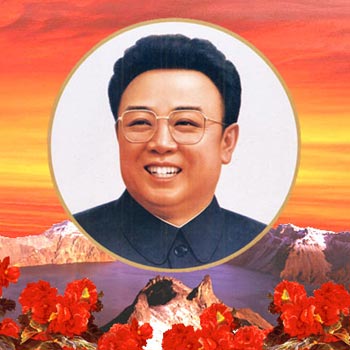 |
| Kim Jong-il |
What is happening here is that the USA and its allies are in the situation of a cop facing a lunatic with a knife. The lunatic cannot win, of course, but he can gravely injure the cop who, therefore, will have to open fire with his firearm as soon as the lunatic gets too close to him.
And, least I get accused of parroting the propaganda of the Western corporate media - let me say here that I have watched interviews of Russian experts who not only worked in the DPRK, but who even worked in delegations which had a direct contact with the Great Leader and the Dear Leader. They all seem to think that at the very least these two are delusional megalomaniacs and that the DPRK is a hellhole of the worst kind.
I sure hope that the current escalation stops soon and that Russia and China will be able to convince the DPRK to cut this bellicose nonsense. Neither country has, so far, evacuated its diplomats from Pyongyang even though the North Koreans have declared that they cannot ensure their safety after April 10th. Hopefully they know something I don't. My main problem is that I don't see any practical way to de-escalate this situation.
This will all probably end up without a full-scale war, but I would not be too inclined to dismiss such a possibility completely.
The Saker
Wednesday, April 3, 2013
Unbelievable - the Saudis are at it again!
Just a few hours after writing about how the Saudis are seriously considering crucifying a Shia cleric, I come across this news item: now the Saudis are apparently considering deliberately paralyzing a man. Check out this BBC article: Amnesty 'outrage' at Saudi paralysis sentence. Here is an excerpt:
This just comforts me in my belief that there is no form of compromise possible between the Wahabism and the rest of mankind. Putin was right when he told them "change your ways or prepare be exterminated".
What also baffles me is the deafening silence of the Muslim world out there. Why? Because in the case of Sheik Nimr al-Nimr "The prosecutor invoked haraba, a form of Islamic punishment enforced by the Saudi government, involving crucifixion and dismemberment" while in this latter case, "The law of qisas, or retribution, in Saudi Arabia means his victim can demand that he suffers exactly the same punishment as he caused". Now, I am clearly no Islamic legal scholar, but even I am aware of the fact that the vast majority of Muslim countries do not practice crucifixion, dismemberment, stoning or deliberate paralyzing. And yet, Islamic law is invoked in these cases and that, I believe, does require some kind of a reaction from those Muslims who do not consider as legitimate the Wahabi interpretation of Islamic law. What are the most respected Muslim scholars saying about this? What does the Organization of Islamic Cooperation have to say about that?
Why are Iran and Syria alone in openly denouncing these murderous psychopaths?!
The Saker
The reported sentencing of paralysis for a Saudi man as punishment for paralysing another man has been described as "outrageous" by a leading human rights group. Saudi reports say the 24-year-old man could be paralysed from the waist down if he cannot pay his victim one million riyals (£250,000) in compensation. Amnesty International says the sentence is a form of torture. The man has been in prison for 10 years since he stabbed a friend in the back. Saudi newspapers say Ali al-Khawahir was 14 when he paralysed his friend in the attack in the Eastern Province town of al-Ahsa. The law of qisas, or retribution, in Saudi Arabia means his victim can demand that he suffers exactly the same punishment as he caused.Good God, what is wrong with these people? Have they lost any kind of common sense? Do they not have a sense of shame of belonging to society which can actually adopt a law which allows for the deliberate paralyzing of a healthy person?!
This just comforts me in my belief that there is no form of compromise possible between the Wahabism and the rest of mankind. Putin was right when he told them "change your ways or prepare be exterminated".
What also baffles me is the deafening silence of the Muslim world out there. Why? Because in the case of Sheik Nimr al-Nimr "The prosecutor invoked haraba, a form of Islamic punishment enforced by the Saudi government, involving crucifixion and dismemberment" while in this latter case, "The law of qisas, or retribution, in Saudi Arabia means his victim can demand that he suffers exactly the same punishment as he caused". Now, I am clearly no Islamic legal scholar, but even I am aware of the fact that the vast majority of Muslim countries do not practice crucifixion, dismemberment, stoning or deliberate paralyzing. And yet, Islamic law is invoked in these cases and that, I believe, does require some kind of a reaction from those Muslims who do not consider as legitimate the Wahabi interpretation of Islamic law. What are the most respected Muslim scholars saying about this? What does the Organization of Islamic Cooperation have to say about that?
Why are Iran and Syria alone in openly denouncing these murderous psychopaths?!
The Saker
Tuesday, April 2, 2013
The USA - in bed with the worst of the worst
Please take a look at this article from the al-Akhbar English language website. I think that it is extremely interesting as it shows the true face of the Saudi Kingdom, not one of modernism and progress, but one of crass pre-medieval barbarity. Let me point of a few things here:
a) Crucifixion as a method of executing is legal in Saudi Arabia. Yup, that's right. What the pagan Romans did 2000 year ago, the Saudi Wahabi still do today, and its all legal.
b) The Saudis practice dismemberment. Now that practice has far more recent precedents, in particular in the European Middle-Ages.
c) The person they want to crucify is a Shia cleric. Yes, you read that right - a Shia cleric. The charges against him? “inciting sectarian strife,” “aiding terrorists,” and “insulting Gulf leaders and scholars.” Translated into plain English these would read: support for the cause of the oppressed Shia minority in the KSA, having contacts with Iran, criticizing Wahabism. In other words, he is clearly a "prisoner of conscience", a political prisoner, somebody charged with political crimes and not actual criminal violations.
 Do you remember Sakineh Mohammadi Ashtiani? She is an Iranian woman sentenced to death by stoning for the murder of her husband by a court in Tabriz. Her case the entire planet erupted in protests, and even many friends of Iran used all their connections to have this sentence overturned which, eventually, it was. Her final status is still unsure.
Now, as an Orthodox Christian I oppose the death penalty on principle. Furthermore, the idea that the all-loving and infinitely merciful God would want anybody to be executed by stoning, crucifixion or dismemberment strikes me as absolutely preposterous and outright blasphemous. I therefore am absolutely appalled that a court in Iran would be capable of handing down such a barbaric sentence. However, having said that, I do not some striking differences between the two cases.
Ashtiani was accused of murder. Sheikh Nimr al-Nimr has not committed any violent crime. Then, Ashtiani's case triggered a huge worldwide wave of outrage. Has anybody even heard about the case of Sheikh Nimr al-Nimr? Not the Western "human rights" organizations for sure. They are probably too busy presenting the "Pussy Riot" group as a noble defender of free speech...
I have written many times here that the Zionist entity called "Israel" is an abomination, a stain on the honor of the entire planet, a disgrace for all of mankind: it is the last openly racist state on the planet and it's ideology actually makes the claim that Jewish racism is God-given. Yes, I still believe that Israel is truly the worst abomination on the planet. But I would rank Saudi Arabia as a clear second worst regime. Both Israel and the KSA are anachronisms is the sense that their true ideology is medieval in its barbarity and fundamentally aggressive and violent by nature.
And yet, these are the closest allies of the USA in the region. The USA, Israel and the KSA - talk about an axis of evil! Talk about "rogue nations"!
And yet, who stands up to these two murderous and crazed regimes? Really only Iran. Everybody else either lacks to guts to say anything, or they actively collaborate with these states and their respective lobbies in the USA.
 And in the meantime, while the USA is subsidising these to satanic regimes with billions of dollars, the Zionists and the Wahabis are destablizing countries worldwide. As for Iran, the only country to truly stand up and resist these two abominations, it is the victim of international sanctions under the totally fallacious pretext that one day Iran "might" develop a nuclear weapon while being under the stricest of monitoring by the IAEA.
It is undeniable that the USA is "in bed" with the worst of the worst, regimes which are so evil and corrupt as to justify their worst abominations by claiming that this is the Will of God.
I can only hope that the BRICS countries will now reach out to Iran and help it economically and politically.
The Saker
 |
| Wahabi crucifixion in Yemen |
b) The Saudis practice dismemberment. Now that practice has far more recent precedents, in particular in the European Middle-Ages.
c) The person they want to crucify is a Shia cleric. Yes, you read that right - a Shia cleric. The charges against him? “inciting sectarian strife,” “aiding terrorists,” and “insulting Gulf leaders and scholars.” Translated into plain English these would read: support for the cause of the oppressed Shia minority in the KSA, having contacts with Iran, criticizing Wahabism. In other words, he is clearly a "prisoner of conscience", a political prisoner, somebody charged with political crimes and not actual criminal violations.

Now, as an Orthodox Christian I oppose the death penalty on principle. Furthermore, the idea that the all-loving and infinitely merciful God would want anybody to be executed by stoning, crucifixion or dismemberment strikes me as absolutely preposterous and outright blasphemous. I therefore am absolutely appalled that a court in Iran would be capable of handing down such a barbaric sentence. However, having said that, I do not some striking differences between the two cases.
 |
| Sheikh Nimr al-Nimr |
I have written many times here that the Zionist entity called "Israel" is an abomination, a stain on the honor of the entire planet, a disgrace for all of mankind: it is the last openly racist state on the planet and it's ideology actually makes the claim that Jewish racism is God-given. Yes, I still believe that Israel is truly the worst abomination on the planet. But I would rank Saudi Arabia as a clear second worst regime. Both Israel and the KSA are anachronisms is the sense that their true ideology is medieval in its barbarity and fundamentally aggressive and violent by nature.
And yet, these are the closest allies of the USA in the region. The USA, Israel and the KSA - talk about an axis of evil! Talk about "rogue nations"!
And yet, who stands up to these two murderous and crazed regimes? Really only Iran. Everybody else either lacks to guts to say anything, or they actively collaborate with these states and their respective lobbies in the USA.
It is undeniable that the USA is "in bed" with the worst of the worst, regimes which are so evil and corrupt as to justify their worst abominations by claiming that this is the Will of God.
I can only hope that the BRICS countries will now reach out to Iran and help it economically and politically.
The Saker
Monday, April 1, 2013
Fascism in Europe next?
In 2007 I wrote several pieces warning of the arrival of overt Fascism in the USA (see: "Rudy Giuliani - the face of American Fascism", "The only thing which can prevent a Fascist President in 2008" and "When is the use of the "F" word appropriate?"). Now, five years later, I would say that what I observe in the USA is some form of "creeping Fascism" which has succeeded in avoiding the type of overt full-spectrum crackdown on the US general public mainly thanks to the artificial but nonetheless semi-effective way a full-scale economic collapse of the US economy has been avoided. Basically, the laws are in place, the repressive apparatus ready to go in high gear, but the plutocrats in power have managed to avoid using these instruments, at least on a noticeable scale. A great deal of the credit for this goes, I sincerely believe, to the US general public who have shown many signs of push-back against some of the most ridiculous excesses of the TSA, the Border Patrol, the FBI, the Pentagon and other agencies. Still, I believe that all it would take is one "bank holiday" for the curtain to come down and the repression to start. But that is a topic for another day, today I want to turn my attention to Europe and what is taking place there, in particular in regards to Cyprus.
What has happened in Cyprus is almost irrelevant to the EU's economy. As one economist aptly put it, the magnitude of the economic crisis in Cyprus is basically one of a rounding error in the EU's overall economy. As far as Europe is concerned, Cyprus could vanish from the face of the earth overnight, and it would not even notice it. Same deal, by the way, for Russia.
In political terms, however, what happened in Cyprus is, I believe, an event of truly apocalyptic nature: the political suicide of Europe. Why?
Think of it in the simplest of terms:
Some Cypriot banks were told that they had to reimburse their creditors. These banks admitted that they did not have the means to do so. Then, the so-called "Troika" met. What is this "Troika"? A tripartite committee composed of the European Central Bank (ECB), the European Commission (EC) and the International Monetary Fund (IMF). Now please keep in mind two crucial things about this "Troika":
a) Nobody has ever elected the "Troika" itself or even any of its constituent parties (ECB, EC, IMF).
b) Neither the Cypriot people nor the Cypriot banks, are represented at this "Troika".
The Troika basically decided to reimburse the creditors of the Cypriot banks by seizing the money deposited in the Cypriot banks. Now, just to make things clear, please keep in mind that if you are in investor or a shareholder in Bank X your fortune does depend on how well this bank is managed and how it performs. However, if you deposit your money in Bank X this money still remains yours, it might be trusted to the care of the bank, but the bank does not own this money which is strictly and only yours. And yet, the "Troika" ordered the Cypriot banks to simply seize the money which had been deposited in (not invested in) their banks and hand it over to their creditors.
Now, the "Troika" really has zero democratic credentials, this is just a product of the will of the EU bureaucracy. It has no legal right to force the Cypriot banks to do anything. Furthermore, the Cypriot banks have no legal right at all to seize the money which has been deposited in them. To take something which does not belong to you is called *theft*.
Marx wrote the private property generates capitalism, and he was right. But what remains of capitalism if its most important aspect, its ideological cornerstone, is suddenly abolished? Does that not mean the end of capitalism itself?
All the political evolution of Europe since the past three or four hundred years has had as its goal to secure each individual's private property not only from the arbitrary seizure by bandits and thugs, but also by kings and governments. I can think of only one example in the history of western Europe when a government decided to overly seize the property of private individuals by force with no other justification than "because we say so" and that is Kristallnacht in 1938. Yes, the Nazis did dare to openly do what the "Troika" is doing now. And, of course, in the East, the Bolsheviks "nationalized" pretty much all the private property of the Russian people. But at least the Nazis and the Bolsheviks more or less had some kind of argument to be acting on behalf of at least one part of the population of their country. Not so the "Troika" which has no national or electoral mandate or legitimacy.
What does all this really show?
It shows that in Europe the rule of law is a big fat joke. Yes, the big players such as Germany will insist on the respect of the rule of law as long as it is beneficial to them, but as soon as it is not, to hell with it - they will use the same methods as the mob.
That, by the way, should surprise nobody.
The rule of law took a big hit in Europe when the Europeans let the US invade Bosnia under the cover of UNPROFOR and it completely died when NATO attacked Serbia in complete illegality.
Turns that that all these oh-so-respectable European politicians and ideologues are nothing more than your garden variety mobsters, with exactly *zero* respect for the rule of law.
This also means that all the money now deposited in Europe is potentially at risk. Though the EU bureaucrats denied it, it is absolutely clear even to the dullest of idiots that what happened in Cyprus sets precedent, that from now on the very method of seizing money deposited in banks has now the "respectability" of having been used by the ECB, the EC and the IMF. I would even argue that the fact that the IMF was part of this decision makes it an international precedent which now has applicability worldwide.
Furthermore, having acted in complete violating of national and international laws, having arrogantly disregarded banking regulations and laws, and having also condoned the illegal use of force (against Serbia), the EU is now showing its true face: a transnational Fascist cartel run by bankers and plutocrats which does not give a damn about what the European population thinks, or what the law says. The real motto of Europe has now clearly become "might makes right", and that is true in Libya, Syria and Cyprus, but that also means that this is true throughout the EU.
Somewhere I welcome that. "Bas les masques!" (off with the masks) as the French say. At least all of the West - USA and Europe - are done playing cute games about democracy, freedom and human rights. Now, finally, we can see beyond any doubt that the entire western political system is about one thing and one thing only: pure, unfettered, greed. Greed and nothing else.
All this take about lofty ideals of individual rights, private property, freedom, representation, democracy, human rights, etc. was just a load of propaganda aimed at masking the true nature of the beast. Most of us already understood that, but now even the dullest of the doubleplusgoodthinking "democrats" will see that there is nothing real at all in the entire edifice of western political thought besides greed served by violence and lies.
Yet another proof that Fascism was a genuine expression of European civilization. Let's remember here that European Fascism has two very different roots: a southern one - the Papacy (Petain, Franco, Pavelic, Mussolini) and a northern one - the Protestant bourgeoisie (Hitler). Or look at the anti-Fascist resistance in Europe: what are the countries which really gave the Germans a determined resistance? Serbia, of course. Who else? The Netherlands, the Poland and the Greece had major resistance organizations. As for the rest of Europe, it did very little real resistance - they Nazis were certainly not loved, but they were accepted in most countries. After WWII the newly imposed elites tried to turn Hitler and Mussolini into some abject monsters and their ideologies into some satanic creation of a few mad men, but the fact is that Fascism and National-Socialism had deep religious, political and cultural roots in Europe and that both the German Nazis and the Italian Fascists very much saw themselves as people who are reviving the true traditions from the European past.
The situation today is different, of course. We are often told that what is taking place is a struggle between the European "core" represented by Germany against the European "periphery" sometimes referred to as PIIGS (Portugal, Italy, Ireland, Greece and Spain). But I would argue that what is taking place is even far bigger than that - its not only the PIIGS which are a target of the European plutocracy, but also France, which is far bigger and whose "explosive potential" is far more threatening to the international financial system. A top analyst for a hedge fund in NY has recently confirmed to me that if France collapses so would the entire US banking system (courtesy of the crazy system of CDS put in place since the 1990s). There are plenty of signs that the entire French economy has come to a standstill and that it is literally running out of cash (Max Keiser and Pierre Jovanovic have been warning about this for many years).
So I ask myself a basic question: if the Troika has had the nerve to basically act like a gang of mobsters in the case of a tiny economy such as the Cypriot one, what will it do if, say, the economies Portugal, Spain or, God forbid, France collapse? What will the European rulers such as Merkel do if mass unrests begin in these countries? France, in particular, as a long tradition of uprisings and civil unrest which could re-ignite in just a few hours given the right circumstances. The government of Francois Hollande is already the most despised of the French 5th Republic even though the man has been very recently elected.
Finally, the anti-EU movements are still active throughout Europe and the current crisis will only strengthen then. What will the (always submissive and pliant) European governments do if they are told by the top EU bosses to crack down on local separatists/sovereignists? Will they hesitate? I think not.
 The bottom line is this: all the European elites, the entire European ruling class, are deeply committed to the Single Europe ideology and they will never, ever, let go of it. The loss of face resulting from a global collapse of the EU project would inevitably result in a loss of power for all those who put their reputation and authority behind this ideology. Nevertheless, the EU is collapsing, and each effort of the European elites to conceal this fact only make the real situation worse. Given a choice between facing the consequences of a popular revolt and the implementation of a Fascist rule there is no doubt in my mind at all that the European elites will chose the latter, with plenty of empty words about "provisional", "exceptional", "temporary" etc.
By now it is becoming undeniable that Europe can have democracy or the EU, but not both. The actions of the "Troika" in the case of Cyprus show, I think, which choice has been made. Fascism might well come to Europe even before it comes to the USA.
The Saker
What has happened in Cyprus is almost irrelevant to the EU's economy. As one economist aptly put it, the magnitude of the economic crisis in Cyprus is basically one of a rounding error in the EU's overall economy. As far as Europe is concerned, Cyprus could vanish from the face of the earth overnight, and it would not even notice it. Same deal, by the way, for Russia.
In political terms, however, what happened in Cyprus is, I believe, an event of truly apocalyptic nature: the political suicide of Europe. Why?
Think of it in the simplest of terms:
 |
| Bank robbery in Cyprus |
a) Nobody has ever elected the "Troika" itself or even any of its constituent parties (ECB, EC, IMF).
b) Neither the Cypriot people nor the Cypriot banks, are represented at this "Troika".
The Troika basically decided to reimburse the creditors of the Cypriot banks by seizing the money deposited in the Cypriot banks. Now, just to make things clear, please keep in mind that if you are in investor or a shareholder in Bank X your fortune does depend on how well this bank is managed and how it performs. However, if you deposit your money in Bank X this money still remains yours, it might be trusted to the care of the bank, but the bank does not own this money which is strictly and only yours. And yet, the "Troika" ordered the Cypriot banks to simply seize the money which had been deposited in (not invested in) their banks and hand it over to their creditors.
Now, the "Troika" really has zero democratic credentials, this is just a product of the will of the EU bureaucracy. It has no legal right to force the Cypriot banks to do anything. Furthermore, the Cypriot banks have no legal right at all to seize the money which has been deposited in them. To take something which does not belong to you is called *theft*.
Marx wrote the private property generates capitalism, and he was right. But what remains of capitalism if its most important aspect, its ideological cornerstone, is suddenly abolished? Does that not mean the end of capitalism itself?
 |
| Hitler as a European knight |
What does all this really show?
It shows that in Europe the rule of law is a big fat joke. Yes, the big players such as Germany will insist on the respect of the rule of law as long as it is beneficial to them, but as soon as it is not, to hell with it - they will use the same methods as the mob.
That, by the way, should surprise nobody.
The rule of law took a big hit in Europe when the Europeans let the US invade Bosnia under the cover of UNPROFOR and it completely died when NATO attacked Serbia in complete illegality.
Turns that that all these oh-so-respectable European politicians and ideologues are nothing more than your garden variety mobsters, with exactly *zero* respect for the rule of law.
This also means that all the money now deposited in Europe is potentially at risk. Though the EU bureaucrats denied it, it is absolutely clear even to the dullest of idiots that what happened in Cyprus sets precedent, that from now on the very method of seizing money deposited in banks has now the "respectability" of having been used by the ECB, the EC and the IMF. I would even argue that the fact that the IMF was part of this decision makes it an international precedent which now has applicability worldwide.
Furthermore, having acted in complete violating of national and international laws, having arrogantly disregarded banking regulations and laws, and having also condoned the illegal use of force (against Serbia), the EU is now showing its true face: a transnational Fascist cartel run by bankers and plutocrats which does not give a damn about what the European population thinks, or what the law says. The real motto of Europe has now clearly become "might makes right", and that is true in Libya, Syria and Cyprus, but that also means that this is true throughout the EU.
Somewhere I welcome that. "Bas les masques!" (off with the masks) as the French say. At least all of the West - USA and Europe - are done playing cute games about democracy, freedom and human rights. Now, finally, we can see beyond any doubt that the entire western political system is about one thing and one thing only: pure, unfettered, greed. Greed and nothing else.
All this take about lofty ideals of individual rights, private property, freedom, representation, democracy, human rights, etc. was just a load of propaganda aimed at masking the true nature of the beast. Most of us already understood that, but now even the dullest of the doubleplusgoodthinking "democrats" will see that there is nothing real at all in the entire edifice of western political thought besides greed served by violence and lies.
Yet another proof that Fascism was a genuine expression of European civilization. Let's remember here that European Fascism has two very different roots: a southern one - the Papacy (Petain, Franco, Pavelic, Mussolini) and a northern one - the Protestant bourgeoisie (Hitler). Or look at the anti-Fascist resistance in Europe: what are the countries which really gave the Germans a determined resistance? Serbia, of course. Who else? The Netherlands, the Poland and the Greece had major resistance organizations. As for the rest of Europe, it did very little real resistance - they Nazis were certainly not loved, but they were accepted in most countries. After WWII the newly imposed elites tried to turn Hitler and Mussolini into some abject monsters and their ideologies into some satanic creation of a few mad men, but the fact is that Fascism and National-Socialism had deep religious, political and cultural roots in Europe and that both the German Nazis and the Italian Fascists very much saw themselves as people who are reviving the true traditions from the European past.
The situation today is different, of course. We are often told that what is taking place is a struggle between the European "core" represented by Germany against the European "periphery" sometimes referred to as PIIGS (Portugal, Italy, Ireland, Greece and Spain). But I would argue that what is taking place is even far bigger than that - its not only the PIIGS which are a target of the European plutocracy, but also France, which is far bigger and whose "explosive potential" is far more threatening to the international financial system. A top analyst for a hedge fund in NY has recently confirmed to me that if France collapses so would the entire US banking system (courtesy of the crazy system of CDS put in place since the 1990s). There are plenty of signs that the entire French economy has come to a standstill and that it is literally running out of cash (Max Keiser and Pierre Jovanovic have been warning about this for many years).
So I ask myself a basic question: if the Troika has had the nerve to basically act like a gang of mobsters in the case of a tiny economy such as the Cypriot one, what will it do if, say, the economies Portugal, Spain or, God forbid, France collapse? What will the European rulers such as Merkel do if mass unrests begin in these countries? France, in particular, as a long tradition of uprisings and civil unrest which could re-ignite in just a few hours given the right circumstances. The government of Francois Hollande is already the most despised of the French 5th Republic even though the man has been very recently elected.
Finally, the anti-EU movements are still active throughout Europe and the current crisis will only strengthen then. What will the (always submissive and pliant) European governments do if they are told by the top EU bosses to crack down on local separatists/sovereignists? Will they hesitate? I think not.
By now it is becoming undeniable that Europe can have democracy or the EU, but not both. The actions of the "Troika" in the case of Cyprus show, I think, which choice has been made. Fascism might well come to Europe even before it comes to the USA.
The Saker
Tuesday, March 26, 2013
First results from the Russia-China partnership
Results from the new Russian-Chinese strategic partnership are coming in fast.
First, Russia has agreed to sell China 4 advanced diesel-electric submarines of the "Lada" class (aka Project 677):
This type of submarine is one of the most advanced in its class, even superior to its formidable predecessor the "Kilo" class Project 636 which was already so silent that it was nicknamed the "Black Hole" because for its ability to avoid detection. Lada class submarines excel in many roles including anti-submarine and anti-surface warfare and reconnaissance, and it has an advanced automated combat system.
Second, Russia will also sell China 24 of its advanced SU-35 multi-role combat aircraft:
The Sukhoi SU-35 is considered a 4++ generation aircraft meaning that while the airframe is still of the 4th generation, the systems installed on-board are already of the 5th generation. Though these are very different aircraft, it is widely admitted that the only aircraft which could match or even exceed the formidable capabilities of the SU-35 in air-to-air combat would be the American F-22 (in the ground attack role the SU-35 is far more capable than the F-22).
In other words, China is now acquiring the kind of military hardware which no other Asian country possesses and which will present the United States with a very serious challenge.
Third, Russia and China also signed a huge energy deal. The WSJ reports:
No kidding!
The Saker
First, Russia has agreed to sell China 4 advanced diesel-electric submarines of the "Lada" class (aka Project 677):
 |
| Project 677 |
This type of submarine is one of the most advanced in its class, even superior to its formidable predecessor the "Kilo" class Project 636 which was already so silent that it was nicknamed the "Black Hole" because for its ability to avoid detection. Lada class submarines excel in many roles including anti-submarine and anti-surface warfare and reconnaissance, and it has an advanced automated combat system.
Second, Russia will also sell China 24 of its advanced SU-35 multi-role combat aircraft:
 |
| SU-35 |
The Sukhoi SU-35 is considered a 4++ generation aircraft meaning that while the airframe is still of the 4th generation, the systems installed on-board are already of the 5th generation. Though these are very different aircraft, it is widely admitted that the only aircraft which could match or even exceed the formidable capabilities of the SU-35 in air-to-air combat would be the American F-22 (in the ground attack role the SU-35 is far more capable than the F-22).
In other words, China is now acquiring the kind of military hardware which no other Asian country possesses and which will present the United States with a very serious challenge.
Third, Russia and China also signed a huge energy deal. The WSJ reports:
After more than a decade of talks, Russia has agreed to supply China with natural gas, a deal that could see China surpass Germany as the largest importer of Russian gas. Officials Friday signed a raft of other energy agreements, including one to double Russian oil supplies and hand China's state oil company a stake in Russian oil fields, tightening the nexus between Russia, the world's largest energy producer, and China, the hungriest consumer. Chinese President Xi Jinping, in Moscow on his first foreign trip as leader, called the accords a "breakthrough" at a signing ceremony in the Kremlin Friday. Russian President Vladimir Putin said the visit would have "long-term, historic results." Russian state gas giant OAO Gazprom said it would conclude a 30-year supply deal with the Chinese by the end of the year, just as the company is struggling with declining demand and regulatory pressure in its core market of Europe. Under the terms of the memorandum, annual deliveries of 38 billion cubic meters of gas will start in 2018. Supplies could eventually reach 60 billion cubic meters a year, Gazprom Chief Executive Alexei Miller told reporters after the signing ceremony. Germany, long the largest consumer of Russian gas, imported 33 billion cubic meters last year.One particularly interesting aspect of all this are the comments made by the state-run China Daily which described this strategic partnerships as "a well-deserved riposte to Washington for America's military 'pivot' to Asia. Xi is executing China's own 'pivot' - the visit to Moscow to cement ties with Mr Putin. Xi's decision to make Moscow the destination of his first official visit as China's president will give the US a sharp reminder that it is not the only power able to flex its muscles" the report, translated by BBC Monitoring, went on.
No kidding!
The Saker
 |
| Defense Ministers Chang Wanquan and Sergei Shoigu |
Monday, March 25, 2013
Russia between Cyprus and China
The last couple of days have been truly of immense, historical, importance for Russia, first because of the hugely important visit of Xi Jinping, the President of the People's Republic of China, General Secretary of the Communist Party of China, and the Chairman of the Central Military Commission. During this visit the Chinese side stressed that it was highly symbolic that Xi Jinping had chosen Russia as the first country to visit following his election. The Russians responded with their own highly symbolic gesture - they invited Xi Jinping to visit the Operational Control Center of the Russian Armed Forces, something no other head of state had ever done before.
Both sides insisted that what took place was absolutely unprecedented. For example, Xi Jinping and Vladimir Putin spent a total of seven hours in direct, face to face, consultations. Both heads of state declared that the Russian-Chinese strategic partnership was of the highest possible importance for both countries and that the two nations would closely collaborate on all levels including long term energy and defense issues. A large number of strategic agreements and contracts were signed and both Putin and Xi Jinping announced that Russia and China would also closely work together and support each other in all international questions. Both leaders stressed that the past was forever gone and that the nature of the new relationship between their two countries will have no historical precedent.
While the western corporate press went out of its way to minimize the importance of this meeting, the Russian and the Chinese press stressed the truly tectonic shift such a close partnership represents for the future of the planet. While everything was said in the most diplomatic language, it is rather clear that what we witnessed over the past few days is the birth of a new strategic alliance which is rather clearly aimed against the West both in economic and even military terms. The goal of Russia and China is not to trigger some kind of confrontation with the West as much as it is to globally counter-act Western imperialism. This is why both delegations insisted on the respect of international law in a multi-polar world were no one country or block can dictate its will.
It will be interesting to see what the impact of this strategic alliance will be upon the SCO, the CSTO and the BRICS countries. My personal sense is that Russia and China will use their combined power to strengthen all these institutions. I also see this strategic alliance as yet another manifestation of the new power of the "Eurasian sovereignists" inside the Kremlin who are now clearly pushing Russia towards a deeper integration with the East.
It is ironic that while this new strategic partnership between Russia and China was finalized in Moscow, the West found nothing better to do than to basically commit and act of pure highway banditry towards Russia. I am referring, of course, to what is happening in Cyprus.
To make a long story short I will sum up what is taking place in the following sentence. The EU bankers and their US sponsors have basically decided to rob Russian bank account holders of about 30% of their money in Cyprus in order to repay the banks which gave dirty loans to Cyprus, in other words, to pay themselves. Not only is such an action a direct violation of all possible laws and regulations pertaining to banking, but it is done against a background of vicious anti-Russian propaganda which basically claims that all the Russian money in Cyprus is dirty money from the Russian Mafia. What the EU leaders are basically telling Russia is "yes, fuck you, we will simply take your money and dare you to do something about it".
Interestingly, the Russia media is very much aware of who is really pulling the strings of this entire operation and no Russian politician spoke out against the Cypriots themselves who are, in reality, as much the victims of the international banking cartels as the Russian investors. The line chosen by Russian politicians and the media is the same one: what is happening here has little or nothing to do with Cyprus and everything to do with the entire EU zone becoming dangerous for Russian investors.
The Russian economy will not suffer from any of that. First, because Cyprus is way too small to matter. Second, this situation only strengthens the position of the "Eurasian sovereignists" who have always been warning against placing money in Western banks. Third, this act of banditry by the EU will only further fuel anti-Western sentiments in the already very hostile Russian public opinion and it will hurt all the pro-Western parties and movements in Russia.
The vast majority of the people in Russia see what is happening in Cyprus as yet another manifestation of the Western anti-Russian racism which appears to be the prime motivator of current Western policies towards Russia. For example, Russian journalists were quick to remember that the last time somebody in Europe simply seized the bank accounts of foreigners was Hitler who did so to grab more money to finance his policies. While I find this parallel a little far fetched, it is, I believe, very indicative of the mood in Russia which is deeply disgusted with the West. This is hardly surprising: after the NATO expansion to the East (which it has promised not to do!), the support by the West for all the anti-Russian regimes, including the most aggressive (Georgia) and racist (Latvia), following the deployment of the US anti-missile system, the support for Jewish oligarchs like Berezovsky or Khodorkovsky, the support for Chechen separatists and their atrocities, the adoption of anti-Russian laws like the Magnitsky Act, the support for Pussy Riot and the homosexual parades in Russia, now the big Cypriot robbery. It is hardly a wonder that the Russians are globally disgusted with the West and its seemingly infinite capability for hypocrisy and lies.
 Still, the creation of this strategic partnership between China and Russia is excellent news for the world wide resistance against the US-run international global new world order and its turbocapitalist ideology. Both Russia and China clearly and unambiguously stand for the ideas of sovereignty and social solidarity, in other words, what is arguably the most powerful alliance on the planet is clearly anti-capitalist in its ideological basis. Sure, this is not the anti-capitalism of Stalin or Mao, and both Russia and China are more than happy to play the corporate game to their own benefit, but it remains that they are not willing to surrender their sovereignty to the trans-national banking interests and nor are they willing to give up the core value of social solidarity (what most Americans think of as "socialism") in their society.
At a time when Latin America is clearly wobbling and unsure about its future course and when Africa is becoming the next hunting ground for Western predators, it is extremely encouraging to see the emergence of a strategic alliance between the two most powerful countries to resist Western imperialism and the New World Order.
The Saker
 |
| Xi Jinping visits the Operational Control Center of the Russian Armed Forces |
While the western corporate press went out of its way to minimize the importance of this meeting, the Russian and the Chinese press stressed the truly tectonic shift such a close partnership represents for the future of the planet. While everything was said in the most diplomatic language, it is rather clear that what we witnessed over the past few days is the birth of a new strategic alliance which is rather clearly aimed against the West both in economic and even military terms. The goal of Russia and China is not to trigger some kind of confrontation with the West as much as it is to globally counter-act Western imperialism. This is why both delegations insisted on the respect of international law in a multi-polar world were no one country or block can dictate its will.
It will be interesting to see what the impact of this strategic alliance will be upon the SCO, the CSTO and the BRICS countries. My personal sense is that Russia and China will use their combined power to strengthen all these institutions. I also see this strategic alliance as yet another manifestation of the new power of the "Eurasian sovereignists" inside the Kremlin who are now clearly pushing Russia towards a deeper integration with the East.
It is ironic that while this new strategic partnership between Russia and China was finalized in Moscow, the West found nothing better to do than to basically commit and act of pure highway banditry towards Russia. I am referring, of course, to what is happening in Cyprus.
To make a long story short I will sum up what is taking place in the following sentence. The EU bankers and their US sponsors have basically decided to rob Russian bank account holders of about 30% of their money in Cyprus in order to repay the banks which gave dirty loans to Cyprus, in other words, to pay themselves. Not only is such an action a direct violation of all possible laws and regulations pertaining to banking, but it is done against a background of vicious anti-Russian propaganda which basically claims that all the Russian money in Cyprus is dirty money from the Russian Mafia. What the EU leaders are basically telling Russia is "yes, fuck you, we will simply take your money and dare you to do something about it".
Interestingly, the Russia media is very much aware of who is really pulling the strings of this entire operation and no Russian politician spoke out against the Cypriots themselves who are, in reality, as much the victims of the international banking cartels as the Russian investors. The line chosen by Russian politicians and the media is the same one: what is happening here has little or nothing to do with Cyprus and everything to do with the entire EU zone becoming dangerous for Russian investors.
The Russian economy will not suffer from any of that. First, because Cyprus is way too small to matter. Second, this situation only strengthens the position of the "Eurasian sovereignists" who have always been warning against placing money in Western banks. Third, this act of banditry by the EU will only further fuel anti-Western sentiments in the already very hostile Russian public opinion and it will hurt all the pro-Western parties and movements in Russia.
The vast majority of the people in Russia see what is happening in Cyprus as yet another manifestation of the Western anti-Russian racism which appears to be the prime motivator of current Western policies towards Russia. For example, Russian journalists were quick to remember that the last time somebody in Europe simply seized the bank accounts of foreigners was Hitler who did so to grab more money to finance his policies. While I find this parallel a little far fetched, it is, I believe, very indicative of the mood in Russia which is deeply disgusted with the West. This is hardly surprising: after the NATO expansion to the East (which it has promised not to do!), the support by the West for all the anti-Russian regimes, including the most aggressive (Georgia) and racist (Latvia), following the deployment of the US anti-missile system, the support for Jewish oligarchs like Berezovsky or Khodorkovsky, the support for Chechen separatists and their atrocities, the adoption of anti-Russian laws like the Magnitsky Act, the support for Pussy Riot and the homosexual parades in Russia, now the big Cypriot robbery. It is hardly a wonder that the Russians are globally disgusted with the West and its seemingly infinite capability for hypocrisy and lies.
At a time when Latin America is clearly wobbling and unsure about its future course and when Africa is becoming the next hunting ground for Western predators, it is extremely encouraging to see the emergence of a strategic alliance between the two most powerful countries to resist Western imperialism and the New World Order.
The Saker
Saturday, March 23, 2013
"The Syrian Diary" - Russian TV documentary (subtitled)
Why I believe that this is a "must watch" documentary:
This is a documentary by Anastasia Popova, a correspondent for the Russian TV station "Rossia 24". Don't expect any kind of sympathy for the FSA from these reporters who are 100% behind the Syrian Army and who are absolutely outraged at what they strongly believe is the rape of a nation by a coalition of international terrorists and NATO special forces. It is precisely this strong identification with one side which makes this documentary so important: it shows the point of view of those whose voice and opinion is absolutely *never* heard in the western corporate media.
It is a sad truth that history is written by victors, and there is a really good chance that the side represented in this video will be the loosing one.
Finally, this is a woman's view on a civil war, something which is also very rarely seen.
For all these reasons I urge everybody to watch this documentary.
The Saker
-------
This is a documentary by Anastasia Popova, a correspondent for the Russian TV station "Rossia 24". Don't expect any kind of sympathy for the FSA from these reporters who are 100% behind the Syrian Army and who are absolutely outraged at what they strongly believe is the rape of a nation by a coalition of international terrorists and NATO special forces. It is precisely this strong identification with one side which makes this documentary so important: it shows the point of view of those whose voice and opinion is absolutely *never* heard in the western corporate media.
It is a sad truth that history is written by victors, and there is a really good chance that the side represented in this video will be the loosing one.
Finally, this is a woman's view on a civil war, something which is also very rarely seen.
For all these reasons I urge everybody to watch this documentary.
The Saker
-------
Friday, March 22, 2013
Has Ayatollah Ali Khamenei made an empty threat? (UPDATED)
If this is not yet another case of mistaken translation, as there have been many in the past, then it appears that the Iranian Supreme Leader, Ayatollah Ali Khamenei, has made a completely empty threat towards Israel. According to RT,
The biggest problem with all that is that this threat is nonsensical. Never in the history of warfare has a city been razed by missile attacks. From the Nazi V-1/V-2 strikes on London, to Saddam's strikes on US forces in the Persian Gulf and on Israel, missiles were never effective in striking cities. In fact, unless they carry nuclear warheads, missiles are not at all suited for that task simply because of the relatively small payloads they carry. For example, the throw-weight of the Iranian Shahab-4 is reportedly less than 1000kg. Sure, 1 ton of high-explosives or cluster warheads will result in a huge explosion, but that is no bigger than the old V-2 rocket were capable of. It will bring down any building, or even a street block, but you would need a huge number of missiles to really raze a major city. Frankly, there are only three ways to raze a city: nuclear warheads, carped bombing from the air, or a massive and sustained artillery barrage. Iran can deliver none of these.
Iran does have an impressive missile force, and Iran's missiles can painfully strike Israel, these missile can destroy key buildings in Israeli cities, which will create a panic and chaos, and if Hezbollah joins in these strikes with its own missiles the panic in Israel will be total, but even in these conditions no city in Israel will be "razed to the ground".
The Iranian leadership should be very careful to avoid making bombastic but empty threats as these only damage Iran's credibility and serve Zionist interests.
The Saker
UPDATE: alas, the translation has been confirmed by PressTV. This is most unfortunate and, I would add, rather uncharacteristic of Ayatollah Ali Khamenei.
Iran’s most powerful authority, Ayatollah Ali Khamenei, said the Islamic Republic would raze the cities of Tel Aviv and Haifa “to the ground” if Israel launched a military strike against it. “At times the officials of the Zionist regime [Israel] threaten to launch a military invasion, but they themselves know that if they make the slightest mistake the Islamic Republic will raze Tel Aviv and Haifa to the ground,” Ayatollah Ali Khamenei said during an address on live state television.Sure enough, the Zio-media turned that into yet another "proof" that the Iranians are hell-bent on genocide.
The biggest problem with all that is that this threat is nonsensical. Never in the history of warfare has a city been razed by missile attacks. From the Nazi V-1/V-2 strikes on London, to Saddam's strikes on US forces in the Persian Gulf and on Israel, missiles were never effective in striking cities. In fact, unless they carry nuclear warheads, missiles are not at all suited for that task simply because of the relatively small payloads they carry. For example, the throw-weight of the Iranian Shahab-4 is reportedly less than 1000kg. Sure, 1 ton of high-explosives or cluster warheads will result in a huge explosion, but that is no bigger than the old V-2 rocket were capable of. It will bring down any building, or even a street block, but you would need a huge number of missiles to really raze a major city. Frankly, there are only three ways to raze a city: nuclear warheads, carped bombing from the air, or a massive and sustained artillery barrage. Iran can deliver none of these.
Iran does have an impressive missile force, and Iran's missiles can painfully strike Israel, these missile can destroy key buildings in Israeli cities, which will create a panic and chaos, and if Hezbollah joins in these strikes with its own missiles the panic in Israel will be total, but even in these conditions no city in Israel will be "razed to the ground".
The Iranian leadership should be very careful to avoid making bombastic but empty threats as these only damage Iran's credibility and serve Zionist interests.
The Saker
UPDATE: alas, the translation has been confirmed by PressTV. This is most unfortunate and, I would add, rather uncharacteristic of Ayatollah Ali Khamenei.
Subscribe to:
Posts (Atom)