Showing posts with label subversion. Show all posts

Saturday, June 11, 2011

America's Next War Theater: Syria and Lebanon? Washington's War against the Resistance Bloc

By Mahdi Darius Nazemroaya for Global Research 

Washington and its allies, Israel and the Al-Sauds, are taking advantage of the upheavals in the Arab World. They are now working to dismantle the Resistance Bloc and weaken any drive for democracy in the Arab World. The geo-political chessboard is now being prepared for a broader confrontation that will target Tehran and include Syria, Lebanon, Iraq, and the Palestinians.

Tying Hezbollah’s Hands through External and Internal Pressure

In Lebanon, there is a deadlock in regards to the formation of a Lebanese government. Michel Sleiman, who holds the presidency and the new Lebanese prime minister have been delaying the formation of the cabinet in a political row with Michel Aoun, the leader of the Free Patriotic Movement.

It may be possible that the formation of a new Lebanese cabinet is being delayed deliberately to keep Lebanon neutralized on the foreign policy front.

The U.N. Security Council and several U.N. bodies are all being used by the U.S. and the E.U. to put pressure on Lebanon. U.N. Secretary General Ban Ki-moon is taking his orders fom Washington. He has contributed to providing legitimacy to the U.S. and NATO wars. Moscow has openly accused Ban Ki-moon of treachery for his 2008 secret dealings with NATO.

It is in this context that the U.N. is being used as a forum for insidious attempts to internationalize the issue of the weapons held by the Lebanese Resistance, with a view to disarming it. Despite the fact that U.N. Resolution 1559 is no longer relevant, the Special Representative for the Implementation of Resolution 1559, Terje Roed-Larsen, still remains active and issues reports against Hezbollah.

The envoys of the U.N. to Lebanon resemble colonial figures making uninvited edicts in Beirut and working as agents of Washington, Brussels, and Tel Aviv. The Special Tribunal for Lebanon (STL), which has an entire division in the U.S. State Department, is also a loaded political weapon that Washington is planning on using against Lebanon and Syria.

An international tribunal was formed pertaining to the circumstances of the the assassination of Rafic Al-Hariri. Hariri at the time of his murder had no official state position, but an international tribunal has been created for his case alone. On the other hand the so-called international community has taken no interest in forming any type of tribunals to investigate the assassination of thousands of people killed in Lebanon. What does this say about the STL and the justice being sought?

The United Nations Interim Force in Lebanon (UNIFIL) has also been complicit in Israeli violations against Lebanon. Even the United Nations Relief and Works Agency for Palestinian Refugees in the Near East (UNRAW) has been infiltrated with officials that are supportive of Israeli crimes against Palestinians and Lebanese. This was demonstrated by Christopher Gunness, the spokesperson of UNRAW, in a May 15, 2011 interview with the Israeli military. While Israel’s IDF was firing on unarmed civilian protesters during Nakba Day 2011, Gunness reaffirmed that UNRAW was working in the interest of Israel’s national security, while also accusing the Palestinians of committing terrorist acts against Israel. Even the Israeli siege of the Gaza Strip was whitewashed by the UNRAW spokesperson.

The absence of a new cabinet in Lebanon has also allowed Saad Hariri and the March 14 Alliance to continue having an ominous hand in managing Lebanon’s affairs. This also buys time for the STL, which can move forward without being challenged by a Lebanese government in Beirut that would be hostile to the STL. In this regard, a new government in Beirut would most certainly question to legitmacy of the STL.

Moreover, the Internal Security Forces (ISF) of Lebanon is also being used by Saad Hariri against Hezbollah and the political opponents of the Hariri family. The ISF may even have a hand in working against Damascus and helping promote violence in Syria. The ISF takes its orders directly from the Hariri family.

Because of the free hand given to Saad Hariri and his cronies (largely due to the absence of a functioning cabinet in Beirut), Ziad Baroud, the acting interior minister of Lebanon, has refused to sign any more papers from his ministry. Baroud has taken this position, because he believes that the ISF is acting covertly and without his approval or supervision. In this regard, the ISF has refused to follow the orders of Ziad Baroud to allow Charbel Al-Nahhas, the acting telecommunications minister of Lebanon, to enter ISF headquarters for a routine check. The ISF was clearly trying to hide its operations and was acting to prevent Al-Nahhas and his team from going to certain floors at ISF headquarters.

It is also no secret that Lebanon is a nest of intelligence agents and operatives from the U.S., the E.U., Israel, Jordan, and Saudi Arabia. Their objective is to confront and dismantle Hezbollah and its coalition.

In 2006, during the Israeli bombardment of Lebanon the embassies of E.U. members were also collecting data against Hezbollah. The Al-Sauds have helped facilitate the links between Israel and the network of spies in Lebanon. This is demonstrated by the clear link between Sheikh Mohammed Ali Hussein, the Shiite cleric caught working for Israel, and the Al-Sauds.

In tune with all this, Hezbollah is constantly accused of being an instrument of Iran. Recently, Hezbollah was blamed alongside Iran for stirring protests in the Persian Gulf, specifically in Bahrain and the Shiite-dominated areas of Saudi Arabia. In this regard Lebanese citizens, regardless of their faith in many cases, have also been singled out by the Khaliji regimes and expelled from the Persian Gulf. This is part of a sectarian card to create regional divisions and hate. Within Lebanon it has been used by the Saad Hariri faction to target Hezbollah and its allies. Hariri has ironically accused Iran of interfering in Bahrain at the very moment the Saudi military invaded the island-state to keep the Al-Khalifas in power.

The petro-sheikhdoms of the Persian Gulf are now systematically preventing Lebanese, Syrian, Iraqi, Iranian, and Pakistani citizens from entering their borders. Kuwait has justified this by saying that there could be trouble within Kuwait due to political instability in these countries.

Destabilizing Syria

Damascus has been under pressure to capitulate to the edicts of Washington and the European Union. This has been part of a longstanding project. Regime change or voluntary subordination by the Syrian regime are the goals. This includes subordinating Syrian foreign policy and de-linking Syrian from its strategic alliance with Iran and its membership within the Resistance Bloc.

Syria is run by an authoritarian oligarchy which has used brute force in dealing with its citizens. The riots in Syria, however, are complex. They cannot be viewed as a straighforward quest for liberty and democracy. There has been an attempt by the U.S. and the E.U. to use the riots in Syria to pressure and intimidate the Syrian leadership. Saudi Arabia, Israel, Jordan, and the March 14 Alliance have all played a role in supporting an armed insurrection.

The Al-Sauds have also helped drown out any authentic calls for democratic reform and marginalized the democratic elements in the Syrian opposition during the protests and riots. In this regard the Al-Sauds have supported both sectarian factions as well as terrorist elements, which question the foundations of religious tolerance in Syria. These elements are mostly Salafist extremists, like Fatah Al-Islam and the new extremist political movements being organized in Egypt. They have also been rallying against the Alawites, the Druze, and Syrian Christians.

The violence in Syria has been supported from the outside with a view of taking advantage of the internal tensions and the anger in Syria. Aside from the violent reaction of the Syrian Army, media lies have been used and bogus footage has been aired. Money and weapons have also been funnelled to elements of the Syrian opposition by the U.S., the E.U., the March 14 Alliance, Jordan, and the Khalijis. Funding has also been provided to ominous and unpopular foreign-based Syrian opposition figures, while weapons caches were smuggled from Jordan and Lebanon into Syria.

The events in Syria are also tied to Iran, the longstanding strategic ally of Damascus. It is not by chance that Senator Lieberman was demanding publicly that the Obama Administration and NATO attack Syria and Iran like Libya. It is also not coincidental that Iran was included in the sanctions against Syria. The hands of the Syrian military and government have now been tied internally as a new and broader offensive is being prepared that will target both Syria and Iran.

Syria and the Levantine Gas Fields in the Eastern Mediterranean

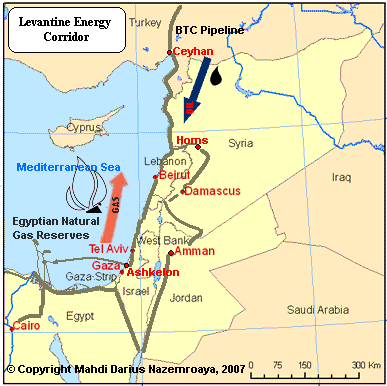
Syria is the central piece of two important energy corridors. The first links Turkey and the Caspian to Israel and the Red Sea and the second links Iraq to the Mediterranean. The surrender of Syria would mean that Washington and its allies would control these energy routes. It would also mean that the large natural gas fields off the Lebanese and Syrian coastline in the Eastern Mediterranean would be out of reach for China and would instead go to the E.U., Israel, and the U.S.

The Eastern Mediterranean gas fields have been the subject of negotiations between the E.U., Turkey, Iran, Syria, and Lebanon. Aside from the Baku-Tbilisi-Ceyhan (BTC) Pipeline, the existence of the Levantine natural gas fields is also the reason why the Kremlin has created a military foothold in Syria for the Russian Federation. This has been done by upgrading Soviet-era naval facilities in Syria. Moreover, it has been Iran that has agreed to explore and help develop these natural gas fields off the Levantine coast for Beirut and Damascus.


Hamas-Fatah Rapprochement

There is a strong correlation between war in Southwest Asia and increased talk at the official level about Palestinian statehood. Hopes of Palestinian statehood have been used twice to discharge pressure in the Arab World built from rising tensions from war preparations against Iraq. The first time was by George H.W. Bush Sr. and the second time by George W. Bush Jr., who was praised for being the first U.S. president to seriously talk about a Palestinian state.

Even as he flip-flops on his position, Obama is also now talking about a Palestinian state. Moreover, rapprochement between Hamas and Fatah has taken place as the count-down towards international recognition of Palestinian statehood begins. The Israelis have also released frozen funds to the Palestinians, which they refused to do before due to Hamas.

The rapprochement between Fatah and Hamas has also served to tie the hands of Hamas. Hamas will have to be careful not to effectively become a junior partner in governing Palestine under Israeli occupation. Hamas must effectively now modify its stance in its partnership in a unity government with Fatah. In all likelihood Tel Aviv and Washington will seek to impose Fatah as the senior partner of the Palestinian Authority. In a manner of speaking, Hamas is being domesticated indirectly by Israel and Washington.

Instability in Pakistan

The announcement that Osama bin Laden has been killed by U.S. forces has contributed to a process of covert political destabilization within Pakistan. There has been a calculated effort to present Osama bin Laden as a popular and venerated figure for Muslims. This is with a view of supporting the so-called “Clash of Civilizations.”

At the same time the U.S. government is starting a media campaign against Pakistan. Islamabad has been portrayed as harbouring Osama bin Laden and his Al-Qaeda network. In reality any Pakistani involvement with terrorists has been ordered and directed by Washington. There is a much more complicated story to all this, but what is happening in reality is that Pakistan as a nation is being targeted for dismantlement.

The dismantlement and destabilization of Pakistan would serve three objectives:
1. Promoting a scenario of a war with Iran: Pakistan would not be under threat of a takeover by revolutionaries that would side with Iran and its allies.

2. The targetting of Chinese interests in Pakistan, including the energy corridor from Iran to China (and the Chinese port in Gwadar), which transits through Pakistan.

3. Regional destabilization in a key area of Eurasia where Southwest Asia, Central Asia and the Indian sub-continent meet. This area extends from Iran and Afghanistan to Pakistan, India, and Western China.

At the same time Washington also wants to neutralize the Pakistani nuclear program.

The U.S. has also announced that it has the right to violate the national boundaries of countries which harbour terrorists as well as send troops to these countries as part of the “war on terrorism.” Hillary Clinton has justified Washington’s stance by saying that U.S. forces would be assassinating terrorists. This is merely an opening door for creating a pretext for military intervention in countries such as Iran, where the Revolutionary Guards have been designated as a terrorist organization by the U.S., or Syria, where several exiled Palestinian groups have been designated as terrorist organizations by Washington.

Friday, January 8, 2010

US Imperial innovation: subversion goes private (has anybody noticed?)

CIA Agents assassinated in Afghanistan worked for “contractor” active in Venezuela, Cuba reports Eva Golinger for her blog Postcard from the Revolution

At least eight U.S. citizens were killed on a CIA operations base in Afghanistan this past Wednesday, December 30. A suicide bomber infiltrated Forward Operating Base Chapman located in the eastern province of Khost, which was a CIA center of operations and surveillance. Official sources in Washington have confirmed that the eight dead were all civilian employees and CIA contractors.

Fifteen days ago, five U.S. citizens working for a U.S. government contractor, Development Alternatives, Inc. (DAI), were also killed in an explosion at the U.S. Agency for International Development (USAID) office in Gardez. That same day, another bomb exploded outside the DAI offices in Kabul, although no serious injuries resulted.

The December 15 incident received little attention, although it occurred just days after the detention of a DAI employee in Cuba, accused of subversion and distribution of illegal materials to counterrevolutionary groups. President and CEO of DAI, Jim Boomgard, issued a declaration on December 14 regarding the detention of a subcontractor from his company in Cuba, confirming that, “the detained individual was an employee of a program subcontractor, which was implementing a competitively issued subcontract to assist Cuban civil society organizations.” The statement also emphasized the “new program” DAI is managing for the U.S. government in Cuba, the “Cuba Democracy and Contingency Planning Program”. DAI was awarded a $40 million USD contract in 2008 to help the U.S. government “support the peaceful activities of a broad range of nonviolent organizations through competitively awarded grants and subcontracts” in Cuba.

On December 15, DAI published a press release mourning “project personnel killed in Afghanistan”. “DAI is deeply saddened to report the deaths of five staff associated with our projects in Afghanistan…On December 15, five employees of DAI’s security subcontractor were killed by an explosion in the Gardez office of the Local Governance and Community Development (LGCD) Program, a USAID project implemented by DAI.”

DAI also runs a program in Khost where the December 30 suicide bombing occurred, although it has yet to be confirmed if the eight U.S. citizens killed were working for the major U.S. government contractor. From the operations base in Khost, the CIA remotely controls its selective assassination program against alleged Al Qaeda members in Pakistan and Afghanistan using drone (Unmanned Aerial Vehicles) Predator planes.

A high-level USAID official confirmed two weeks ago that the CIA uses USAID’s name to issue contracts and funding to third parties in order to provide cover for clandestine operations. The official, a veteran of the U.S. government agency, stated that the CIA issues such contracts without USAID’s full knowledge.

Since June 2002, USAID has maintained an Office for Transition Initiatives (OTI) in Venezuela, through which it has channeled more than $50 million USD to groups and individuals opposed to President Hugo Chávez. The same contractor active in Afghanistan and connected with the CIA, Development Alternatives Inc. (DAI), was awarded a multi-million dollar budget from USAID in Venezuela to “assist civil society and the transition to democracy”. More than two thousand documents partially declassified from USAID regarding the agency’s activities in Venezuela reveal the relationship between DAI and sectors of the Venezuelan opposition that have actively been involved in coup d’etats, violent demonstrations and other destabilization attempts against President Chávez.

In Bolivia, USAID was expelled this year from two municipalities, Chapare and El Alto, after being accused of interventionism. In September 2009, President Evo Morales announced the termination of an official agreement with USAID allowing its operations in Bolivia, based on substantial evidence documenting the agency’s funding of violent separtist groups seeking to destabilize the country.

In 2005, USAID was also expelled from Eritrea and accused of being a “neo-colonialist” agency. Ethiopia, Russia and Belarus have ordered the expulsion of USAID and its contractors during the last five years.

Development Alternatives, Inc. is one of the largest U.S. government contractors in the world. The company, with headquarters in Bethesda, MD, presently has a $50 million contract with USAID for operations in Afghanistan. In Latin America, DAI has operations and field offices in Bolivia, Brazil, Colombia, Cuba, Ecuador, El Salvador, Guatemala, Haiti, Honduras, Mexico, Nicaragua, Peru, Dominican Republic and Venezuela.

This year, USAID/DAI’s budget in Venezuela nears $15 million USD and its programs are oriented towards strengthening opposition parties, candidates and campaigns for the 2010 legislative elections. Just two weeks ago, President Chávez also denounced the illegal presence of U.S. drone planes in Venezuelan airspace.
-------
Commentary: all this is another good example that people need to wake up to the reality that the USraelian Empire often uses non-governmental organizations for its covert subversive operations. It is mind boggling that nations that are clearly the prime targets of US subversive efforts such as Venezuela, or Bolivia have not followed Iran's example and simply expelled all organizations with "ties" to the USA.

On a similar note, Jeremy Scahill reported in The Nation that at least two Blackwater employee were killed in the December 30th Khost bombing in Afghanistan even though, officially, the CIA had severed all contact with Blackwater on Dec 11.

Bottom line: the US Empire's subversive activities have clearly "gone private", although In reality, they US always made use of private entities for its covert operations (see John Perkins' two books Confessions of an Economic Hitman and The Secret History of the American Empire for details). Still, in the past decade or so we can clearly see a increase in this "privatization of subversion" and the nations who are not part of the US Empire (yet) need to adapt to this reality.

Wednesday, July 1, 2009

Plunge into the depths until you reach the truth

by "Ya_Baqiyatullah"

We live in a world where the media helps shape our lives; be it for social, economical, political or entertainment purposes the importance of media cannot be underestimated. It is something which builds our personalities due to the information it feeds us. We are in many ways attached to this source and make it our comfort zone. Today, where the World has reached a critical stage in every aspect due to the economical situation as well as the political situation, the Media has become a very important tool. A tool which has replaced religion as the opium of masses in many ways. Today there are millions of people who are addicted to it by being hooked through the slim line flashy television sets in their homes. Our personalities are defined through the programs that are aired, our views and perceptions are built upon the reports that are broadcasted and our lifestyle is based around the characters of a certain hit series. The Media has become this comfort zone for people who do not wish to delve to see the true reality and are happy with what is being fed to them through their television set.

In most recent example of Iranian elections, the Media became the force of this election for the Reformists, who used the internet as a tool for their campaigning. The Mousavi Group on Facebook boasts 89,000 users, many of them from Iran, who update the rest of the world with the latest news on the happenings in Iran as well as the speeches of Mr Mousavi himself. On the other hand, the social networking site Twitter is being used to get information regarding the aftermath of the elections. Then there are the Western Channels and their reporting stories on the elections and different groups that are competing in it. One thing that stood out from this recent episode is how easy it is for the Media to manipulate and present a totally different perception to that which is reality.

Let us cast our minds back to early this year when the Israel siege was happening around Gaza. Israel barred Foreign Media reporters from Gaza, instead they were reporting from the 'Hill of Shame', as Jon Snow called it. There was no widespread condemnation of the Israeli policy then by either US analyst or British reporters as there is now to Iran's policy of restricting the Foreign reporters. In US, the Congress voted 405-1 condemning the approach Iran had taken. I wonder if the Israelis received such a strong protest too as they barred the reporters from the Gaza strip and slayed hundreds of civilians?

In the UK, the Iranian Ambassador was summoned to explain the remarks of the Wilayatul Faqee, Ayatollah Ali Khamenai regarding the BBC coverage. The remarks were nothing short of what the BBC deserved for their half baked reporting and their manipulations, the BBC were guilty of much more than what they got told. One such example is that during the Friday Sermon of Ayatollah Ali Khamenai the BBC Radio Service indicated a number of times that the slogans being shouted during the sermon are anti-Khamenai. In reality the slogans were actually supporting the Wilayatul Faqee and the system of Iran. One can accept that a mishap happens once but for it to happen a number of times in the same coverage is far from a mishap. Another example of BBC misinformation is the report by Jon Leyne who offered his interpretation of the blast at the Shrine of Ayatollah Khomeini to be the work of the Iranian government, in order to help their cause. What followed was a swift action by Iran in asking the reporter to leave the country and rightly so. These are only certain example of how BBC were guilty as charged however the masses rejected it calling it a weak attempt by the Iranians to cover up their shortcomings.

Mr Brown went a step further in his statement stating that "The whole of the world is speaking out." One has to ask how does Mr Brown come to this conclusion? Many countries of the world congratulated Ahmedinijad and accepted the result of the elections. Many of them have actually condemned the view of the Western powers regarding their rhetoric towards Iran and there was no comment from China or Russia. However the point to note here is that why was the world quiet as the Palestinians died in Gaza? Why did Mr Brown fail to say such a statement then? Is it easy to condemn an nation because their ideology is not conformed with his ideology?

January 2009 witnessed the oppression and tyranny of the Israeli forces in Gaza killing over 1400 civilians and damaging the strip by attacking the infrastructure, yet there was no public outcry as bodies laid of innocents. There was no condemnation of this aggression nor on the restrictions of reporting by the US President Mr Obama nor there was there criticism by UK Prime Minister Mr Brown. June 2009 saw the Iranian people go to the polls and re-elect Ahmedinijad. The propoganda machines came into work in distorting the will of the people who chose Ahmedinijad by indoctrinating people with constant reports of 'stolen elections', 'rigging' and 'fraud'. The manipulations and the spin by the Western Media continued to weave a particular image into the minds of the people around the World regarding Iran. They portrayed an image that displayed Iran to be an oppressive dictatorial regime which had rejected the 'rightful' choice of the people by endorsing Ahmedinijad. The platform of misinformation provided the Politicians of the Western countries to take advantage and add their rhetoric too. The minds of people accepted it all as they were blinded to reality, their perception was based on what the Media reported and showed.

In leaving no stone uncovered, the Western Media jumped at the tragic death of Neda Soltan. A lady who had allegiance to neither camps and was tragically killed on the streets of Tehran, but what followed afterwards was a trail of exploitation of her death. The Western Media symbolized her as the Martyr of the Reformist Revolution. Her death was aired again and again to incite the emotions of people all over, to display how brutal the Iranian Government is in dealing with its own people, to portray how the Iranian Government oppresses women. The reality was left aside as emotions bought the propaganda coming from the box set. The Media acted as the judge, jury and the executioner in her case without stopping to consider or in certain aspects reporting the unaswered questions surrounding her death. One has to ask where was this added coverage when 500 children died in the assault on Gaza? Where was such emotion when the bombs dropped on civilians in the Gaza strip? What happened to humanity when BBC refused to air the Gaza appeal commercial? Where did this garb of judge, jury and executioner disappear to in the light of these crimes? The answer will come with a dose of self righteousness. What you see in this article are two situations with an air of similarity in some aspects around it but what you also see are two vastly different reactions and perceptions from both the Media and the Western Governments, the question remains; why has the aspect of justice and equality been lost? Why the differentiation in responses when both; friend and foe are guilty of the same act of censure?

We live in a world which is connected to the Media, we seek and are content with the surface of everything that is given to us. We refuse to devlve further because we fear. We fear that we may not be comfortable anymore if we find the truth and it does not conform to our beliefs. We fear that we may not fit into the society anymore if we know the truth. Let me finish with a quote from the first Shi'ite Leader Ali ibn Abi Talib [a] who has said 'Plunge into the depths until you reach the truth'.

Sunday, April 12, 2009

Who is behind Moldova's Twitter Revolution?

By José Miguel Alonso Trabanco for Global Research

"A lot of what we [National Endowment for Democracy] do today was done covertly 25 years ago by the CIA." -Allen Weinstein

It seems that those who anticipated the end of color revolutions have been proven wrong. So far, color revolutions have succeeded in Serbia, Georgia, Ukraine and Kyrgyzstan. On the other hand, they have failed in Belarus, Uzbekistan and Myanmar. Their common denominator is a wave of protests and sometimes riots whose purpose is to overthrow a local government, often held during electoral times or shortly afterwards. It has not gone unnoticed that the so called color revolutions have been backed (and engineered?) by enthusiastic western supporters including NGO's, diplomats, businessmen, governmental institutions and heads of state. In those countries where such political mobilizations have prevailed, pro-Western leaders have been enthroned as a result thereof. If one pays close attention to a map, it is impossible not to wonder if it is simply a coincidence that color revolutions have erupted in countries close to Russian and Chinese borders. It has to be pointed out that no color revolution has ever occurred in any country whose government is staunchly pro-Western.

Today, it is indeed quite likely that events taking place in Moldova are none other than the evident signs of the latest color revolution. Only a few days ago, elections were held there and the official announcement of preliminary results of the electoral process showed that the Party of Communists of the Republic of Moldova (affiliated to the Party of the European Left) had received nearly 50% of the votes. The Organization for Security and Co-operation in Europe (OSCE) certified that Moldovan parliamentary elections were free and fair. Nevertheless, protests attended by tens of thousands started shortly afterwards. However, these demonstrations can hardly be described as peaceful since media reports confirm that organized violence has targeted government facilities, including the parliament building as well as a presidential office. The script bears some similarities with Ukraine's Orange Revolution, which started with large protests demanding new elections once opposition politicians were discontent with electoral results.

It is telling that protestors have been photographed waving the flags of both Romania and the European Union. They have also requested the ouster of Moldova's current government, denouncing it as a "totalitarian regime" and demanded parliamentary elections to be re-scheduled. So far, Moldovan law enforcement has been overwhelmed and is unable to control these riots even though it has resorted to tear gas and water cannons. Moldovan senior government officials have stated that they regard these episodes of civil unrest as unlawful and that they will act accordingly. Furthermore, the Romanian ambassador in Moldova has been declared persona non grata and visa requirements for Romanian nationals have been established. Also, pro-Moldovan protesters rallies have taken place in many cities throughout Romania. Although no color has been chosen to name this color revolution, these events have already been termed as the Twitter Revolution because on-site reports indicate that protest organizers have made extensive use of social-networking tools in order to fuel discontent.

To determine whether or not any event is geopolitically significant, the timing is an element which always needs to be taken into account. The post Soviet space is one of the most active arenas of great power strategic competition and there are some meaningful recent precedents such as:

· The fact that Ukraine and Georgia have not been accepted as NATO members in spite of intense diplomatic pressure by prominent NATO members.

· Unlike other post Soviet states, Moldova's government had declared that Chişinău would remain neutral and that it would thus refuse to side with great powers, which more or less resembles the position taken by fellow former Soviet Republic Turkmenistan whose foreign policy must meet criteria of strict neutrality.

· The Russo-Georgian war in which Moscow inflicted a military defeat on strongly pro-Western Georgia.

· The announcement by the Kyrgyz government that the Manas air base will be closed.

· The European Union launched its Eastern Partnership project, designed by Poland and Sweden to reach out to Ukraine, Belarus, Azerbaijan, Georgia, Moldova and Armenia. This was seen in Moscow as an attempt to co-opt these countries and marginalize them away from Russian influence.

· Ukraine's decision to hold anticipated elections. It might be added that pro-Western Viktor Yuschchenko's candidacy does not look particularly promising.

The above demonstrates that the geopolitical rivalry between Russia and NATO has been intensifying. In fact, Russian senior politicians are already claiming that civil unrest in Moldova is been orchestrated by western intelligence survives. They have also emphasized that the ultimate goal is to accomplish regime change in Chişinău so NATO member Romania can swallow Moldova. It is no secret that hardline nationalists in Bucharest would like to achieve Anschluss with Moldova. Yet Western governments have refrained from voicing a strong support for the anti-government crowd in Moldova. However, it is necessary to explore what Western interests could consist of in this tiny post Soviet republic.

Why Moldova?

Moldova was one of the poorest and less developed republics of the Soviet Union, as well as the most densely populated. It is a landlocked country contiguous to Romania and Ukraine. Soviet planners had decided that Moldova would specialize in food production. Nevertheless, Moldova was not entirely homogeneous. The country's industrial infrastructure was built in Transnistria, a region mostly populated by people of Slavic ethnicity (i.e. Russians and Ukrainians). This region was responsible for a large of percentage of Moldova's GDP (40%) and it also contributed with almost the entire power generation of the Moldovan SSR. Toward the end of the Cold War, Romanian dictator Nicolae Ceauşescu had stated that the Kremlin had annexed Bessarabia (aka Moldova), which implied that he considered it as a part of Romania.

The disintegration of the Soviet Union changed little. The overall Moldovan economy is not specially outstanding since it exports wine, fruits and other beverages and food products. Moldova is a net importer of coal, oil and gas since if has no natural deposits of any of these resources. According to the CIA World Factbook, Moldova ranks 138th in a list of countries arranged by GDP.

Transnistria declared its independence from Moldova following the Soviet collapse because it was fearful of an increasingly nationalistic Moldova and the reemergence of pro-Romanian sentiment. This triggered a war between Chişinău and Transnistrian separatists. Russian forces were then deployed in order to end hostilities. The conflict has been frozen ever since. Nevertheless, the presence of Russian military personnel (which numbers nearly 3000) has allowed Transnistria to keep its de facto independence from Molvoda even though it still formally belongs to the latter. Indeed, Transnistria has its own authorities, military, law enforcement, currency, public services, flag, national anthem, constitution and coat of arms. Nearly half of Transnistrian exports are shipped to Russia.

Russia has supported Transnistria because it is inhabited by a considerable proportion of ethnic Russians loyal to Moscow; this must not be born in mind because people is Russia's scarcest resource. Furthermore, Transnistria is located in the easternmost region on Moldova and, more importantly, it borders Ukraine. Last but not least, Transnistria's small economy is based on heavy industry, textile production and power generation, which represents an additional atractive. As a result of Russian involvement, Chişinău has been careful not to be antagonistic toward Moscow.

Moldova's current president, Vladimir Voronin (the name can be misleading but he is, in fact, an ethnic Romanian), was elected in 2001 as the candidate of the Party of Communists of the Republic of Moldova. Regardless of his party's name, his administration can be described a pragmatic; for instance, he decided to continue privatization plans first put forward by his predecessor. Back in 2002, he angered nationalists by designating the Russian language as a second official language. Nevertheless, it would be a mistake to brand him as pro-Russian because his foreign policy has been seeking to balance Russian and Western interests without having to take sides. For example, his administration has expressed a desire to establish closer ties with the EU (which even runs a permanent mission in Chişinău) and cooperation with NATO and Russia, excluding membership in the Atlantic alliance or in the Russian-led CSTO. Furthermore, Voronin's government has stressed Moldova's need to preserve its independece instead of being absorbed by Romania. In short, he is neither pro-Russian (like Alexander Lukashenko) nor pro-Western (like Mikheil Saakashvili). Rather, his political position is closer to those of Ukraine's Kuchma, Georgia's Shevardnadze or even Turkmenistan's Niyazov and Berdymukhamedov.

Nonetheless, it is not far-fetched to assume that NATO in general and the US in particular are interested in regime change in Moldova. The main goal would be to overthrow the current Moldovan government and have it replaced by rulers more antagonistic toward Moscow. If such attempt succeeds, a new government in Moldova could be harangued into expelling Russian troops from Transnistria in an effort to rollback Russian military presence away from Eastern Europe, an effort meant to diminish Russian influence in the post Soviet space and to undermine Russia's prestige there and elsewhere. Moreover, it could be a Western reminder to Moscow that the slightest Russian distraction will be taken advantage of by NATO. A hypothetical pro-Western Moldova could even be later incorporated into NATO member Romania, moving the alliance borders eastward bypassing ordinary acceptance protocols for new members.

It remains to be seen if the Kremlin was caught by surprise and it is unclear how it will ultimately react to an eventual regime change in Chişinău, particularly if any new government attempts to take over Transnistria by force, much like Georgia did last year concerning South Ossetia. What is clear, however, is that Moscow does not want to be trapped into a conflict which could drain financial, military, diplomatic and political resources. Yet, Russian decision makers do not like what they are witnessing in Moldova; it is a script that had seen at play before. Therefore, it is reasonable to assert that Russia will resort to its intelligence assets it operates overseas in order to counter anti-Russian moves in Moldova before any deployment of troops is seriously considered. It is still too early to accurately foresee what defining developments will take place in Moldova and how they will unfold. If the current Moldovan government survives, the Twitter Revolution there could backfire. If that is indeed the case, Moldova's rulers could end up openly embracing Moscow as a result of real or alleged Western covert support for anti-government forces.

Russian accusations regarding the involvement of Western intelligence agencies has not been proved because all clandestine operations operate on the principle of plausible denial. Nonetheless, there are circumstantial facts which seem to demonstrate foreign intervention. For instance, some Western semi official institutions and NGO's openly acknowledged their activities in Moldova. For example:

· The USAID website concerning the agency's activities in Moldova mentions that some of them include "Moldova Citizen Participation Program", "Strengthening Democratic Political Activism in Moldova" and "Internet Access and Training Program". The latter is noteworthy because online social networks have been employed in order to increase anti-government activism. USAID's website specifies that "[its program] provides local communities with free access to the internet and to extensive training in all aspects of information technology". It goes on to explain that "Target groups include local government officials, journalists, students, local NGO representatives, professors and healthcare providers..."

Those examples are particularly revealing if one takes into consideration that those organizations were prominent participants in previous color revolutions. That is, both the players and the Modus Operandi remains largely unchanged. A notorious protagonist and organizer of the Twitter Revolution is journalist Natalia Morar who used to work as press secretary for "The Other Russia", a strange coalition of anti-Putin political groups which encompasses hardline nationalists, communists and pro-Western activists.

In short, bearing in mind all of the above, it looks like a new episode of geopolitical confrontation between Russia and the West is unfolding in Moldova. This battle is not over yet and whatever its outcome turns out to be, its strategic implications will be deep because they will send strong shockwaves throughout Eastern Europe and the post Soviet space. The stakes are certainly being raised in this new round of the Great Game. A few years ago, notorious neocon pundit Charles Krauthammer observed that "This [Ukraine's Orange Revolution] is about Russia first, democracy second". The same phrase applies to Moldova's Twitter Revolution.

José Miguel Alonso Trabanco is an independent writer based in Mexico specialising in geopoltical and military affairs. He has a degree in International Relations from the Monterrey Institute of Technology and Higher Studies, Mexico City. His focus is on contemporary and historic geopolitics, the world's balance of power, the international system's architecture and the emergence of new powers.