Showing posts with label Greenpeace. Show all posts

Tuesday, November 12, 2013

Greenpeace vs Russia - the relevant context and the real issues

Last month I wrote an article about the real reasons behind the Greenpeace action in the Russian Arctic in which I mentioned several examples of the surge in Arctic related activities initiated under Vladimir Putin:
A few years ago, a Russian submarine placed a Russian flag on the North Pole as a clear sign that Russia was claiming its share of the polar resources. Needless to say, the US, Canada and the EU are not happy at all about it. But there is nothing much they can do, if only because Russian polar technologies are way ahead of what exists in the West. Not only are Russian submarines far better suited for polar operations than their western counterparts, the Russians also have unique nuclear icebreakers which make it possible for them to open routes in very thick ice (more are currently being build).  Western technologies have always been far more "equator oriented". For example, the US GPS navigation system is more accurate on the lower latitudes while the Russian GLONASS is more accurate in the polar regions. Most of the US Navy's power is centered on warmer regions of the globe. In contrast the most powerful and best equipped Russian fleet has always been the Northern Fleet which is used to operate in polar conditions. Under Putin, Russia has embarked on an ambitious plan to defend its interest in the Arctic: old abandoned polar bases are now being reopened and a special Arctic motor-rifle division is being created. The Russian Air Force has resumed an intensive program of Arctic operations while the Navy has embarked on a cycle of regular Arctic maneuvers involving its most advanced surface vessels (...) The fact is that the West has neither the know-how nor the money needed to try to match the Russian moves.
And I concluded by explaining that the West still has is some very useful Cold War era tools: the "independent" non-governmental organizations.

What I did not know at the time is that while I was writing this the Russian Northern Fleet was in the middle of a massive, truly unprecedented, mission to built an "arctic airport" in just one month.  A few days ago the Russian armed forces TV channel Zvezda released a very interesting report about this mission which shows a lot of the technologies I was referring to in my October article.  The video is in Russian, but it is also very self-explanatory.   I also will write a summary of the important points right under this video.  Check it out:


These are some of the key things shown or mentioned in the video:
-------
In early September 10 ships sailed from Severomosrk to Kotelnyi Island.  The official goal of the mission was to:

1) maintain Russian military presence in the Arctic
2) defend Russian economic interests in the Arctic

As part of the mission, this task force was ordered to build a fully functional airport in less than one month and to finish the entire mission before the beginning of November.  Besides a few transport ships, the following ships were included in the task force:
  • The heavy nuclear missile cruiser Peter Velikii (the most heavily armed ship on the planet)
  • 2 Large Amphibious assault ships
  • The nuclear icebreaker Vaigach
  • The nuclear icebreaker Iamal
  • The nuclear icebreaker Taimyr
  • The nuclear icebreaker "50 years of the Victory"
This means that the full nuclear fleet of Russia was sent over the 73rd parallel to cross three arctic seas (the sea of Barents,  the sea of Karsk, and the sea of Laptev) which is over 2000 miles less than one week.  The task force was commanded by  Vladimir Korolev, C-in-C Northern Fleet and included the flagship of the Russian Navy, the heavy nuclear missile cruiser Peter Velikii under the command of First Captain Vladislav Malakhovskii.

In the course of its journey, the naval task force practiced beyond-visual-range missile interceptions, and also practiced helicopter reconnaissance missions as far as 200km away from the task force  

Once the task force arrived to Kotelnyi Island, Naval Infantry amphibious assault units began by securing the landing area.  More forces were then disembarked to clean up the area (which will be declared a natural preserve) and scouts were sent to locate sources of fresh water.  Special polar tents with powerful heaters were deployed.  Such tents are capable of maintaining an internal temperature of 25C-28C/77F-83F regardless of the conditions outside.

The task force began working 24 hours a day (a "day" lasts 4 hours here) and 13 living modules and 4 containers bought in by helicopters.  Tons of heavy gear was brought in with pontoon boats.  Soon satellite communications and the Internet were restored.  A hospital, including a full surgical suite, was built.
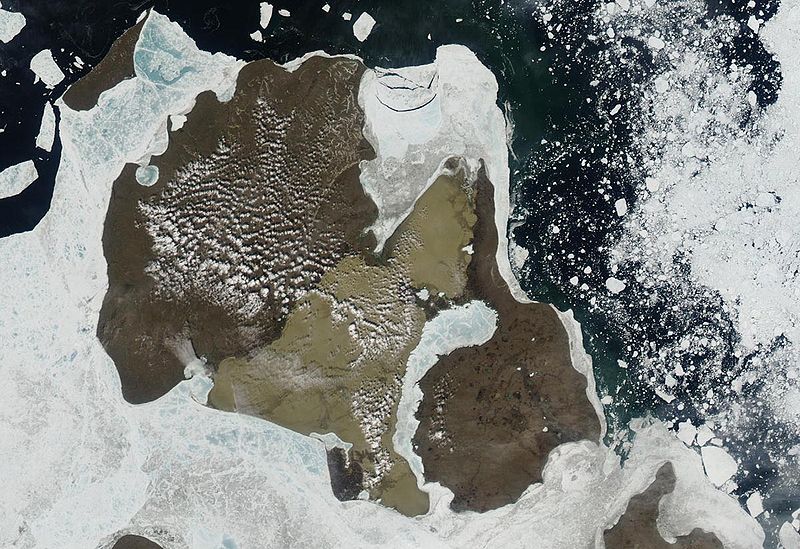
Satellite view of Kotelnyi Island
The building of the airport began with the creation of a fully paved runway.  Special transport means were then brought over from the cargo ship to assist in the mobility of the disembarked forces including tracked vehicles and hovercraft.

In less than a month, an airport capable of receiving aircraft year-long and 24 hours a day was built, including modern radar and air defense systems.  8500 tons of ground material had to be brought in to build the foundation for this modern airport.

The first aircraft to land at the "Temp" airport was an An-72.  Soon heavy-lift Il-76 transport aircraft began dropping even more supplies by parachuted palettes.  The airport also received its full complement of personnel (50 military specialists).

Eventually, the polar tents were replaced with solid modular living facilities which are built with advanced materials which naturally retain heat in conditions as severe as -40C/F.

Next, similar bases will be built on Franz-Joseph and Wrangel islands and then all along the northern coast of Russia.  These bases will serve to guide and protect commercial and civilian shipping throughout the "Northern Passage" of Russia.
-------
Due to its very "public relations" nature this video is focused on equipment and technology, and what is only mentioned in passing is the huge, crucial importance of the experience of operating in Arctic conditions.  Only at one specific moment in the video do we see an officer commenting on the complexity of the landing operation in these circumstances saying "there is enough study material here to write a thesis" and he is correct.  There is much more to military operations in the Arctic than just dressing warm: the conditions are so dramatically different that it would be more accurate to think of this environment as a different planet.  This is the reason why the video shows the commander in chief of the Northern Fleet proudly commenting that "we could really be called the Northern and Arctic Fleet".

No other country in the world currently has the know-how and capabilities which Russia has in the Arctic, not even close, and Putin's Russia is pushing that advantage full steam ahead.

Take a look at the map to the right.  It shows the main advantage Russia has over other Arctic nations: Russia has a longer Arctic coastline and keep in mind that the Russian far north is inhabited.  While the US, Canada, Denmark or Norway will have Arctic bases, these are always far away from the rest of the country.  This is not the case for Russia where the outposts at the far north are organically linked to the "big land" as the Russians often call the more accessible part of their country.

Another map worth looking at one one developed by the International Boundaries Research Unit at Durham University which shows the potential maritime jurisdictions and exclusive economic zones if the Law of the Sea treaty was fully implemented.  Here is the map itself:


Click for legend
The Law of the Sea Convention was signed at the United Nations by 157 countries.  Looking at the map above can you guess which major country did not sign this document?  Yup!  The USA, of course, since all it gets from the big pie is a narrow slice over Alaska (for more on this topic click here and here).  So far, the US government itself has not made any aggressive claims, but several US politicians have and most experts agree that the combination of the effects of global warming and economic imperatives will make the Arctic a crucial arena of competing international interests very soon.

It is this context that the entire Greenpeace operation must be understood:  Russia has the geographical and technological advantage in the Arctic.  Russia is also the only country with a meaningful Arctic power projection capability.  Russia has the political will and financial resources to back up its rightful claims under the Law of the Sea.  Now Russia has also demonstrated that it also has unique military and technological capabilities.  The only option for the Anglosphere is to try to either block Russia politically or, at least, to slow it down as much as possible.

And Mother Nature in all that?  Let's just say that her importance is proportional to the wealth she offers in any one specific location.  As long as the North Pole was pretty much a no-go area, nobody gave a damn about how much pollution the USSR or Russia could potentially create there.  But now, all of a sudden, this is a top priority topic.

The really sad thing is that the Soviet legacy of pollution is particularly terrible in the Russian north and that we should not yield to the temptation of dismissing very real ecological issues in the Arctic with the antics of the hyper-politicized group like Greenpeace.  In other words, if Greenpeace is a joke, the preservation of the Arctic is not, and all the countries with access to the Arctic should be put under pressure to respect this unique ecosystem.  The fact that the Russian military operation in Kotelnyi Island began with a huge cleanup operation is good news, as is the fact that this island will now be declared a natural preserve.  Hopefully, this will not be a one time PR stunt and this model will be implemented for all the future Russian expeditions in the Arctic.

The Saker

Tuesday, October 8, 2013

What Russia should do in response to the latest Russia-bashing campaign

In Europe the Russia-bashing campaigns come and go with the regularity reminiscent of times.  Let's try to recall some of them (in not particular order): Berezovsky as a "persecuted" businessman, Politkovskaya "murdered by KGB goons", Khodorkovsky jailed for his love of liberty, the "Pussy Riot" "prisoners of conscience", Litvinenko "murdered by Putin", the homo-lobby's call to boycott Russian vodka, the homo-lobby's call to boycott the Sotchi Olympics, Magnitsky and the subsequent "Magnitsky law", the Snowden affair, the "stolen elections", the "White Revoluton" on the Bolotnaya square and the new "Sakharov" Alexei Navalnyi, etc. etc. etc.  I am probably forgetting quite a few.

What is certain is that as soon as Putin came to power in 2000 and all throughout the past 13 years the western plutocracy has fought a sustained, if not very effective, political propaganda campaign against Russia in general and against the "Eurasian sovereignists".   In response to that campaign, Putin has very successfully responded with a kind of a "judo-move" in which he turned every one of these campaigns into an electoral argument in support of his policies by showing the Russian people how utterly absurd these Russia-bashing campaigns were,  And, truth be told, these were absolutely ridiculous, every single one of them, and this is also why none of them ever had any bigger impact than a wet firecracker.

This time, however, the latest Russia-bashing campaign is qualitatively different in which it links a non-issue (the non-existing pollution threat to the Arctic from the new Russian oil drilling platform) with a very real and even strategic issue: the future of the Arctic.

I have to provide some context here.

The crucial context to understand current events

For the last decade Russia has embarked on a very ambitious plan to fully exploit the immense potential of the Arctic.  Call it a unintended but positive impact from the Global Warming phenomenon, but it has now become possible use the so-called "Northern Route" to link Europe and Asia by a maritime corridor along the northern coast of Russia.  Russia has also developed a unique type of oil drilling platform which can operate in waters saturated with drifting icebergs.  A few years ago, a Russian submarine placed a Russian flag on the North Pole as a clear sign that Russia was claiming its share of the polar resources.  Needless to say, the US, Canada and the EU are not happy at all about it.  But there is nothing much they can do, if only because Russian polar technologies are way ahead of what exists in the West.  Not only are Russian submarines far better suited for polar operations than their western counterparts, the Russians also have unique nuclear icebreakers which make it possible for them to open routes in very thick ice (more are currently being build).  Western technologies have always been far more "equator oriented".  For example, the US GPS navigation system is more accurate on the lower latitudes while the Russian GLONASS is more accurate in the polar regions.  Most of the US Navy's power is centred on warmer regions of the globe.  In contrast the most powerful and best equipped Russian fleet has always been the Northern Fleet which is used to operate in polar conditions.

Under Putin, Russia has embarked on an ambitious plan to defend its interest in the Arctic: old abandoned polar bases are now being reopened and a special Arctic motor-rifle division is being created.  The Russian Air Force has resumed an intensive program of Arctic operations while the Navy has embarked on a cycle of regular Arctic manoeuvres involving its most advanced surface vessels.


The flagship of the Northern Fleet: the nuclear heavy guided missile cruiser Petr Velikii - here on manoeuvres escorted by four (unseen) nuclear attack submarines.
What can the West do about it?

The fact is that the West has neither the know-how nor the money needed to try to match the Russian moves.  But what it still has is some very useful Cold War era tools: the "independent" non-governmental organizations.

In this context, the recent move by Greenpeace to create yet another Russia-bashing PR campaign, this time combined with a campaign to shut down the first Russian Arctic oil drilling platform.  We all know what happened after that: in the course of their second attempt at boarding the oil rig, the Greenpeaceniks were arrested by security forces and their vessels seized.

This time around, however, its Greenpeace which skilfully put a "judo-move" on Russia by turning the arrest of its activists into an international campaign to free these "political prisoners" and, unlike the previous Russia-bashing campaigns, this one appears to have more traction with the western public opinion, primarily because the western media does not provide the context which I gave above.  Simply put, this is not about pollution, its about who will get to use the Arctic resources.  As Roger Waters used to sing: "can't you see?  it all makes perfect sense, expressed in dollars and cents, pounds shillings and pence..."

Regardless of whether the arrested Greenpeace activists realize this or not (they probably don't), they are the pawns, the "useful idiots" used by western plutocrats in their fight against Gazprom and Russia.

And this morning I read that the Dutch cops seemed to have gone totally apeshit and actually assaulted and beat-up a senior Russian diplomat in The Hague.  Clearly things are getting ugly.  So what could Russia do?

Hit them where they care: their money

I think that Russia should not bother with the Greenpeace activists who, at any rate, are probably all sincere and naive folks who really care about the Arctic and pollution and who are utterly unaware of being used.  Russia should simply expel them and ban them from re-entering into Russia of a decade or so.  That would deflate the "innocent prisoners of conscience" crap.  But what Russia should also do, is seize all the equipment used in this operation and, in particular, the main Greenpeace ship used, the Arctic Sunrise.  That would hit these folks where it counts: their pocketbooks.  In fact, Russia should make that a policy: all the equipment used by foreign nationals to illegally cross the Russian borders or to violate Russian law should be automatically confiscated.  I bet you that this would very rapidly have its intended effect.

Having myself worked in a major humanitarian organization (which I am unwilling to name at this point in time), I can attest to the fact that the vast majority of the people working there are absolutely honest and sincere folks who have no idea at all of how they are being used.  The people who do know that are at the very top of these organizations, they are those who are officially in charge of fundraising.  They spend most of their time speaking to "generous donors" and they are very much attuned to the, shall we say, "sensitivities" of their donors.  All you need to do to understand who is using what organization is take a look at the list of donors, in particular the top five or so and everything will become immediately clear.  Just "follow the money" and all the naive talk about noble causes vanishes in thin air.

It is precisely because these so-called non-governmental and humanitarian organizations are used by their donors that countries which are the target of these operations should aim their responses at the financial aspect of these operations.  Holding the militants/volunteers makes no sense.  In fact, I can attest to the fact that the top brass of these organizations considers the "basic" volunteer as canon-fodder for good PR (because good PR means more money from the donors).

So, Russia - do the right thing: let the dummies go home, but seize all their gear and assets and impose huge fines on the organizations.  Hit them where it really hurts!

The Saker