Monday, July 22, 2013

EU politicians reach a new landmark in mindless subservience to Israel

Recently, we had the EU politicians committing an act of "air piracy" on behalf of the USA, now we have the same folks committing an act of abject subservience to Israel: they have declared that the military wing of Hezbollah is a terrorist organization.  Of course, this statement has nothing to do with terrorism, it is an attempt at punishing Hezbollah for its successful intervention in the Syrian conflict.  The BBC openly admits that.

Needless to say, Hezbollah couldn't care less about such nonsense: it has no assets or supporters in the EU anyway, and it also understands that regardless of that statement EU governments will, of course, continue to discreetly talk with Hezbollah "off the record".

I can attest to the following here: I know for a fact that in many, if not most, European countries there are semi-official Hezbollah representatives who live there and with whom the local authorities maintain contacts "off the record".

General Structure of Hezbollah
The rather amusing thing is that the EU decided to only declare the "military wing" of Hezbollah as a terrorist organization as opposed to some "civilian wing" which presumably would be very different.  This reminds me of the differentiation made between the IRA and Sinn Féin or between ETA and Herri Batasuna, but its completely inapplicable to Hezbollah whose structure is far more unitary than the EU pretends to believe (see chart; source). 

Bottom line: yet again, the EU achieves nothing other than further humiliate itself and proving its status of US/Israeli colony.  It really seems to me that empty symbolic gestures are all which the Europeans are capable off or, better, trusted with.

Real decisions, of course, are made in the USA and Israel.

The Saker

Friday, July 19, 2013

FSA statement about an al-Qaeda state in northern Syria - fact, rumor or fabrication?

Yesterday, I posted an article and a video about the statement made by FSA officials that al-Qaeda had decided to create an Islamic state in northern Syria.  As posted it "as is" since I did not have the time to comment about it, which is what I want to do today.

The first thing which came to my mind yesterday is that this was probably not true, and that the FSA was trying to spread disinformation about al-Qaeda as a retaliation against the hardening of the anti-FSA stance of al-Qaeda.  Think of it - how likely is it that al-Qaeda would announce the creation of an "al-Qaedastan" right in the middle of the Mashriq knowing full well that this would horrify everybody: not only the majority of the Syrian population, but also Turkey, the Kurds, the US, the EU, NATO, Jordan, the Iraqis, the Iranians and even probably the Saudis and Qatari.  Why?  Because everybody understands that any tract of land on the planet which would officially declare itself to be "al-Qaedastan" would immediately turn itself into a high-priority target for the US military which would literally have to bomb it or risk turning the entire GWOT into a farce (ok, the GWOT is already  farce, but most Americans still do not realize this).  To declare some kind of Islamic Caliphate or Emirate in norther Syria would be phenomenally stupid, really.  You might as well paint a big bullseye on you.

I am aware of the fact that the Chechen insurgents did just that, they declared "Caucasus Emirate", but they did that only in 2007, when they really did not control any meaningful territory.  Before that, when they were in control of some territory they only declared a much more modest "Chechen Republic of Ichkeria".  Which, of course, made much better sense from a PR point of view.

In contrast, the FSA has all the motives to accuse al-Qaeda/al-Nusra of planning to create some kind of Islamic Emirate or Islamic Caliphate in Syria: the hope would be to scare off those who otherwise might support these organizations both directly or indirectly.

In fact, I would argue that even western intelligence services would have a reason to spread such a rumor.  Imagine that you are some NATO intelligence service who came to the conclusion that arming the insurgents (whether FSA or al-Nusra) is extremely dangerous.  You cannot overtly go against your allies or, in some cases, against your own government.  So you start a rumor like that just to sabotage the entire concept.

Finally, needless to say, that the Russians also would immensely benefit from such a rumor too as it would make the insurgency look really terrible.

The only group who does not have an interest in this rumor is, I think, al-Qaeda/al-Nusra & Co.

This being said, I very much hope that this is true.  My personal dream would be to have al-Qaeda declare an Islamic Caliphate not only in Syria, but the entire Middle-East along with a promise to overthrow every single "Kufar" regime in the region beginning with Turkey.  Now that would be fun to watch!!  Alas, I don't believe that the Anglo handlers of these crazies will allow that, even if they wanted to.  But who knows?

Bottom line: I call this a rumor and a deliberate disinformation.

Are there any other opinions on that?

The Saker

Thursday, July 18, 2013

FSA says Al-Qaeda to announce Islamic state in Syria

Iranian.com reports:

FSA says Al-Qaeda to announce Islamic state in Syria.

Europeans now believed unlikely to arm Syrian opposition.

Beirut, Asharq Al-Awsat—A senior figure in the Free Syrian Army (FSA) has told Asharq Al-Awsat that Al-Qaeda was about to announce an Islamic state in northern Syria.

The source, who preferred to remain anonymous, said the time for the announcement was confirmed to be the first day of Eid, at the end of Ramadan, and that “the Bab El-Hawa and Harem border points are the main targets, the first to control arms and ammunition supplies, and the second to raise funds by smuggling crude oil.”

He said: “The implementation of this plan started last week with the killing of Commander Fadi El-Qash and his brother in Dana village, followed by the killing of senior member of the Supreme Command Council, Kamal Hamami, and will be followed by more assassinations of officers and important figures in the FSA.”

The sources confirmed that “the FSA circulated this information within limited, trusted circles as soon as it became available, and will avoid any confrontation that could weaken the rebels in their fight against the government forces.”

He claimed that the FSA was currently “deploying units and erecting checkpoints in towns that will be targeted according to the plan, and strengthen our presence in these towns to stop them becoming prey to the Islamic state.”

Meanwhile, the FSA source said “we will try to sit down and talk to the Islamic state if we find someone who listens, in order to avoid bloodbaths and clashes which would reflect negatively on the fight against the government forces.”

He added, however, that “whatever we do, there will definitely be war between us.”

The BBC reported on Tuesday that the FSA, following the killing of Hamami, said: “The Islamic state had threatened to kill all of the other members of the Supreme Military Council, another sign of the escalating struggle within the armed uprising.”

In another development, EU foreign ministers are expected to discuss the arming of Syrian rebels in a meeting in Brussels on July 22. However, hopes are fading for the two main players in this issue, France and Britain, will play a decisive role towards arming the opposition.

Diplomatic sources told Asharq Al-Awsat that “the first of August, the date when European arms are supposed to reach the opposition, will not change anything regarding the situation on the ground today,” adding that “Paris and London will not provide the arms requested by the opposition,” especially the anti-armor missiles and mobile air defense systems.

In the meantime, the Syrian opposition has announced plans to name a president for the interim government to replace Ghassan Hitto, who resigned last March. The new president will be announced after Ramadan. 

Tuesday, July 16, 2013

Why the military coup is a disaster for the Egyptian Christian community

The Lebanese newspaper Daily Star published the following article:
Wave of attacks on Egypt Copts, state failing to act: NGO
CAIRO: Egypt's Christians have been targeted in a wave of attacks since the ouster of Islamist president Mohammed Mursi, and the state is failing to protect them, an NGO said Monday.

Sectarian violence since the latest political upheaval in Egypt began has killed four Coptic Christians in Luxor governorate, with churches elsewhere torched and looted, said the Egyptian Initiative for Personal Rights.

A Coptic man was also found decapitated on Thursday, five days after being kidnapped in the restive Sinai, where gunmen killed a Coptic priest the week earlier.

"What is disturbing is the failure of the security apparatus to act -- which at times looks like collusion -- to protect citizens and their property who are being targeted on the basis of their religion," the EIPR's Ishak Ibrahim said in a statement.

"Copts are paying the price of the inflammatory rhetoric against them coming from some Islamist leaders and supporters of the former president, who accuse Coptic spiritual leaders of conspiring to foment army intervention to remove Dr Mursi," he added.

In the worst violence cited by the rights group, in the two day's after Mursi's ouster, revenge attacks over the killing of a Muslim man in Al-Dabaiya, a town west of Luxor, left four Copts dead and several homes torched and looted, the NGO said.

It accused the police of taking no action to protect them or escort them from their homes, which were surrounded, despite the fact they repeatedly calls the security services for help.

The EIPR said it was troubled by the "disregard" of state institutions for these incidents and called on the interim authorities to take swift action to protect Egyptians and "end inflammatory campaigns targeting citizens on the basis of religion".

Sectarian tensions in Egypt have risen since an Islamist came to power for the first time in 2012, following the country's first free elections.

Egypt's Coptic Patriarch Tawadros II accused Mursi of "negligence" over his response to clashes outside Cairo's Coptic cathedral in which two people died and many were wounded.

The funeral service was for four Christians killed in a gun battle with Muslims in a town north of Cairo in which one Muslim also died.
This article makes an assumption which is illogical, to say the least: it implies that it would be in the military's interest to prevent the Muslim Brotherhood and/or the Salafis from killing Christians.  That is fundamentally wrong for the following reasons:

First, every case of a Muslim murdering a Christian can now be used by the state propaganda as a "proof" that the coup was needed to remove these "bloodthirsty Islamists" from power.  This is also why the Algerian military had a vested interest in having the FIS and the GIA commit as many atrocities as possible.

Second, by directing the wrath of the Islamists against the Christians (which is not too hard considering that Christian clergymen were also present at the military's official declaration that they were overthrowing the democratically elected government) the military is distracting the Islamists from their real enemy: the military, of course.

Third, while Mursi was in power it was possible to blame him for any anti-Christian attacks and demand that he deal with the guilty Islamists.  Now that Mursi has been overthrown, he can hardly be blamed for what is followers or allies might do.  In other words, at least when he was in power he had a "responsibility of command" for what was happening in Egypt, but now that he has been overthrown, he cannot be held accountable (unless he personally and directly participates in anti-Christian attacks).

Now, please get me right, as a Christian myself I am under no illusion about the vicious and bloodthirsty nature of some of the Islamists in Egypt.  My point is that as long as Mursi was in power he had a double legitimacy:

a) he was democratically elected
b) he was also the chosen candidate of the Islamists

Therefore as long as Mursi was in power he could be held accountable and he had better legitimacy to try to stop such atrocities than anybody else. Even more importantly, while Mursi was in power he had a clear interest in preventing anti-Christian violence: to prove that the MB could rule Egypt effectively and secure the peace.


In contrast, the military, of course, fails on both accounts since it no legitimacy and, arguably, no "provable" responsibility.  As for the Islamists, they can blame it all on "uncontrollable" "extremist" groups, which might even be true in some cases.

I am frankly disgusted by those who applauded the military coup and who now shed crocodile tears over the plight of the Christians in Egypt.  Did they really believe that a coup would make Christians safer?!  Is is possible that those who supported the coup could really be unaware of a basic fact of human history: lawlessness always puts minorities at risk!

The reality is, of course, that nobody cares about Egyptian Christians, least of all the US and Israel.  If they did, they would not have overthrown Saddam Hussein and they would not have attempted to overthrow Bashar al-Assad.  

What is happening to the Egyptian Christians was clearly foreseeable and is therefore directly to be blamed on those who supported the military coup.  Only a fundamentally dishonest or ignorant person could deny that.

The Saker

Russia breaks into top 5 world economies, displacing Germany

RT reports:

Russia has overtaken Germany as the fifth largest economy in terms of purchasing power parity, according to the latest World Bank ranking that measures 214 economies based on their 2012 GDP performance.

Russia's oil and export driven economy, ranked fifth amongst the top ten economies in the world with $3.4 trillion in GDP. In 2011, Germany surpassed Russia in GDP with $3.227 trillion compared to Russia’s $3.203 trillion. In 2005, Russia was in eighth place.


The report was published last week in an annual ranking of GDP. The World Bank also updated their ranking of countries in terms of gross national product (GNP) per capita, grouping Russia in the ‘high income’ nation block, with individuals yearly income of $12,616 or more.

The United States was ranked by the World Bank as the world's largest economy by purchasing power parity last year with $15.7 trillion, followed by China with $12.5 trillion, India with $4.8 trillion, and Japan with $4.5 trillion.

Prime Minister Dmitry Medvedev publicly lauded the advance on Monday, as did President Vladimir Putin, but warning his country still needs to be financially vigilant.

"The World Bank has concluded that Russia has the purchasing power of the fifth economy in the world. According to this indicator, we are ahead of the Federal Republic of Germany. But we have a lot of areas that still need special attention", Putin said at a socio-economic meeting in the Sakhalin region, an energy rich Far East island north of Japan where Rosneft just put the final touches on a new drilling platform ‘Orlan’ in the Sea of Okhotsk. Sakhalin-1, a joint venture with Japan, India, and the US, has reserves of 2.3 billion barrels of oil and 485 billion cubic meters of gas.

In June, the World Bank cut its growth forecast for Russia to less than 2.2 percent in 2013 and 3 percent in 2014, after revising January forecast the economy would grow by 3.6 percent in and 3.9 percent in 2014. This is the 'new normal' for lethargic global demand and momentum, according to the report's author Andrew Burns.

The World Bank rating differs from the International Monetary Fund, where Russia is listed as the eighth largest economy with a GDP of $2 trillion. The same matrix calculates the US GDP as the first with $15.7 trillion, China second with $8.2 trillion, Japan third with $6 trillion, Germany fourth with $3.4 trillion, France fifth with $2.6 trillion, the United Kingdom sixth with $2.4 trillion, and Brazil seventh with $2.4 trillion.

The purchasing power parity rate is determined on how many goods and services $1.00 can buy in different countries.

Rankings were only assigned to economies with confirmed PPP GDP estimates.

-------
Commentary: though this report does point to something relevant, it is easy to misunderstand what it really says about the Russian economy or, for that matter, the US economy.  First, purchasing power parity (PPP) is a rather weird economic indicator. The excellent "Simple English Wikipedia" explains it with a well chosen example:
Purchasing Power Parity (PPP) is measured by finding the values (in USD) of a basket of consumer goods that are present in each country (such as orange juice, pencils, etc.). If that basket costs $100 in the US and $200 in England, than purchasing power parity exchange rate is 1:2.
Clearly PPP is centered on the costs of living and not really on how much is produced by an economy.  In simple terms, it measure how "relatively rich" the population is.  Gross Domestic Product (GDP) is also a weird indicator (check here for more details).

What I am getting at here is that when the media says that "Russia displaces Germany" by the size of its economy this elicits images of Russian manufacturers outperforming BMW, Siemens or Deutsche Telekom.  This is not so.  Simply put, the huge natural reserves of Russia, in particular in energy products, generate a lot of wealth in Russia and this output of raw materials has a direct impact on both the PPP and the GDP.  So yes, there is a lot of money in Russia but no, this is not the result of the Russian economy outperforming Germany's in manufacturing or services.  BTW - if the Russian PPP and GDP as skewed by the export of Russian raw materials, the US PPP and GDP are skewed by the huge size of the US banking/financial sector which also does not really "produce" anything.  Bottom line: PPP and GDP are tricky indicators which should not be used as a way of measuring the "real world" capabilities of an economy.

The Saker

Saturday, July 13, 2013

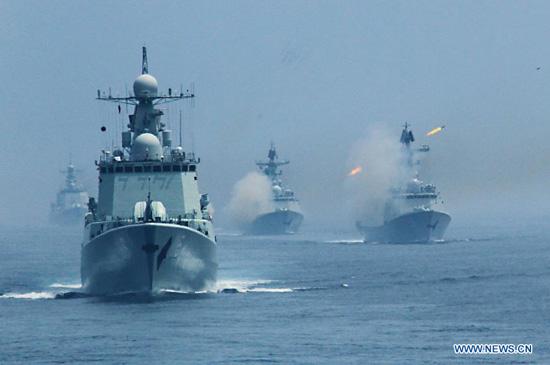
Russian armed forces are conducting large scale military exercise in the Far East and Pacific Ocean

Since Putin sacked Serduikov and replaced him with Shoigu, the Russian military has been regularly tested in surprise large-scale military exercises involving a sudden order to prepare for battle typically followed by a long distance move to an unknown location.  This time it is the the Eastern Military District which has undergone such a readiness test, but on a scale previously unknown.  It involved an emergency relocation from the city of Khabarovsk on Russian mainland to the port of Vanino and then to the island of Sakhalin.  On average, the forces had to travel 3'000km to get to their destination. 


A total of 160'000 soldiers, 1'000 tanks, 130 aircraft and 70 navy ships where involved.  The military command declared that "our Far Eastern neighbors were informed of these maneuvers".  What the command did not say, but everybody in the region no doubt understood, is that this was a clear message sent to Japan: Russia can rapidly and effectively reinforce its forces currently deployed on Sakhalin, so do not threaten us there.

This is a Russian TV report about these exercises (in Russian only):

-

This begs the question whether Japan did threaten Russia or not.  The answer is "not directly".

Over the past decade Japan did reinforce its armed forces which are less and less "defensive" and which regularly acquire better projection capabilities.  The Japan as a country never threatened Russia, but there are enough Japanese politicians who did exactly that, not only in regards to the so-called "Northern Territories" issue, but also with hostile statement concerning the Russian presence on Sakhalin.  The real problem which these latest maneuvers tackle is not really a Japanese one, but a Russian one: for years the Russian military forces in the Far East have been neglected and their level or readiness reduced to an almost comical level.  Yes, some elite forces (nuclear, airborne, navy) were in pretty decent shape, but the bulk of the ground forces has been completely neglected.  With time, this resulted in a great sense of weakness and even vulnerability not only amongst the well-informed specialists, but also in the general public, in particular in Siberia.

The purpose of these latest large-scale exercises is to demonstrate the viability of the new Russian military doctrine in which each of the four Strategic Commands is in complete control of all the forces in its area of responsibility and each Strategic Command can autonomously deal with any contingency.  In other words, the Eastern Strategic Command should be able to repel a Japanese attack on Sakhalin or even the entire Russian Far East autonomously, without external reinforcements or assistance.  The key test of this latest exercise is whether forces usually dispersed all over the huge Eastern Strategic Command area of responsibility could be rapidly moved and concentrated on Sakhalin.  So far, it appears that the exercise was generally successful, but with some rather embarrassing screw-ups including a 10 hour delay to refuel some aircraft in Khabarovsk.

I would add that if the "defending" forces were all drawn from the Eastern Strategic Command, the "attacking forces" are being moved in from the other Russian Strategic Commands, some as far as from 8'000km away.


Defense Minister Shoigu
Shoigu is clearly determined not only to immediately make such screw-ups public, but also to continue "hunting" for such weaknesses all over the Russian military.  Previous exercises had revealed some very bad weaknesses in the readiness of some ground forces and some major issues of command and control which were immediately addressed.  Other exercises were pleasant surprises with, for example, the Airborne Forces or the Black Sea Fleet performing exceptionally well.

Does all this really matter to the rest of the planet?

I would say that it does, and a great deal.  Simply put, Russia cannot fulfill its role of major power unless its military is in good shape.  The Russian economy is still relatively small, and many years of "democratic" rule under Eltsin have terribly weakened Russia as an ally (how can an American colony be considered as a useful ally).  The fact is that Russia can only offer one thing at this moment in time: the political will to resist the Anglo Empire and the commitment to do so within the limits of international law, as it did in the case of the US/NATO war on Syria.  However, this Russian political commitment only has value as long as the Russian military remains capable of repelling any possible aggression against it because if it cannot fulfill this mission it simply becomes yet another a target for the Anglos.


"Joint Sea 2013"
Furthermore, the Far East and the Pacific region are gradually becoming the most important part of the planet and one in which the simmering US-Chinese tensions will, sooner or later, boil over into something overt.  Hence the recent "Joint Sea 2013" joint large-scaled naval exercise between Russia and China.

The bottom line is this: Russia is continuing the systematic re-construction of its armed forces in a steady process is involving more and more types of forces and units which are being tested in realistic exercises conducted throughout all the regions of Russia.  The final goal is equally clear: to stop relying a few "elite" units and to finally bring the bulk of the armed forces to a readiness level equal to either "satisfactory" or "good".  This will be done by making sure that no less than 70% of all the equipment is modern and by conducting more and more exercises of increasing complexity and size.


General Valerii Gerasimov
It is quite remarkable how much Sergei Shoigu has already achieved in his rather short tenure as Defense Minister (he was appointed to this position on November 6th, 2012).  True, he is being assisted by an exceptionally capable Chief of General Staff, General Valerii Gerasimov, who replaced the clueless and corrupt General Makarov.  Those two men, Shoigu and Gerasimov, are working hand in glove to finally rebuilt a military which has suffered from several decades of neglect, corruption and gross mismanagement.  For literally years the worst problems were always coming from the "top" while the simple solider was told to fight in the worst possible conditions.  The most amazing thing is that this simple solider managed to succeed in this impossible task, often brilliantly (2nd Chechen war, 08.08.08).  Finally, all the signs appear to show that the "top" has finally stopped being part of the problem and has finally become part of the solution.  If that means that the line commanders and soldiers will not have to fight "on two fronts" at the same time we could witness a qualitative change in the capabilities of the Russian military which would allow it to make a meaningful comeback on the world stage alongside the rapidly growing and progressing Chinese military.

The Saker

Friday, July 12, 2013

Latin American states to recall ambassadors from Europe over Bolivian plane incident and Snoden asks for political asylum in Russia

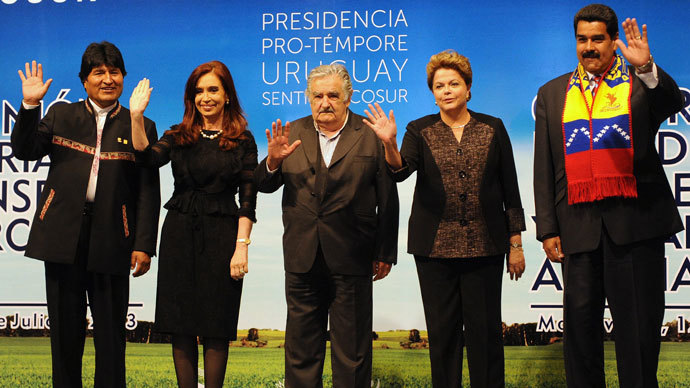
Plenty more good news this Friday. First, all the members of the MERCOSUR trading alliance have decided to recall their ambassadors from the European countries involved in the grounding of the Bolivian president’s plane.


I am particularly happy to see that Brazilian President Dilma Rouseff supported the decision and did not cave in to Anglo pressures.

Of course, a similar decision by UNASUR would have been even better, but with US puppet-regimes like the one in Colombia this was not possible.

I would be curious to find out what Ecuador, Nicaragua and Cuba will do, if anything.  I would hope that they would also follow the example of MERCOSUR, especially since this is a totally symbolic measure which, on a "diplomatic scale of irritation" is maybe a modest 5 (out of 10), meaning "we are angry, but we will let our anger fizzle out pretty soon".  This is somewhere between "summoning an ambassador" (3/10) and expelling an ambassador (8/10).  Topping such a scale is "closing down an embassy" (9/10) or, even better, "closing down the US embassy" (10/10).  Still, recalling ambassadors as a block is a good show of solidarity and probably the most Rouseff would have agreed to.

Mitterrand and Macros
The real price to pay for countries like France will be far more subtle and far more painful.  For a country which under de Gaulle was clearly an independent world power France has slouched down to a level of colonial subservience to the USA which it will probably never recover from.  Long gone are the days when Danielle Mitterrand (wife of President Francois Mitterrand) flew to Mexico to meet with Subcommander Marcos or when Regis Debray joined the Che in the jungles. 

I can personally attest to the fact that in the 1970s and 1980s France really enjoyed not only the image of a popular country with many cultural ties to Latin American, but even a certain authority, as a country which had a tradition of caring for human rights.


Debray with the Che
This is all over now.  If Dubya had found his "poodle" in Blair, then Obama most definitely has found his "bitch" in Hollande, arguably the worst French leader in the entire history of this ancient country.  The fact that France blindly obeyed the absolutely idiotic and humiliating US order to deny its airspace to a Latin American head of state, Hollande has turned the French moral authority in Latin America into road kill.  And do not judge the severity of what happened by the reaction of the Latin American leaders, they have very little options and they are in a tough struggle already.  But for the people of Latin America who have loathed the Yankee oppression of the entire continent and the systematic support for the worst kind of dictatorships, the attitude of the French is nothing short of revolting, disgusting and fundamentally dishonorable.


Hollande and Obama
The only good thing coming from all that is a new sense of clarity, a realization that even France has totally surrendered to the Anglo Empire and that Latin America needs to look elsewhere for allies or friends.

More importantly, this incident also shows that there is no such thing as a "US ally".  One is either a US puppet or an enemy of the United States.  Washington simply cannot accept that a so-called "ally" would not immediately execute any order given from the White House.    Finally, this will only further convince the people of Latin America that the Anglo Empire is racist and that, silly as this may sound to a normal person, a soft-spoken and gentle Indian head of state like Morales simply gets no respect at all from the big and mighty Anglos.  All this is, of course, very good news as it further polarizes the political choices for Latin America while making the very notion of being a "US ally" look nauseating.


Snowden in Sheremetevo
The other good news today is that Snowden finally decided to ask for political asylum in Russia.  Better late than never, I suppose.  That should at least take care of his immediate security problem and allow him to ask, if not for political asylum proper (it is unclear to me that it is possible to ask for asylum in one country when you already have it in another), at least for immigration papers to other Latin American countries, which seems to be his preference even though this is definitely a dangerous choice for a long-term residence.  With the exception of Cuba, I would personally consider every single Latin American country as potentially "within reach" of US kidnap or murder teams.  Whatever may be the case, he will soon be able to leave the airport and legally travel to the Venezuelan, Ecuadorian or even Cuban embassies or consulates in Moscow.

Still, in terms of life and career, Snowden would be far better off in Russia, where he would be safe from CIA goons, where he could probably easily find a good job in the IT industry, and where he could enjoy all the advantages of living in a huge but safe country.  Ain't much of an IT industry in Cuba or Ecuador, and all the countries which offered asylum Snowden are pretty small, at least if compared to the USA.  Anyway, that is his choice to make now, but at least he can make it calmly and safely.  I wish him well.

The Saker

Al-Qaeda militants killed Syrian rebel commander - FSA spokesman

RT reports:
A senior figure of the rebel Free Syrian Army has been executed by Al-Qaeda-linked militants during negotiations. Multiplying conflicts between moderate and extremist rebels confronting President Assad might lead to an opposition split-up.  Supreme Military Council member Kamal Hamami, also known for his call-sign Abu Bassel al-Ladkani, was meeting with members of the Islamic State of Iraq and the Levant in the Syrian port city of Latakia when he was murdered, FSA spokesman Qassem Saadeddine informed Reuters.   “The Islamic State phoned me saying that they killed Abu Bassel and that they will kill all of the Supreme Military Council,” Saadeddine said. “He met them to discuss battle plans.” (...)  "Nusra is now two Nusras. One that is pursuing Al-Qaeda's agenda of a greater Islamic nation, and another that is Syrian with a national agenda to help us fight Assad," a senior rebel commander with close ties to the Al-Nusra Front told Reuters.  "It is disintegrating from within," he added.
This is all excellent news, of course.  First, this clearly indicates that the Wahabi crazies have gone even "crazier": if they are shooting people during negotiations it is unlikely that they will have many people willing to negotiate with them.  Second, if they really plan to kill all of the Supreme Military Council this will force the latter to take action, if only to protect itself.  Third, if al-Nusra has really split into two factions, that means that the single most effective combat force on the side of the insurgency is disintegrating.  Forth,  these developments suggest that Western intelligence services are loosing control of the insurgency as they would never allow them to start killing each other.  Finally, and most importantly, this kind of development is a very strong indicator that the insurgency has major problems and that, in turn, shows that the much talked-about program to arm the insurgency is petering out like a wet firecracker.

Truly, this is excellent news.  Hopefully, the Wahabi crazies will continue killing each other while the FSA bonzes will return where they belong: to Virgina, USA.

The Saker

The collapse of legitimacy: How Egypt's secular intelligentsia betrayed the revolution

by Khaled Abou El Fadl for ABC Religion and Ethics

Legitimacy (shar'iyya) is a key word in the Arab world these days. In Egypt, it is the most contested word in the political language of the day. Morsi's supporters are willing to die in the name of shar'iyya, and his opponents claim that the true source of shar'iyya are the masses of Tahrir Square.

The Egyptian intelligentsia do not seem to tire of defining, explaining and expounding upon this key word. The amount of philosophizing that flows endlessly from the pens and mouths of Egyptian intellectuals is dizzying and, in my view, mostly incoherent, opportunistic and forced.

So, for instance, according to the pundits that fill every media outlet:

  • There is revolutionary legitimacy, which is different from electoral legitimacy, and there is constitutional legitimacy, but there is also supra-constitutional legitimacy. The legitimacy of constitutions can be trumped by meta-principles, grund norms, or preemptory principles.
  • There is legitimacy created by expectations and promises made during the electoral race, and conversely, the loss of legitimacy because of the failure to uphold those promises.
  • There is the legitimacy conferred and withdrawn by the guardians of legitimacy, who are also the ultimate protectors of Egypt's sovereign state interests.
  • There is the legitimacy of the streets and the legitimacy of the manifest destiny of Egypt in human history.
  • There is a lost legitimacy of an elected president who dared infringe upon the sanctity of the judiciary - something like the religious idea of mortal sin. But there is also the legitimacy of a judge, who remains a member of the judiciary, but is granted executive, and legislative powers all at once.
  • There is the legitimacy granted by a sincere commitment to democracy, and the illegitimacy of parties that should have never been allowed to form a political party because they are religiously based.
  • There is the legitimacy of the social contract and the illegitimacy of those who are insincere in their commitment to the contract because they do not believe in the civic state and its legitimacy.
In short, after a revolution that overthrew one of the oldest dictatorships in the Middle East, and after six different popular elections, Egyptian intellectuals seem to be hopelessly chaotic in their understanding of what legitimacy is, and how one goes about acquiring it in a democratic system.

The revolution of 25 January 2011 promised a complete paradigm shift in the way the Egyptian intelligentsia think about political legitimacy. The revolution created a hope, which now feels like a passing dream, that Egyptians could learn the lesson taught by so many tragedies in human history. Quite simply, this lesson is that sovereignty belongs to the citizenry, and that the only source of legitimacy is the integrity and sanctity of the democratic process. No group and no person, whatever the imagined urgency or ultimate wisdom, has the right to short change or overrule the process.

One truly hoped that the Arab Spring was the beginning of a new era in which it is finally understood that sovereignty belongs to the people, and that the exclusive and sole way that the sovereign will can be expressed - and hence, the only way to gain legitimacy - is through the integrity of the process. The integrity of the political process must be defended above all.

Civil society needs civic values, and civic values are upheld through a civil discourse that does not exclude or marginalize the other. Civic discourses cannot be navigated if the participants of the discourse get into the habit of using language to eradicate the other's worth, value or dignity. Civic discourses try to search and achieve consensus over shared values, and strive to respect and tolerate values upon which people cannot agree. Yet it has become all too common for liberal secular forces to refer to Islamists as traitors, murderers, fascists and hoodlums, and on the other side, for Islamists to question the faith, piety and loyalty of their opponents.

But in principle, regardless of how polarizing the discourse might have become, respecting the process was the only guarantor that there would be a non-violent and reliable way to challenge power, hold officials accountable, and establish legitimacy. If all else fails, civil disobedience would be the last resort because it can correct procedural deviations while remaining within the bounds of the civic order. Violence and forced military interventions de-legitimate the very logic of a civil order. 

***
The secular intelligentsia in Egypt and in the Arab world in general has locked the region into a near perpetual circle of self-defeatism because they appear incapable of understanding that nothing kills lofty ideas quite like the pragmatic hypocrisy of their bearers.
***
The military coup, even if it came in response to widespread grievances, is a fatal blow to the Egyptian Revolution. It is a fatal blow because it reaffirmed the politics of the old guardians in Egypt. It confirmed the traditional polarized, mutually exclusivist and equally supremacist politics that has prevailed, not only in Egypt, but throughout the Middle East since the colonial era. Unfortunately, the military coup and the return of the repressive security forces in Egypt came as a natural conclusion to the elasticity of the claims of legitimacy made by so many parties after the revolution.

But more than anything else, it is the Egyptian secular intelligentsia and the revolutionaries themselves that forced the revolution to commit suicide. This secular intelligentsia - not only in Egypt, but also in the Arab world in general - has locked the region into a near perpetual circle of self-defeatism because they appear incapable of understanding that nothing kills lofty ideas quite like the pragmatic hypocrisy of their bearers.

Hence, it is critical to understand that the failure above all else is the defeat dealt to the ethics of legitimacy. It speaks volumes that the grievances against Mohammed Morsi were that he tried to monopolize power, he failed to respect the rule of law as embodied in the judiciary and he infringed upon the rights of dissenters. Yet the representative of the judiciary sitting as Egypt's interim president is blissfully untroubled by the unlawful closing of opposing media outlets, by the mass arrests and even murder of pro-Morsi advocates, and by his own monopolization of legislative and executive powers deposited in him by the military.

The secular intelligentsia that presented itself as the upholder of civic and democratic principles during Morsi's rule is now celebrating the appointment of Mohamed ElBaradei, who has not gone through a single electoral test of his legitimacy and has been superimposed upon the sovereign Egyptian people through military will. One cannot miss the paradoxical irony that interim President Adli Mansour, sitting as a judge on the Constitutional Court, could not tolerate any degree of political intervention by a civilian president, but is not troubled by receiving his marching orders from the military.

Why did the Egyptian secular intelligentsia betray their revolution? Why have they fallen into such profound and blatant contradictions such that they killed the infant revolution? To answer this question we must go back in time and understand what can be described as the time honoured traditions of Egyptian politics.

Long before the military coup, the secular intelligentsia and some of their revolutionary partners destined the revolution to a painful suicide by indulging in what has now become an often-repeated offense. They imagined themselves as the one and only true possessors of legitimacy, not because they represent the sovereign will but because they and they alone possess the civilizational and intellectual values necessary for a progressive order in which true democracy, unhampered by reactionary forces, can be achieved.

Since the age of colonialism, legitimacy has become an elastic word that is exploited to invent and repress history; to construct and de-construct identity; and to uphold and deny rights. Legitimacy is possessed by no one but claimed by everyone, and it is enforced only through sheer power. In the absence of a transparent and accountable civil process, those who believe that they are the de facto possessors of legitimacy massacre in cold blood, torture, maim and commit every possible offense in the name of defending the existing legitimacy. 

***
Since the age of colonialism, legitimacy has become an elastic word that is exploited to invent and repress history; to construct and de-construct identity; and to uphold and deny rights.
***
It is paradoxical, but very telling, that long before the military coup, the secular intelligentsia, whether on the right or left, adopted and promoted the claim that the Islamists were brought into power by the United States to implement an American agenda in the region. According to countless published articles and intellectuals appearing on privately owned television stations, the Muslim Brotherhood was but a pawn for American interests in the region.

This conspiratorial framework was set out in great detail in numerous articles published in the opposition papers in which it was alleged that the United States brought Islamists to power in Libya, Tunisia and Egypt and planned to bring Islamists to power in Syria so as to keep Arabs backwards and underdeveloped. Although no country has done more to undermine the Brotherhood than Saudi Arabia, Egyptian intellectuals blissfully continued to claim that there is an Egyptian, Turkish, Qatari and Israeli conspiracy to augment the United States' hegemonic power in the Middle East and to end any semblance of independence in the region.

This conspiratorial view is repeated so incessantly and persistently, but it is not a propaganda ploy or simple rhetorical flare. Is it possible that the secular intelligentsia truly believes that Abdel-Fattah El-Sissi, who was trained and educated in the United States, and the likes of ElBaradei, who served under Hosni Mubarak and who is more at home in the West than in Egypt, are capable of setting an independent course for Egyptian foreign policy? Is it possible that this secular intelligentsia have not noticed that as soon as Morsi was overthrown, Saudi Arabia and UAE came forward to save the Egyptian economy with an unprecedented lucrative aid package?

I am confident that the secular intelligentsia has noticed, but the conspiratorial accusatory framework is a poorly intellectualized way of making a very important point, and that is: not just the Brotherhood, but all Islamists in the region, lack real legitimacy. Portraying the Islamists as part of a foreign conspiracy is driven by the need to cast them as outsiders to society. Accordingly, Islamists do not represent any type of traditional or native authenticity, but are agents provocateurs manipulated by outsiders. They exploit native symbols, but only to serve foreign agendas that have nothing to do with the material interests of the people they claim to represent.

The tactic of claiming that Islamists are agents of foreign interests is not new. It has been used by every Arab dictator who has repressed Islamic groups since the 1950s. The secular intelligentsia were forced to resort to it, not only because they were incapable of galvanizing the electoral vote, but because they themselves are alienated and poorly rooted in the cultures for which they claim to speak.

The colonial era witnessed the rise of a largely Western educated class that was trained and weaned to form the necessary bourgeoisie that would service the state bureaucratic apparatus necessary for servicing colonial interests in the region. However, at that time, many of the Western educated intelligentsia still enjoyed close ties to influential reform-oriented religious figures such as Muhammad Abduh. These religious figures worked to reconcile traditional Islamic values with the modern nation-state, democracy and constitutionalism. They also represented a symbolic link to historical continuity and the legitimacy of tradition.

The ability of the Westernized intelligentsia to negotiate grounds of commonality with religious intellectual forces granted them a relative degree of native legitimacy. Typically, this Westernized intelligentsia was thoroughly grounded in post-renaissance European thought, but knew precious little about the pre-colonial Islamic epistemic tradition. Indeed, this intelligentsia saw their own native tradition largely through Western eyes. In other words, what they understood or believed about Islamic history and thought came largely from the writings of Western orientalists. Even to this day, the general outlook of the secular intelligentsia - their understanding of the progression, trajectory, contributions and the very worth of the Islamic tradition is derived practically exclusively from the writings of Western scholars on Islam.

In the nineteenth and early twentieth centuries, the secular intelligentsia played a critical role in translating orientalist literature into Arabic and taught these sources in urban universities throughout Egypt. As such, they acted as a persistent bridge to transplanting and transforming Western views of Islamic history and thought to an internalized self-view in the consciousness of the urbanized elite.
***

Typically, the Westernized intelligentsia was thoroughly grounded in post-renaissance European thought, but knew precious little about the pre-colonial Islamic epistemic tradition. Indeed, this intelligentsia saw their own native tradition largely through Western eyes.
***
The cooperative and friendly relationship of the Westernized intelligentsia with the reform and liberal minded Islamic scholars did not last. With the rise of Pan-Arab nationalism, and ideological movements such as Nasserism and Ba'athism in the 1950s, the dynamics between the Westernized intelligentsia and Islamic orientations changed in fundamental and dramatic ways. Arab nationalism adopted the rhetoric of religion as a fundamentally reactionary force pitted against a progressive force of national liberation. The secular intelligentsia, which at the time were largely leftist and socialist, legitimated and defended the repressive praetorian state as necessary for achieving progressive historical objectives.

A very significant number of Egyptian intellectuals, such as Hussein Haykal, saw religion as a private and personal matter that should play no normative role in the public sphere. In reality, however, religion was not excluded from the public sphere, but it was allowed to exist only within the narrow space allowed it by the Arab secular state. The secular state created officially sanctioned podiums for religion and, in effect, created an official state religion that rubber-stamped and legitimated state politics. At the same time, this state-sponsored religion lost its legitimacy on the ground as the clergy of Azhar became salaried employees of the state. With the domestication of the native Azhari clergy, critical Islamic thought drifted into stale apologetics that placated and satisfied only the most uninspired and unchallenging intellects. This helps explain the powerful symbolism invoked when El-Sissi placed the Shaykh of al-Azhar and the Pope of the Coptic Church on either side of him when he announced his coup.

The 1967 defeat and the rise of Saudi funded Wahhabi-Salafi movements in the 1970s heralded the death of pan-Arab nationalism, and challenged the privileged status of the Westernized Egyptian intelligentsia. While intellectually unsophisticated, Wahhabi-Salafi movements achieved something that the Westernized intelligentsia was no longer capable of doing - to appeal to and galvanize the masses.

After the cooptation of the scholars of Azhar by the state, and the death of the pan-Arab socialist dream, what captured the imagination of the masses was the impassioned rhetoric of the Islamic groups who recalled in the imagination of their audiences a time of glory when Muslims were powerful and respected, and when justice reigned.
***
 
The uncomfortable truth is that the Westernized intelligentsia continued to rely on the repressive state to continue in a privileged status
***
While Islamic groups appealed to the masses on the street by embracing many of their social and economic problems and by capturing their imagination with the promise of a regained glory, the secular intelligentsia had a very different path.

Over four decades the secular intelligentsia relied on the praetorian state to placate and repress the Islamists. But embracing the evolving language of the age, this intelligentsia adopted the Western language of democracy, pluralism, civil society and human rights. While failing to understand or engage the aspirations of the masses, the secular intelligentsia adopted an increasingly elitist and even supremacist attitude towards Islamists. They borrowed the language of modernity, postmodernity, globalization and the international community as a self-assuring and self-congratulatory discourse about their own ability to understand the complexity of the modern world, to rise up to the challenges of the globalization, and to move Egyptian society towards development and progress. Meanwhile, the gap between the rich and poor grew ever larger, and the economic problems of Egypt became more complicated.

The secularist and Islamist discourses grew ever more polarized. The secularists saw the Islamists as reactionary forces often describing them as dhalamiyyun ("of the dark ages" or "living in the dark ages"), and the Islamists saw the secularists as essentially alien to the society they claimed to represent. The irony is that both parties spoke the language of democracy and civil rights, and both continued to believe that they represented the true and legitimate public good. In the name of democracy, Islamists won elections and in the name of democracy the secular intelligentsia continued to rely on the repressive state as their guarantor against the reactionary Islamist forces.
***

The uncomfortable truth is that the Westernized intelligentsia continued to rely on the repressive state to continue in a privileged status.
***
A new emerging reality, however, had overtaken Egyptian society and marginalized all else. The military and security forces continued to enjoy the patronage of the United States, and control the institutions of the state. But Egyptian society was flush with Gulf money, and this created an odd and painful dynamic. Saudi Arabia continued to fund Wahhabi-Salafi movements and, eventually, funded a number of privately owned satellite stations. However, other privately owned media sprung up that belonged to a class of investors with a complex web of interests involving Gulf money and Mubarak's state apparatus. Significantly, a large segment of the Egyptian secular intelligentsia relied on these profitable cultural venues for their very survival.

The Mubarak regime balanced the Islamist media with a secular media. The same balancing act is played by the Saudi government, which owns secular channels such as the rather racy MBC and plays them off religious channels such as Iqraa. Importantly, the Mubarak regime had a complex network of incentives, rewards and punishments for journalists, writers, media personalities and everyone who could affect public opinion. Most of the secular intelligentsia became clientele of the state in which they played the role of the loyal opposition. Their measured and domesticated opposition legitimated the repressive state apparatus that had become increasingly savage and brutal.

The Egyptian revolution was sparked by an idealistic group of youth who had lost faith in all the institutions of power. This youth was defiant, innocent, idealistic, and uncorrupted. But it was successful because the destitute masses had suffered enough.

The Egyptian revolution presented the arrogant and domesticated secular intelligentsia with a true challenge. Suddenly, for the first time, they were presented with the task of practicing what they preached, and of speaking for the populace without the mediating role of the repressive state. Even when at times, they defended the rights of a member of the Brotherhood or of an Islamist, the repressive state stood as an ultimate guarantor that the Islamists would never become too powerful.

For decades, this intelligentsia theorized about the sovereign will, reactionism, progressivism and the place of Egypt in world history, but for the first time, they were forced to come face to face, deal with, and explain themselves to the Egyptian people. For the first time, they could not simply dismiss the Islamists with contempt and arrogance, and they would have to figure out a native language - a language that does not simply transplant Western concepts, ideas and historical movements, but would actually empower these ideas with meaning to the Egyptian people. Would the secular intelligentsia be capable of working through the will of the people without guardian state institutions such as the army, police, or judiciary to package this will and present it in a palatable fashion?

Why did the secular intelligentsia fear the Brotherhood so much? The Muslim Brotherhood had been the perpetual victim. Since 1954, there was no significant time that passed without the Brotherhood being persecuted and repressed in some fashion or another. Unable to depend on the powers of the state, the Brotherhood developed a network of charitable projects, and lived and preached among Egypt's disappearing middle class and impoverished masses.

Like all wealthy Egyptians, the Brotherhood relied on Gulf money, but it was capital amassed when their members were forced to escape to Gulf countries during Nasser's regime. Under Sadat and Mubarak, many of those who lived in exile in Gulf countries returned to Egypt and focused their energies on entrepreneurial projects that capitalized on their Gulf connections. However, the Brotherhood had an odd love-hate relationship with Saudi Arabia. They clearly accommodated Wahhabi-Salafi Islam and benefited from Saudi largess in some contexts, but at the same time, their brand of Islam was different. Unlike the Wahhabi-Salafi movement, they sincerely believed in democracy as the inevitable and Islamically acceptable system of government. They also rejected the infamous Wahhabi practice of takfir (or of calling their Muslim opponents infidels). Consequently, the Brotherhood was well positioned to appeal to the electoral ballot.

The secular intelligentsia tried to put off an electoral showdown with Islamists. They openly complained that they had not had a chance to work with the masses while the Islamists were adept at tricking and cajoling the simple-minded public that could not understand complex ideas such as constitutionalism and limitations on power. They tried in every way to dissuade the Supreme Council of the Armed Forces (SCAF) from holding a referendum that raised the ultimate question of the Islamic identity of the state. Many of them tried to convince the SCAF that true democracy requires the banning of religiously based parties, and the prohibition of religious symbolism in elections. However, the military wanted a real sense of the pulse of the masses, and did not want to be dragged into a violent showdown with Islamists.

The Islamists won the referendum of 19 March 2011 with 77 percent of the vote. The parliamentary elections of 28 November 2011 was a landslide in favour of the Islamists with the Brotherhood winning 43.3 percent and other Islamic alliances winning 25 percent. The Shura Council elections were also a landslide win with the Brotherhood capturing 58.3 percent and al-Nour 25 percent of the popular vote.

Both the secular intelligentsia and the SCAF itself were now worried, and the elite class of petty capitalists who for decades had thrived only through a parasitical relationship with Mubarak's corrupt state apparatus were worried as well. On 14 June 2012, the Supreme Constitutional Court (SCC), staffed by Mubarak appointees, dissolved the entire parliament because purportedly the election laws discriminated against independent candidates. On 18 June 2012, the SCAF passed the infamous "revisions" to the first Constitutional Declaration insulating the armed forces from civilian oversight or accountability and granting the army veto power over the act of declaring war. A few days later on 25 June, the SCC challenged the legality of the Shura Council, giving a clear indication that it too was likely to be dissolved.

The last remaining hope for the Islamists was the presidential elections, which were begrudgingly held by the SCAF after repeated demonstrations and protests. Just in case the Islamist dominated parliament would not be dissolved by the SCC, the SCAF and the judiciary allowed General Ahmed Shafiq, Mubarak's last prime minister, to run against the Islamists despite the numerous corruption charges pending against him. Moreover, the old regime with its full network of petty capitalists put all its weight behind General Shafiq, who was reinvented by the privately owned media into a revolutionary figure who fervently believed in the rule of law.

Considering that General Shafiq was given the full support of the Egyptian state and that the privately owned media launched a full-fledged attack on the Brotherhood, the real surprise was that President Muhammed Morsi was still able to eek out a narrow victory of 51.7 percent against Shafiq's 48.3 percent. The presidential elections presented the secular intelligentsia with a stark choice: they could support the old order or they could swallow the bitter pill of supporting an Islamist candidate.

Most chose to do neither. But their sense of grievance and belief that the masses were not mature enough to decide the fate of the country through free elections was only reaffirmed.

Morsi and the Brotherhood gave their secular opponents a golden opportunity with his poor performance as Egypt's first freely elected president. Comforted by the repeated electoral victories, he moved against two bastions of privilege and power in Egypt - both secular, entitled, elitist and deeply offended at having to limit their power. Egypt is the only purported democracy where it is a criminal offense to criticize the military or judiciary and it is impossible to penetrate through the veil of immunity behind which corruption takes place.

Although the Islamists were able to pass the New Egyptian Constitution by a 63.8 percent vote on 25 December 2012, this was the last straw. The old regime with its unholy and somewhat psychotic alliances returned. The secular intelligentsia once again manned all of the podiums provided by the privately owned media, the SCC kept rejecting draft after draft of the revised electoral that was intended to save the Shura Council from being dissolved, and the military started negotiating with Washington, D.C. to remove Morsi from power.

The guardians of truth, the military and judiciary, needed to reset the revolution on its proper course by undoing the results of all six elections and by turning over the revolution to its rightful owners - the rightful owners being the possessors of the secular truth, that religion has no role in the public sphere, and that the masses need to be shepherded into a democracy.


Most importantly, in my view, panicking from the new breed of democratic Islam, the Saudis waged a campaign of economic sabotage against Morsi's government causing repeated power outages and gasoline shortages all over Egypt. And, they opened their coffers to numerous writers and journalists for waging an incessant and sometimes irrational campaign against the Brotherhood.

The massive turnout of protestors on 30 June 2013 came as nothing short of a real gift to the Brotherhood's opponents. Weeks before the secular intelligentsia had been openly calling upon the old guardians - namely, the military and judiciary - to intervene to save Egypt's revolution. Reminiscent of the role they have consistently played since the colonial era, they called upon old guardians to save the country from the follies of its natives. The guardians of truth needed to reset the revolution on its proper course by undoing the results of all six elections and by turning over the revolution to its rightful owners - the rightful owners being the possessors of the secular truth, that religion has no role in the public sphere, and that the masses need to be shepherded into a democracy rather than be treated as true sovereign agents.

The actual coup was a mere formality. The secular intelligentsia, however, felt more empowered than ever before. Now, they badly wanted to believe that in one year of Morsi's rule, they had finally achieved what they had failed to achieve since the colonial period - mass appeal. This is why they jumped on the figure of thirty million people demonstrating in Tahrir as proof positive of the legitimacy of the secular project. It is this group in Tahrir Square and no other, who are the indisputable source of legitimacy, and of what the intelligentsia knew all along, that Islamists should return to the periphery of power where they belong, and should be prevented by the old guardians from misleading the masses.

This is why the secular intelligentsia did not have a problem with the unlawful closings of the media owned by Islamists and with the unjust arrests that included the speaker of the dissolved parliament and even the attorneys who represented the Brotherhood before the SCC.

Paradoxically, it is the secular intelligentsia that unwittingly admitted the empty circle in which they keep revolving. According to them, 1952 and 2013 were legitimate revolutions in modern Egyptian history - in 1952, the army rose against injustice and the people backed it up, and in June 2013 the people rose against injustice and the army backed them up! But the secular intelligentsia fails to note that in both 1952 and 2013 the army remained the ultimate arbiter of power and the only force that at will invents and destroys constitutions, rights and institutions.

Indeed, it does appear that they are determined to repeat history once again. By celebrating the coup of 2013, just as they celebrated the coup of 1952, the Egyptian secular intelligentsia demonstrated that they have learned nothing.

Khaled Abou El Fadl is the Omar and Azmeralda Alfi Distinguished Professor of Law at the UCLA School of Law and Chair of the Islamic Studies Interdepartmental Program at UCLA. He is one of the world's foremost authorities on Islamic law, and a prominent scholar in the field of human rights. He is the author of numerous books on Islam and Islamic law, including The Great Theft: Wrestling Islam from the Extremists and The Search for Beauty in Islam: A Conference of the Books.

Wednesday, July 10, 2013

For Egypt’s Islamists, War Is Now a Legitimate Option

By Michael Scheuer for Information Clearing House
 

Egyptian president Mohammad Morsi and his Muslim Brotherhood were elected a year ago in what the so-called “International Community” judged a free and fair election. They and Egypt’s Salafist movement garnered nearly 65-percent of the vote. On Friday, Egypt’s military intervened in the political arena and overthrew and detained Morsi.

Why? Because those who deservedly and miserably lost to the Islamists in 2012 did not care to wait for the next election to try to defeat Morsi. Those in the West who have contended that some Muslims are not capable of democracy have been proven right, although the proof lies in the behavior of those pro-democracy Egyptians the West praises and supports. Egypt’s Islamists, on the other hand, played by the political game’s rules and—if the military’s diktat holds—they have lost and war is now their main option.

What next in Egypt? After a period of post-coup semi-quiet, I think, the likeliest answer will be escalating violence for the foreseeable future. If the Brotherhood and their Salafist allies cannot hold the power to govern they legitimately won by an overwhelming margin, they will decide quite correctly that it is time to reach for the Kalashnikovs. They will be encouraged to make this decision by the Western-dominated International Community‘s tepid criticism of Morsi’s anti-democratic overthrow, which was made while it loudly applauded the Egyptian army‘s promise of new elections relatively soon.

Egypt’s increasingly popular and bin Laden-like Salafist movement was never happy with the idea of Western-style popular elections nor did they believe the West would tolerate a Sharia government. Still, they put their religious scruples on the backburner and participated in the 2012 vote. To the West’s shock and horror, they finished on the Brotherhood’s heals.

Today the Salafists know that all future Egyptian elections will be rigged against them and the Brotherhood. (NB: Egypt’s coup-against-democracy will be read the same way by Islamists worldwide.) The Salafists will tell Morsi and his colleagues “we told you so” and head for their arsenals, as well as to Egypt’s borders to welcome fellow Salafist fighters coming to their aid from Eastern Libya, elsewhere in Arab-Spring-ed Africa, Iraq, Afghanistan, and Somalia. And all of them will be supported with guns, money, and more volunteer mujahedin from the Sunni states of the Arab Peninsula.

The Brotherhood, on the other hand, is in an impossible situation; it can only opt for war. If Morsi and his lieutenants accept the military’s action and reward the losers of the election the Islamists won in 2012, they may form some kind of illegitimate temporary regime but only at the cost of their political and religious credibility.

In addition, such a blatantly corrupt and anti-democratic compromise will drive large numbers of the Brotherhood’s members—especially its young males, some of whom are in Egypt’s armed forces—into the arms of the Salafists. If this occurs, Egypt will have a civil war with part of the army siding with the Islamists and the other part with the effete, militarily useless pro-democracy forces. In such a scenario, the Egyptian Islamists will win, though, as in Syria, it may take a while.

What should concern Americans most about the near certainty of war in Egypt, and thus the broadening of the mujahedin’s overall war against the West, is whether Obama’s administration—in league with pro-Israel Republican and Democratic senators, Britain, and Israel—used its intelligence services to help the leaders of Egypt’s anti-democratic opposition to organize, fund, and train the democracy-killing forces that filled Cairo’s streets with demonstrations and prompted the Egyptian army to use that most democratic of all tools—a military coup.

Readers will recall that former-Secretary of State Clinton and her diplomatic minions—when they were not getting Americans killed in Benghazi—bank-rolled the intervention of a number of Western NGO-like groups to operate inside Egypt to build a secular, pro-democratic movement meant to overthrow the Islamists. When Morsi and his cabinet identified this violation of Egyptian sovereignty they—like Putin when he found the same U.S.-backed threat in Russia—arrested and jailed Clinton’s agents and then threw them out of the country.

Was that the end of it? Well if Obama, the Senate’s bipartisan Israeli shills, the British, and the Israelis were smart, they would have stopped right there. But events of recent decades suggest they probably just shifted gears and went from overt, NGO-type interventionist activity to covert action interventionist programs conducted by their intelligence services.

As the Western media—and no outlet more flagrantly than the BBC—have been busy cheerleading for Morsi’s removal, I have heard no journalist who has bothered to ask how Egypt’s spectacularly fractured pro-democracy movement—it fielded 17 disunited, feckless presidential candidates in the 2012 election Morsi won—has in a twelve-month become a better organized, better-funded, and more united and logistically effective force. While it is only a guess, my money would be placed on a bet that Obama, Cameron, Netanyahu, McCain, Lieberman, Schumer, and Graham cooperated in devising a covert program that used their long-time friends in the Egyptian army and those Egyptians who this week proved themselves utterly incapable of democracy to invalidate Egypt’s free-and-fair 2012 election.

If this proves to be the case, the composite force of young Egyptians intolerant of the democratic process and Western and Israeli leaders who pretend Muslims do not hate their constant, cavalier interventionism will have ensured that al-Qaeda leader Zawahiri’s 2005 forecast that only jihad can defend Islam and install Sharia rule is accepted as truth by more tens of millions of Muslims. And then we will have to face an ever intensifying, Salafist-led religious war against the West, a war which America will end up fighting overseas and at home.

Michael F. Scheuer is a former CIA intelligence officer, American blogger, historian, foreign policy critic, and political analyst.